A book is the most powerful authority asset a coach or consultant can own. It positions you before you walk into a room. It commands premium pricing before a client has spoken to you. It generates speaking enquiries from people who found you through a library catalogue, a podcast recommendation, or a colleague’s recommendation months after publication. And it builds credibility at a speed and scale that no amount of social media content can replicate.
According to a report on the ROI of business books, 64% of business books generate a profit for their authors. But the more significant finding is where that profit comes from: the real commercial return from a coaching or consulting book is not in royalties. It is in the downstream opportunities the book creates — speaking engagements, higher consulting rates, media appearances, and a fundamentally different quality of inbound client enquiry. A client who has read your book arrives at a discovery call already convinced. You do not start from zero. You start from a position of established credibility that took years of expertise to earn and one book to communicate.
The challenge is that most coaches and consultants who know they need a book never write one. Not because they lack ideas — most have more than enough material for three books. But because the path from “I should write a book” to “my book is live and working for my business” is unclear, the process feels overwhelming, and nobody has told them exactly how it works from start to finish.
This guide does exactly that. By the end, you will have a clear, actionable roadmap from where you are now to a professionally published book that builds your authority and supports your business.
Step 1: Decide What Your Book Is Actually About
This is the step most coaches and consultants rush past or get wrong — and it is the one that determines whether your book works as a business asset or simply sits on Amazon generating modest royalties while doing nothing for your practice.
The mistake is thinking too broadly. A book about “everything I know about leadership” is not a book with a clear market. A book about “how first-generation executives lead teams through rapid growth without burning out their most important people” is a book with a specific reader who recognises themselves on the cover and buys it immediately.
Your book should be about one specific transformation for one specific type of person. The question to answer before you write a single word is: who is my ideal reader, what specific problem do they have, and what is my specific approach to solving it that is different from every other approach available to them?
There is a useful distinction between a book as a deliverable and a book as an authority asset. A book as a deliverable demonstrates expertise and checks a credibility box — success is measured by completion. A book as an authority asset sharpens your positioning, reframes how the market understands your work, and attracts aligned demand — success is measured by what changes after publication. For coaches and consultants, you want the second type. That means the positioning and the specific angle of the book need to be thought through carefully before the writing begins.
Test your idea before you write. Share your working title and one-sentence premise with ten people who match your ideal reader profile. Ask them: “If this book existed, would you read it? Would you buy it?” Their responses will tell you whether the positioning is landing or whether the angle needs refinement.
Step 2: Structure Before You Write
The most common reason coaches and consultants get stuck mid-manuscript — or abandon books they have started — is that they began writing without a clear structure. They write Chapter 1, then Chapter 2, then somewhere around Chapter 5 they realise the argument does not hold together, the chapters overlap, and the narrative has no clear direction. At that point, the book either gets abandoned or requires a full rebuild — which is demoralising and expensive if you are working with a ghostwriter or editor.
The professional approach is to spend one to two weeks on structure before writing a single body paragraph. Your structure should answer three questions: What does the reader believe or think at the start of this book? What do I need them to believe or understand by the end? And what is the sequence of ideas, arguments, and stories that takes them from one to the other?
A structure that works consistently for professional non-fiction books by coaches and consultants:
- Introduction: The problem your reader is experiencing, why the existing approaches are failing them, and a preview of your different view
- Part 1 — The Diagnosis: Why things are the way they are; the root cause of the problem your reader is trying to solve
- Part 2 — The Framework: Your specific methodology, model, or approach, explained clearly enough that the reader could describe it to someone else
- Part 3 — The Application: How to implement the framework in practice, illustrated with case studies, client stories, and specific examples
- Conclusion: What changes when the framework is applied fully, and what is next for the reader
This is not the only valid structure — adapt it to your material. But having a structure this explicit before you begin writing is what separates books that get finished from books that do not.
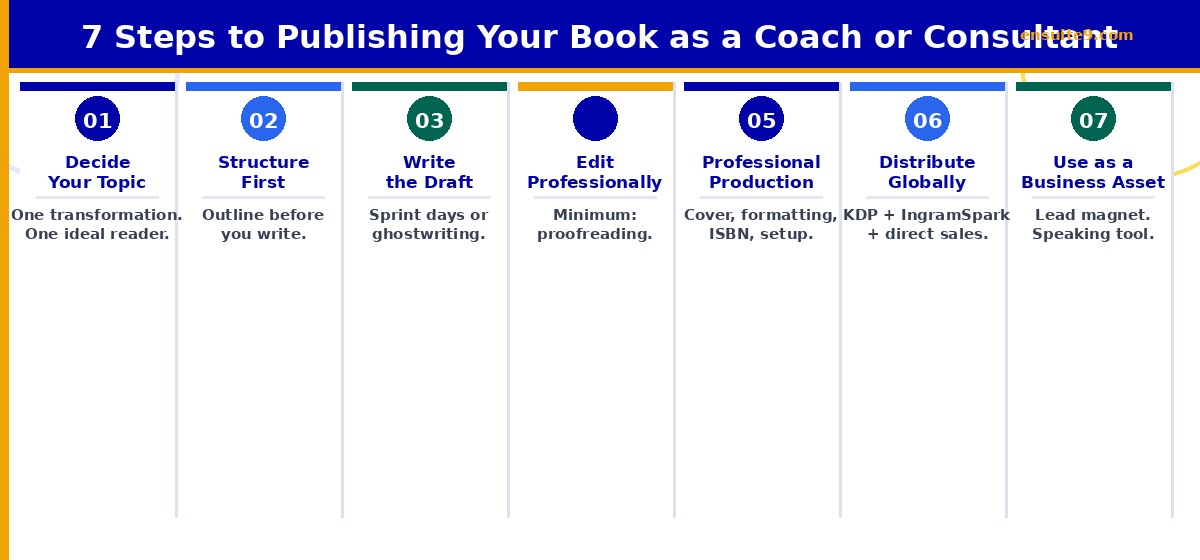
Step 3: Write the Manuscript
A typical non-fiction book for coaches and consultants runs 30,000 to 60,000 words. There is a useful framework from Trivium Writing that categorises professional books by their strategic purpose: a short book of 15,000 to 30,000 words functions as a lead-generating asset that introduces your approach without giving everything away. A mid-length book of 30,000 to 60,000 words is a strategic resource that gives away more of your framework and creates genuine buy-in. A full-length book of 60,000 words or more plants your flag as a category-defining authority.
For most first-time coaching or consulting authors, the 30,000 to 50,000 word range is the right target — substantial enough to feel authoritative, short enough to be written in a realistic timeframe alongside an active practice.
Two approaches to writing that work for busy professionals:
Writing sprints: Block out one complete day per month — no client calls, no email, no interruptions. Use this day to write one chapter in a single sitting. Twelve months, twelve chapters, book complete. This is the most sustainable approach for practitioners who cannot carve out daily writing time but can protect one day per month.
Ghostwriting: If writing is the bottleneck — not the ideas, not the expertise, but the act of sitting down and producing the words — hire a professional ghostwriter. You share your thinking through recorded conversations, voice notes, and existing materials. The ghostwriter structures, writes, and produces the manuscript in your voice. You review, refine, and approve. The result is a book that is entirely your thinking and your perspective, professionally written. For a complete guide to hiring a ghostwriter, see: How to Hire a Ghostwriter — What to Look For, What to Avoid, and What to Ask.
Step 4: Edit Before You Format
Every manuscript needs professional editing before it is formatted for publication. This is not optional, and it is not vanity; it is the step that determines whether your book holds up under the scrutiny of professional readers, media, and clients who will form an opinion of your expertise based on its quality.
Your own eyes cannot catch your own errors. This is not a reflection of your intelligence or your writing ability; it is a cognitive reality. When you read your own writing, your brain reads what you intended to write rather than what is on the page. An independent editor reads what is actually there.
At minimum, invest in professional proofreading, a final pass catching spelling, punctuation, and grammatical errors. For most first books, professional copy editing is the appropriate level, addressing sentence-level clarity, consistency of terminology, logical flow between paragraphs, and overall readability. For a complete breakdown of editing types and costs, see: How Much Does It Cost to Publish a Book in Nigeria in 2026?
Ensuite 9 provides professional editing and proofreading services for manuscript-stage books.
Step 5: Professional Production
Professional production transforms your manuscript from a Word document into a published book. It involves five components, all of which need to be done correctly for the book to compete in a global marketplace.
Cover design is the most commercially important production decision. Readers judge books by their covers — this is not a cliché, it is documented consumer behaviour. A cover that looks amateur in Amazon search results will be passed over regardless of the quality of the content inside. Invest in a professional book cover designer with demonstrable experience in your genre. For coaches and consultants publishing non-fiction, the cover needs to look like it belongs on the shelf next to traditionally published business books — because on Amazon, it will be sitting next to them.
Interior formatting converts your manuscript into a properly typeset document meeting the specifications of your chosen publishing platform. Print and eBook formatting have different requirements — a file formatted for Amazon KDP’s print specifications is not the same file that IngramSpark needs, and an EPUB file for digital distribution is a completely different deliverable from either. For a full explanation of EPUB formatting, see: What Is an EPUB File? Everything Authors Need to Know.
ISBN registration gives your book its permanent global identifier. Each format — paperback, hardcover, eBook — requires its own ISBN. In Nigeria, ISBNs are issued by the National Library of Nigeria. For authors based outside Nigeria, the registration agency depends on your country of residence. For a complete guide, see: ISBN Registration in Nigeria — Step by Step Guide, or for diaspora authors: ISBN for African Authors — Nigeria, UK, US, Canada and Australia.
Platform setup configures your book on Amazon KDP, IngramSpark, and any other distribution platforms. This includes metadata optimisation — ensuring your title, subtitle, description, categories, and keywords are set correctly to maximise discoverability in search results. For African authors, platform setup also involves the KDP tax interview and Payoneer configuration. See our full guide: The African Author’s Complete Guide to Amazon KDP in 2026.
Step 6: Distribution Strategy
Distribution determines where your book is available and who can find it. The right distribution strategy for most coaching and consulting books in 2026 involves three channels working simultaneously.
Amazon KDP for eBook and print-on-demand — this gives you global reach through the world’s largest online book retailer, with no upfront printing costs. For a full breakdown of KDP for African authors specifically, see: The African Author’s Complete Guide to Amazon KDP in 2026.
IngramSpark for bookstore and library distribution — this places your book in the ordering catalogue used by physical bookshops and libraries globally, including Waterstones in the UK, Barnes and Noble in the US, and library acquisition systems via OverDrive and Baker and Taylor. For a comparison of KDP and IngramSpark, see: IngramSpark vs Amazon KDP for African Authors.
Direct sales through your own website or platform — giving you the highest royalty rate (typically 90 to 95% of the sale price versus 35 to 70% on Amazon), direct relationship with the reader, and payment through local processors like Paystack or Flutterwave for Nigerian readers. Platforms like Selar and Bambooks are particularly useful for African authors. For a full guide to direct book sales, see: How African Authors Can Sell Books Directly Without Relying on Amazon.

Step 7: Using the Book as a Business Asset
This is the step that separates coaches and consultants who publish a book from those who publish a book that changes their business. Publishing is not the end of the process. It is the beginning of deploying an asset that should be working for your practice every day, whether or not you are actively promoting it.
Here is how the most commercially effective coaching and consulting authors use their book as a business asset:
Pre-discovery call tool: Send a copy of your book to every significant prospective client before the discovery call. The conversion rate on discovery calls increases substantially when the prospect has read your book beforehand — they arrive already understanding your methodology, already convinced by your thinking, and already self-selecting as someone who resonates with your approach.
Lead magnet: Offer the first chapter or introduction of your book as a free download in exchange for an email address. This builds your list with exactly the right people — those who are interested enough in your specific approach to read about it. For a coaching or consulting practice, a list of 500 engaged readers of your book excerpt is more commercially valuable than a list of 5,000 generic newsletter subscribers.
Speaking credential: A published book is the standard credential for speaking bureaus, conference programme committees, and podcast hosts. It signals that your ideas have been developed to the point of book-length argument, which is a different category of thought leadership from blog posts or social media content. Many speaking opportunities that require a book as a prerequisite simply do not exist for unpublished professionals regardless of their expertise.
Programme foundation: Your book’s framework is the natural basis for a workshop, a course, a group coaching programme, or a corporate training module. Authors who publish a book with a clear methodology typically find that the book creates demand for the live or structured version of that methodology; clients who have read the book want to work through it in more depth.
Media and PR asset: Journalists writing about topics in your field need credible sources. A published author is a fundamentally different category of source than an uncredentialed expert. An author media kit, built around your book, gives journalists and editors everything they need to feature you. For guidance on building one, see: What Is an Author Media Kit and How Do You Build One?
Publishing Route Options: Which Is Right for You
Coaches and consultants publishing in 2026 have three realistic options, each with different trade-offs.
Traditional publishing involves submitting to literary agents who pitch to publishers. If accepted, the publisher covers production costs and handles distribution. In exchange, they take the majority of royalties, significant control over positioning and timing, and typically require 18 to 36 months from accepted manuscript to published book. Advances for first-time coaching and consulting authors are modest. The loss of control over timing, pricing, and positioning is a significant trade-off for professionals who need their book to serve specific business goals on a specific timeline.
Professional self-publishing involves working with a publishing service that handles formatting, cover design, ISBN registration, platform setup, and distribution. You retain 100% of rights and royalties. The publication timeline is 4 to 8 weeks from completed manuscript. You control every strategic decision about the book — positioning, pricing, distribution, marketing, and timing. For most coaching and consulting authors, this is the right choice.
DIY self-publishing involves handling formatting, cover design, and platform setup independently. It is the cheapest option financially but carries the highest risk of a book that does not meet professional production standards. The time cost is also significant — learning to use professional formatting software, cover design tools, and platform-specific technical requirements takes time that most active practitioners cannot afford to spend.
The African Coach and Consultant Advantage
African professionals publishing books in 2026 occupy a market position that is genuinely advantageous and underexploited. The global publishing market is growing, African voices are receiving unprecedented international recognition, and the infrastructure to publish professionally and reach a global audience has never been more accessible.
A Nigerian coach publishing a book on leadership in 2026 has potential readers in Lagos, London, New York, Toronto, and Sydney simultaneously, through Amazon KDP, IngramSpark, and direct sales channels. The diaspora market alone — Nigerian professionals in the UK and the US who actively seek out books by Nigerian authors on professional topics — is a substantial, commercially valuable readership that is underserved by existing published content.
The coaches and consultants who publish now, with professional production and a clear authority strategy, are positioning themselves at the beginning of a market expansion. For context, the African book market is currently valued at approximately $7 billion and is projected to reach $18.5 billion in the coming years. The professionals who have established published authority before that expansion reaches full pace will have built an asset that compounds in value as the market grows. For the full context, see: The State of African Publishing in 2026.
Frequently Asked Questions
How long does it take to write a book as a coach or consultant?
With consistent effort — one writing sprint day per month — a 40,000 to 50,000 word manuscript can be completed in 8 to 12 months. With a professional ghostwriter handling the writing, the same manuscript is typically completed in 4 to 6 months. With daily writing of 500 words per day, it takes 80 to 100 days of actual writing time, spread across 6 to 12 months of real time given the realities of a busy practice.
How much does it cost to publish a book as a coach or consultant?
A professionally published eBook costs approximately $300 to $700 all-in. A full print and eBook publication with distribution on both Amazon KDP and IngramSpark costs approximately $900 to $1,500. For a complete cost breakdown including editing, cover design, formatting, ISBN, and platform setup, see: How Much Does It Cost to Publish a Book in Nigeria in 2026?
Should I ghostwrite my book or write it myself?
The right answer depends on where your bottleneck is. If writing is genuinely enjoyable and sustainable for you and the only constraint is time, a structured sprint approach to self-writing is appropriate. If you have started and abandoned a book project more than once, or if you consistently find that writing falls to the bottom of your priority list when client work is busy, ghostwriting removes the bottleneck without compromising the authenticity of the content. For a full guide, see: How to Hire a Ghostwriter.
Does self-publishing carry a stigma?
In 2026, no. The stigma attached to self-publishing was a product of the era when self-publishing meant poor production quality and no editorial standards. Professional self-publishing, with a properly designed cover, professionally edited interior, and distribution through KDP and IngramSpark, is indistinguishable from traditionally published work in a bookshop or on Amazon. The distribution is the same. The quality standards are the same. The authority signal is the same.
What should my book be about?
Your book should be about the specific transformation you produce for your most valuable clients. Not everything you know, one specific problem, one specific methodology, one specific reader. The more specific the topic, the more clearly the right reader identifies themselves in the premise, and the more powerfully the book positions you as the specific expert for that specific problem.
If you are ready to take your book from idea to published reality, book a free 30-minute discovery call with Ensuite 9. We handle everything from manuscript assessment and ghostwriting through to professional production, platform setup, and launch strategy, giving you a published book that works as hard as your practice.