Hiring a ghostwriter is one of the most significant professional decisions a coach, consultant, author, or business leader can make. A good ghostwriter gives you back your time, produces content that sounds authentically like you, and builds the written presence that most professionals know they need but never find time to create themselves. A bad ghostwriter wastes your money, damages your brand, and leaves you with content you cannot use and a process you would rather forget.
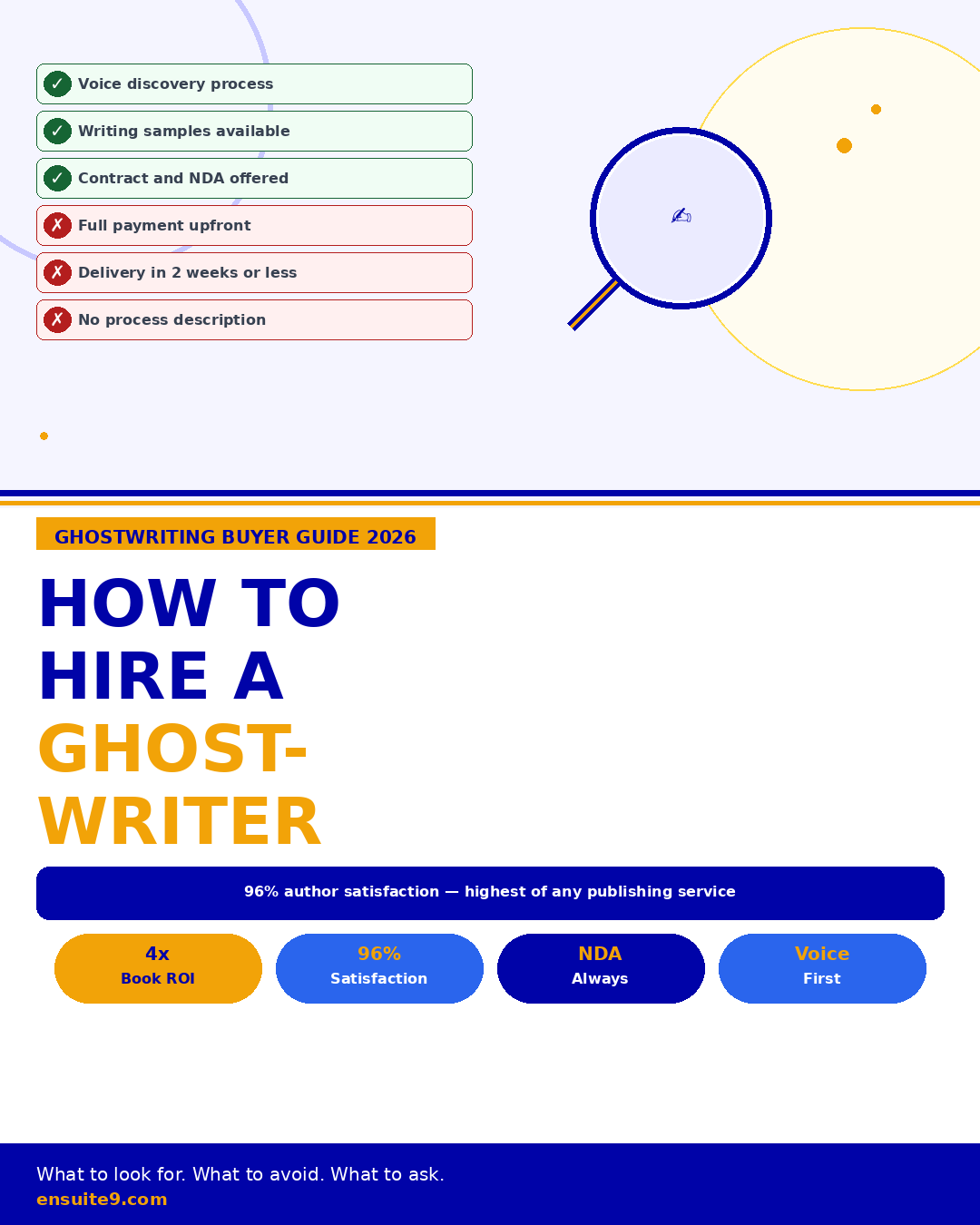
The stakes are real. According to a comprehensive Business Book ROI Study of 350 non-fiction authors, ghostwritten books generated four times the profit of non-ghostwritten books. The satisfaction rate among authors who used professional ghostwriters was 96% — the highest of any publishing service category, surpassing copy editors, PR agencies, developmental editors, and book coaches. And among authors whose books had been out for six months or more, 18% reported more than $250,000 in total revenue attributable to their book — with the majority of that income coming not from book sales but from speaking engagements, consulting work, and new business generated by the book’s authority signal.
The data makes a compelling case. But those results assume you hired the right ghostwriter. This guide tells you exactly how to do that.
What a Ghostwriter Actually Does — And What They Do Not
Before the hiring process, clarity about what ghostwriting actually involves prevents the most common disappointments.
A ghostwriter writes content — books, articles, LinkedIn posts, speeches, sales copy, email sequences — that you publish under your own name. The ghostwriter’s contribution is confidential. The content belongs to you completely. The expertise, ideas, and perspective being expressed are genuinely yours. The ghostwriter’s role is to take your substance and express it in writing that is clear, compelling, and professionally produced.
This is not a new arrangement and it is not a form of deception. Political speeches, presidential memoirs, CEO books, corporate thought leadership, and the majority of major non-fiction published by recognisable figures has been ghostwritten or significantly edited by professional writers for centuries. The arrangement is standard, legal, and widely understood in professional publishing circles. What changes is the quality of the result — and that depends almost entirely on which ghostwriter you hire and how you brief them.
What a ghostwriter does not do: they do not generate your ideas, they do not know your story unless you tell them, they do not replace the need for you to be involved in the process, and they do not guarantee commercial success regardless of how good their writing is. The best ghostwriters are collaborators, not magicians. The quality of what they produce is directly proportional to the quality of the raw material you give them to work with.
The Different Types of Ghostwriting — Know What You Need Before You Start Looking
Ghostwriting is not a single service. The skills required to ghostwrite a business book are different from those required to ghostwrite LinkedIn content, and both are different from ghostwriting sales copy or speeches. Starting your search with a clear understanding of the type of content you need prevents you from hiring the wrong person for the job.
Book ghostwriting is the most intensive and expensive type of ghostwriting engagement. A full non-fiction manuscript of 40,000 to 80,000 words requires months of close collaboration — discovery sessions, outlining, drafting, revision, and refinement. A book ghostwriter needs strong research skills, the ability to sustain a consistent voice across a long-form document, deep understanding of how non-fiction books are structured, and experience producing work that competes in a published marketplace. This is a very different skill set from producing short-form content.
LinkedIn and social media ghostwriting require a different set of skills — understanding of platform algorithms, ability to write compelling short-form content, strong voice matching, and knowledge of what types of content generate engagement versus what falls flat. A ghostwriter who produces excellent long-form books is not automatically equipped to produce effective LinkedIn posts, and vice versa. When looking for LinkedIn ghostwriting, prioritise demonstrated experience with the platform specifically.
Blog and newsletter ghostwriting sits between book and social media ghostwriting in terms of length and complexity. It requires SEO understanding (how to write for both readers and search engines), the ability to produce authoritative content on a consistent schedule, and research skills for fact-based professional content.
Sales and conversion copywriting is a specialised discipline with its own methodology. A ghostwriter who writes excellent narrative non-fiction may not understand conversion copywriting — the specific craft of writing headlines, leads, and calls to action that move people to take specific actions. If you need website copy, sales pages, or email sequences, look specifically for someone with a conversion copywriting background rather than a general ghostwriter.
Speech and presentation ghostwriting requires an understanding of how language sounds when spoken rather than read — rhythm, pacing, the use of repetition and emphasis. It is a distinct skill from page-based writing and should be treated as such when hiring.
Where to Find a Ghostwriter Worth Hiring
The quality of ghostwriters available through different channels varies significantly, and understanding where to look for each type of engagement prevents wasted time evaluating candidates who are not appropriate for your needs.
Referral from a trusted peer. This remains the most reliable way to find a good ghostwriter at any price point. If a colleague, mentor, or peer has worked with a ghostwriter and been genuinely satisfied, that recommendation carries more weight than any portfolio or testimonial. When asking for referrals, be specific about what you need — a ghostwriter who excelled at a business book may not be the right person for LinkedIn content.
Reedsy. Reedsy is a curated marketplace of vetted publishing professionals, including ghostwriters, editors, cover designers, and book marketers. Reedsy vets its freelancers more rigorously than general marketplaces, making it a more reliable source than Fiverr or Upwork for professional-quality book ghostwriting. The trade-off is higher rates — Reedsy ghostwriters typically start at $30,000 for a full manuscript.
LinkedIn search. Search “ghostwriter” plus your industry or content type. Look at their profile, read their posts, and assess whether their writing style matches what you are looking for. A ghostwriter who does not demonstrate strong writing in their own public content is unlikely to produce strong writing for you.
Professional ghostwriting agencies. Agencies like Ensuite 9 provide a team-based approach to ghostwriting rather than relying on a single freelancer. This means consistent quality oversight, reduced risk of a writer disappearing mid-project, and access to specialists across different content types within a single engagement. For ongoing content retainers or for clients who need multiple content formats, an agency approach is typically more reliable than a single freelancer.
Upwork and Fiverr. These platforms have large volumes of ghostwriters at highly variable price and quality levels. They are appropriate for very budget-constrained engagements or for testing a writer on a small project before committing to a larger one. For a book manuscript or a professional content retainer representing your brand, the risk of quality inconsistency on these platforms is significant enough to warrant caution.
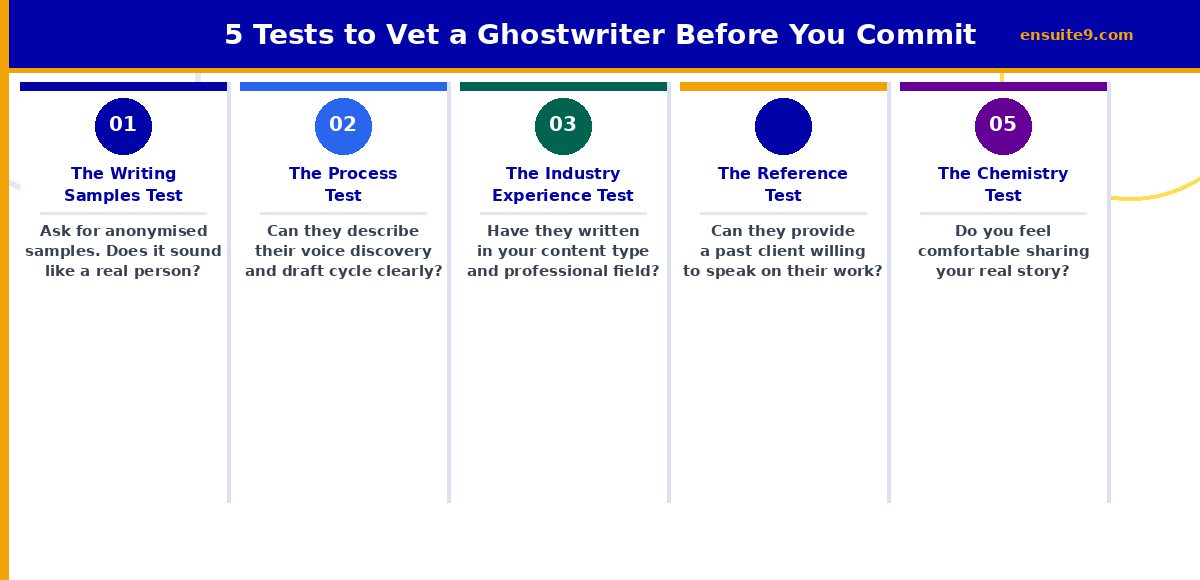
How to Vet a Ghostwriter Before You Commit — The Five Essential Tests
Vetting a ghostwriter properly before signing a contract is not optional — it is the step that determines whether the next six months of your life are productive or deeply frustrating. These five tests, applied consistently, will tell you what you need to know before any money changes hands.
Test 1: The writing samples test. Ask for writing samples. Understand that because ghostwriting is confidential by nature, a ghostwriter cannot always share samples that are publicly attributed to their work. A good ghostwriter will be able to share anonymised samples — content they have written that demonstrates their voice-matching ability, structure, and quality — even if they cannot say who the client was. Read the samples carefully and ask yourself: does this sound like a real person? Does it have a distinct, consistent voice? Does it hold my attention? Is the argument or narrative structure clear? Generic, flat writing that could have been produced by anyone is not a good sign regardless of its technical correctness.
Test 2: The process test. Ask them to walk you through their process in detail. A professional ghostwriter will have a clear, defined process that they can describe confidently. At minimum, expect to hear about: how they conduct voice discovery (what sessions or exercises they use to capture your specific voice and perspective), how they develop and present an outline for your approval before writing begins, what their draft delivery and revision cycle looks like, and what they do when a draft misses the mark. Vague answers or an inability to describe a clear process is a significant red flag — it suggests they are improvising rather than operating a professional service.
Test 3: The industry experience test. Ask specifically about their experience with your type of content and your industry or professional context. A ghostwriter who has written ten romance novels is not automatically equipped to write a business strategy book for a management consultant. A ghostwriter who writes fiction blogs is not automatically equipped to write LinkedIn thought leadership content for a corporate executive. The best ghostwriters specialise — they know the conventions, expectations, and competitive landscape of the specific type of content they produce. Ask for examples of work in your content category specifically, even if the examples are anonymised.
Test 4: The reference test. Ask if they can provide a reference from a past client — someone willing to speak to their experience of working with the ghostwriter. NDA terms sometimes prevent this, and a refusal to provide any reference at all is not automatically disqualifying if the ghostwriter can explain why NDA restrictions apply. However, a completely unverifiable track record — no references, no verifiable samples, no professional connections who can vouch for them — should give you pause before committing significant budget.
Test 5: The chemistry test. This is the least objective test but in some ways the most important. Ghostwriting is an unusually personal collaboration. For a book project, you will share private stories, professional vulnerabilities, and unresolved career questions with this person over months. For a LinkedIn retainer, they will be inside your professional thinking every week. The working relationship needs to feel comfortable enough for you to be genuinely open — because the quality of the final product depends on the quality of what you give the ghostwriter to work with, and you will only give them your best material if you trust them. If a discovery call leaves you feeling uncomfortable, guarded, or unconvinced that they understand you, trust that instinct even if their portfolio is impressive.
Red Flags — Walk Away From These
The following are not minor concerns. Each of these is a signal significant enough to justify ending the conversation regardless of how attractive the pricing or portfolio appears.
No contract or NDA offered. Any professional ghostwriter working at a legitimate level will offer a written service agreement and a non-disclosure agreement before work begins. The NDA protects you — it legally commits them to confidentiality about their involvement in your content. A ghostwriter who says a contract is not necessary, who says “we can just work on trust,” or who deflects when you ask about formal agreements is not operating professionally. This is the single most important red flag on this list.
Full payment requested upfront. Legitimate ghostwriting engagements are structured with a deposit (typically 30% to 50%) on signing, a mid-project payment on delivery of a first draft, and a final payment on completion. A ghostwriter asking for full payment before delivering any work has no financial incentive to produce good work — or any work at all. The staged payment structure aligns incentives and protects you throughout the engagement.
Promises of unrealistically fast delivery. A professional non-fiction manuscript of 50,000 words requires months of work when done properly — discovery sessions, research, outlining, drafting, and multiple revision rounds. A ghostwriter who promises to deliver a complete book in two to four weeks is either planning to produce something rushed and shallow, or planning to use AI-generated content with minimal editing and call it ghostwriting. Neither is what you are paying for. Quality writing takes time. Anybody who tells you otherwise is not being honest about what they are selling.
Rates dramatically below market. The market rate for professional book ghostwriting starts at $5,000 for entry-level work and runs to $50,000 or more for experienced professionals. LinkedIn ghostwriting retainers start at $250 to $300 per month for entry-level and run to $1,500 or more per month for experienced practitioners. Rates significantly below these ranges typically indicate one of three things: the writer is very inexperienced, the work will be largely AI-generated with minimal human editing, or the quality delivered will not match what was described. In ghostwriting more than most services, the correlation between price and quality is real.
No brand voice or discovery process. A ghostwriter who is ready to start writing without first conducting a discovery process to understand your voice, your perspective, and your audience is planning to write generic content that sounds like a ghostwriter — not like you. The discovery process is not a formality. It is the foundation of everything they produce. If it is absent from their process description, the content will reflect that absence.
AI-generated samples. In 2026, a significant number of low-cost ghostwriting services on platforms like Fiverr and Upwork are using AI tools to generate most of the content they sell, with minimal human editing. You can often identify this by the characteristic flatness and genericism of AI writing — smooth sentences that say very little, ideas presented at surface level, no specific details or human moments, and a voice that belongs to no one in particular. If the samples feel like they could describe anyone’s business or anyone’s story, they probably were not written by a human who knows your story.
The Contract and NDA — What Must Be in Writing Before Work Begins
Before sharing any manuscript ideas, business strategy, personal story, or unpublished content with a ghostwriter, two documents must be signed: a service agreement and a non-disclosure agreement. These are not bureaucratic formalities — they are the legal foundation of a professional engagement that protects your intellectual property, your reputation, and your investment.
The service agreement should cover: the exact scope of work (what is being produced, to what specifications, in what timeframe), the payment schedule (deposit amount and due date, milestone payments, final payment trigger), what revision rounds are included and how they are defined, the process if either party terminates early, and who owns the deliverables at each stage of the project.
The NDA should cover: the ghostwriter’s commitment to never disclose their involvement in your content, their commitment to never claim authorship or credit for the work, their commitment to never reproduce or use any of your content for any other purpose, and the duration of the confidentiality obligation (for ghostwriting, this should be indefinite — not limited to a fixed term).
IP transfer must be explicitly stated: all content produced by the ghostwriter under this agreement belongs to you in full upon receipt of final payment. The ghostwriter retains no rights whatsoever. This clause should be unambiguous — phrases like “non-exclusive licence” or “work for hire subject to conditions” are not full ownership. Full ownership means the ghostwriter has no claim on the content in any form, ever.
At Ensuite 9, every ghostwriting engagement — whether a book manuscript, a LinkedIn retainer, or a single article — begins with both a signed service agreement and a comprehensive NDA before a single word of content is produced. Our contracts are available for review before signing and our clients retain full ownership of everything we produce for them the moment final payment is received.
How to Brief a Ghostwriter for Maximum Quality Output
The quality of what a ghostwriter produces is directly proportional to the quality of the brief you provide. This is not a cliché — it is a practical reality. A ghostwriter working from a vague brief will produce generic content. A ghostwriter working from a detailed, specific, well-considered brief will produce content that genuinely sounds like you and serves your specific professional goals.

For a book project, the most useful brief material includes: a clear articulation of who the book is for (your ideal reader, described in specific detail — not "business owners" but "coaches with five to fifteen years of experience who have built a successful client base through referrals and want to move beyond trading time for money"), what you want that reader to think, feel, or do differently after reading the book, the central argument or framework of the book stated as clearly as you can manage, the key stories from your own experience that illustrate your core points, any topics or positions you would never include in the book, and examples of books you have read that felt well-written and books you have read that felt badly written — and an honest articulation of why.
For a LinkedIn or content retainer, the most useful brief material includes: your ideal client profile described specifically, the core beliefs you hold about your industry that differentiate your perspective from other practitioners in your field, the specific outcomes your clients achieve when they work with you, content you have admired from others in your field and why it resonated, content you found off-putting or inauthentic and why, phrases or expressions you use naturally in conversation, and topics you would never address publicly.
A professional ghostwriter will conduct a structured brand voice discovery session at the start of every engagement — a recorded conversation designed to extract exactly this information in a way that does not require you to prepare a written brief. If your ghostwriter does not offer this, ask for it. The discovery session is the most important investment in the quality of the final product.
What to Expect from the Ghostwriting Process — A Timeline
Understanding what a professional ghostwriting engagement actually looks like from start to finish helps you evaluate whether a potential ghostwriter's proposed process is credible, and helps you plan your own involvement accordingly.
For a book project (typical timeline: 4 to 8 months):
Weeks 1–2: Contract and NDA signed. Discovery sessions conducted — typically two to three recorded conversations of 60 to 90 minutes each. The ghostwriter reviews any existing material you have — previous writing, talks, social media posts, interview transcripts. Brand voice document produced and approved.
Weeks 3–5: Manuscript outline developed and presented for your review and approval. This is a detailed chapter-by-chapter breakdown of the book's structure, argument, and key points. You should feel that the outline accurately represents your thinking and your intended book before the ghostwriter begins writing a single paragraph of body content.
Weeks 6 onwards: Chapter-by-chapter drafting begins. Most ghostwriters deliver chapters in batches rather than all at once — this allows you to provide feedback while the writing is in progress rather than at the end when changes are more costly. Expect at minimum two revision rounds per chapter. The total writing phase typically takes two to five months depending on manuscript length and the pace of feedback exchange.
Final phase: Full manuscript review and polish. Consistency check across chapters. Final revision round. Delivery of the complete, approved manuscript ready for editorial review or formatting.
For a LinkedIn retainer (typical monthly rhythm):
Month 1: Discovery session and brand voice document. First batch of posts delivered. Feedback round. Voice refinement. First posts published.
Month 2 onwards: Monthly briefing session (30 to 45 minutes). Content calendar planned for the coming month. Posts drafted and delivered for approval 3 to 5 days before scheduled publication. One revision round. Monthly performance review looking at which posts performed best and why.
Ghostwriting for African Authors and Coaches — What Is Specific to Your Context
African coaches, consultants, and authors hiring ghostwriters face a few considerations that are specific to their context and worth addressing directly.
Voice and cultural authenticity. One of the most important considerations for African professionals hiring a ghostwriter is whether the ghostwriter is equipped to write in a voice that is genuinely yours — including the cultural references, turns of phrase, and professional context that reflect your specific background. A ghostwriter who has only ever written for US or UK clients may produce content that sounds generically professional but lacks the specificity and authenticity that makes your perspective distinctive. Ask specifically about their experience writing for African or diaspora clients, and pay close attention to whether their voice matching process is thorough enough to capture the nuances of your specific voice.
Market positioning. African professionals publishing or building content presence in 2026 occupy an interesting position — there is genuine global demand for African expertise and perspective in fields like business, leadership, and entrepreneurship, and relatively few African professionals have built the kind of professional content presence that positions them for international visibility. A ghostwriter who understands this dynamic — who can help you position your content for both Nigerian and international audiences simultaneously — is significantly more valuable than one who can only write for a single market.
Payment and contracts across borders. If you are hiring a ghostwriter internationally, ensure the contract specifies the currency of payment, the payment method, and what happens in the event of currency fluctuation for long-term engagements. Payoneer, Stripe, and Wise are all commonly used for cross-border ghostwriting payments. Ensure the contract is governed by a law and jurisdiction that is enforceable for both parties — not simply whatever the ghostwriter's home country happens to be.
Frequently Asked Questions
Is ghostwriting legal?
Yes. Ghostwriting is a legal, widely practised professional service with a history stretching back centuries. There is no legal requirement for an author to disclose whether their book was written with professional assistance. The only contexts where disclosure is explicitly required are academic work (where institutional policies prohibit ghostwriting) and certain regulated professional communications.
How much does ghostwriting cost?
Costs vary significantly by content type and writer experience. LinkedIn ghostwriting retainers start at approximately $250 per month for entry-level writers and run to $1,500 or more for experienced practitioners. Book ghostwriting typically starts at $5,000 for entry-level work and runs to $50,000 or more for experienced professionals. For a full breakdown of 2026 ghostwriting rates across all content types, see our guide: How Much Does Ghostwriting Cost in 2026?
How long does book ghostwriting take?
A complete professional non-fiction manuscript of 40,000 to 60,000 words typically takes four to eight months from signed contract to approved final draft. This includes discovery sessions, outlining, chapter-by-chapter drafting, and revision rounds. Engagements that promise significantly faster timelines without a clear explanation of how that is possible are worth scrutinising carefully.
Will my ghostwritten content sound like me?
If you work with a professional ghostwriter who conducts a proper brand voice discovery process, yes. The first month of any ghostwriting engagement is typically a calibration period where the ghostwriter refines their understanding of your voice through feedback. By the second or third month, a professional ghostwriter should be producing content that consistently sounds like you — not like a generic professional writer.
Can I use a ghostwriter for LinkedIn content?
Yes. LinkedIn ghostwriting is one of the most common and commercially valuable forms of ghostwriting in 2026. Most of the LinkedIn profiles you find impressive from coaches, consultants, and founders are ghostwritten or significantly supported by professional writers. The key is finding a writer with specific LinkedIn experience and a thorough voice matching process. For a full guide to LinkedIn ghostwriting specifically, see: LinkedIn Ghostwriting for Coaches and Consultants.
If you are ready to discuss a ghostwriting engagement with Ensuite 9 — whether a book manuscript, a LinkedIn retainer, or a content strategy — book a free 30-minute discovery call. We will tell you exactly what is involved, what it will cost, and whether we are the right fit for your project.