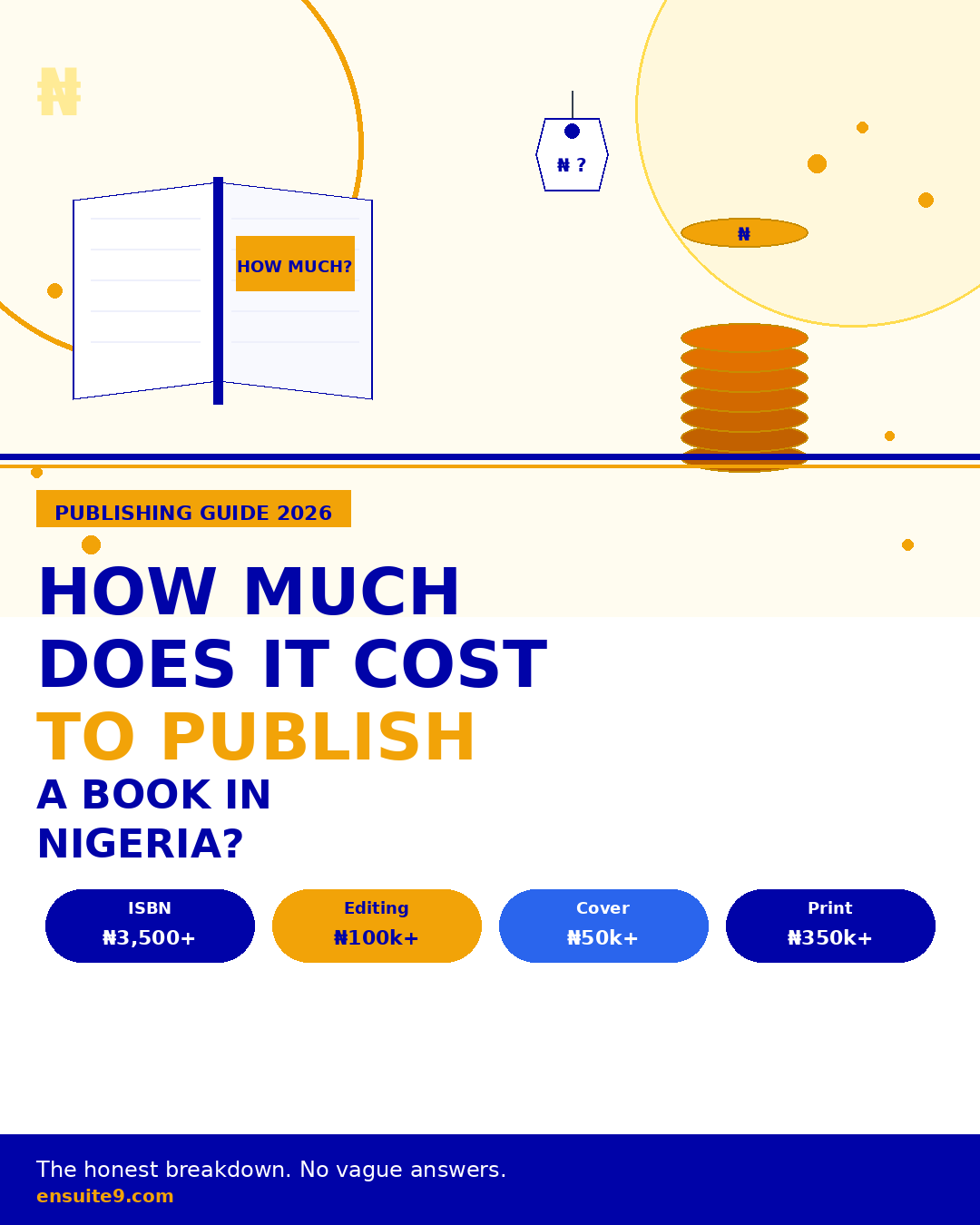
The most common question Nigerian authors ask before starting the publishing process is not “how do I publish?” It is “how much will this cost me?” And it is a question most publishers and services in Nigeria answer vaguely, with phrases like “it depends” or “contact us for a quote”, because transparency about pricing is rare in the Nigerian publishing industry.
This post ends that vagueness. What follows is the most transparent, specific, and up-to-date breakdown of publishing costs in Nigeria available in 2026, covering every stage of the process from manuscript to live book, with real naira and dollar figures for each component. We also include a comparison of what the same book costs to publish internationally, because many Nigerian authors, especially those in the diaspora or targeting global audiences, need to understand both sides of that equation before making decisions.
These figures are drawn from current market rates, data from publishers operating in Nigeria in 2026, and Ensuite 9’s own pricing from working with authors across Nigeria, the UK, the US, Canada, and the UAE. Where ranges are given, the lower figure represents a competent but lean production and the higher figure represents a fully professional, market-competitive result.
The Three Phases of Book Publishing, And Why Each One Matters
Before the numbers, a framing point that most cost guides miss entirely: publishing a book has three distinct phases, and the costs and quality decisions at each phase affect the ones that follow. Understanding this prevents the most expensive mistake Nigerian authors make, spending money on printing before the manuscript is ready, or printing a book with a poor cover because the cover budget was cut to increase print volume.
The three phases are pre-press, press, and post-press.
Pre-press covers everything that happens before the book is formatted and printed – editing, proofreading, cover design, interior formatting, ISBN registration, and platform setup. This is where the quality of the book as a product is determined. A book that goes to print with editing errors, a generic cover, or incorrect formatting will not sell well regardless of how much is spent on marketing after the fact. Pre-press is where the majority of a professional publishing budget should be concentrated.
Press covers production — printing physical copies or creating digital files for distribution. The decisions here are largely financial: how many copies, what paper quality, which printer, digital-only or print-and-digital. These decisions are shaped by the author’s distribution strategy and budget.
Post-press covers everything after the book is produced — distribution, marketing, launch activities, and ongoing sales strategy. Many Nigerian authors underestimate or ignore this phase entirely, which is why many professionally produced books fail commercially. A book without a post-press strategy is a privately printed document, not a published title.
Cost 1: Editing
Professional editing is the most important investment in a book’s quality and the one most commonly skipped or underfunded. There are three levels of editing, each serving a different function, and understanding the distinction prevents authors from paying for the wrong level of service.
Developmental editing addresses the structure, argument, and organisation of the manuscript. It asks, ‘Does this book achieve what it sets out to do?’ ‘Are the chapters in the right order?’ ‘Is the argument coherent?’ ‘Is the reader taken on a clear journey from opening to conclusion?’ Developmental editing is most valuable for first-time authors or authors who wrote without a detailed outline. It is the most expensive level of editing and the least commonly needed for authors who have planned their manuscript carefully.
Current Nigerian market rates for developmental editing in 2026: ₦5 to ₦10 per word. For a 50,000-word manuscript, that is ₦250,000 to ₦500,000.
Line editing or copy editing addresses sentence-level clarity, word choice, flow, consistency, and style. It assumes the structure is sound and focuses on making the writing as clear and compelling as possible at the paragraph and sentence level. This is the level of editing most professional non-fiction books need, and it is the level Ensuite 9 recommends as the baseline for any book targeting a professional audience.
Current Nigerian market rates for copy editing in 2026: ₦2 to ₦5 per word. For a 50,000-word manuscript, that is ₦100,000 to ₦250,000. For a 30,000-word book (a common length for professional non-fiction), that is ₦60,000 to ₦150,000.
Proofreading is the final pass before production — catching remaining spelling, punctuation, and grammatical errors in a manuscript that has already been edited. It is not a substitute for editing. A manuscript that has been proofread but not properly edited will still have structural and clarity problems. Proofreading is the minimum; editing is the baseline.
Current Nigerian market rates for proofreading in 2026: ₦1.50 to ₦3 per word. For a 50,000-word manuscript: ₦75,000 to ₦150,000.
International comparison: For authors targeting international markets or working with internationally based ghostwriters and editors, rates are quoted in USD. Professional copy editing internationally runs $0.02 to $0.05 per word — approximately ₦30 to ₦75 per word at current exchange rates. Nigerian rates for equivalent quality are significantly lower, which is one of the genuine cost advantages of working with Nigeria-based editorial professionals.
Cost 2: Cover Design
Your book cover is the single most commercially important production decision you will make. More than the title, more than the back cover blurb, and far more than anything inside the book — the cover is what determines whether a potential reader stops scrolling or keeps moving. This is not an opinion. It is the consistent finding of every major publishing industry study on reader behaviour.
The Nigerian market for book cover design has a significant quality range, and the difference between a ₦5,000 cover and a ₦150,000 cover is visible at a glance. The question is not whether to spend money on cover design — it is how much is appropriate for the market your book is competing in.
Basic cover design in Nigeria (2026):
- Entry level freelancer: ₦5,000 – ₦15,000 (template-based, limited customisation, identifiable as amateur in global markets)
- Mid-range designer: ₦20,000 – ₦80,000 (custom work, suitable for local market)
- Professional book cover designer: ₦80,000 – ₦200,000 (custom, market-competitive, appropriate for authors targeting Amazon and international distribution)
For print books specifically, the cover must include front, spine, and back in a single print-ready file built to the exact specifications of your chosen printer. A cover designed only as a front image is not a print-ready cover. Ensure your designer understands print specifications or work with a service that handles this as part of the package.
International comparison: Professional book cover design internationally runs $300 to $800 for a mid-range designer and $800 to $2,000+ for a senior book cover specialist. At current exchange rates, a ₦150,000 cover is approximately $100 — significantly below international rates for equivalent quality, which again reflects a cost advantage for authors working with Nigeria-based design professionals.
Cost 3: Interior Formatting
Interior formatting is the process of converting your manuscript from a Word document into a file that meets the technical specifications of publishing platforms and printers. This is not simply changing the font and adding page numbers — professional interior formatting involves typesetting, widow and orphan control, consistent heading hierarchy, correct front matter structure, proper chapter breaks, and file output in the correct format for each production method.
There are two distinct types of interior formatting with different requirements and costs:
eBook formatting (EPUB and MOBI) converts your manuscript into a reflowable digital file that adapts to any screen size. A professionally formatted EPUB includes a functioning clickable table of contents, correct front matter, properly embedded images, clean underlying HTML code, and metadata embedded in the file itself. An improperly formatted EPUB will be rejected by distribution platforms or display incorrectly on reading devices.
- Nigerian market rate (2026): ₦13,000 – ₦60,000 depending on complexity
- International rate: $100 – $300 for standard non-fiction
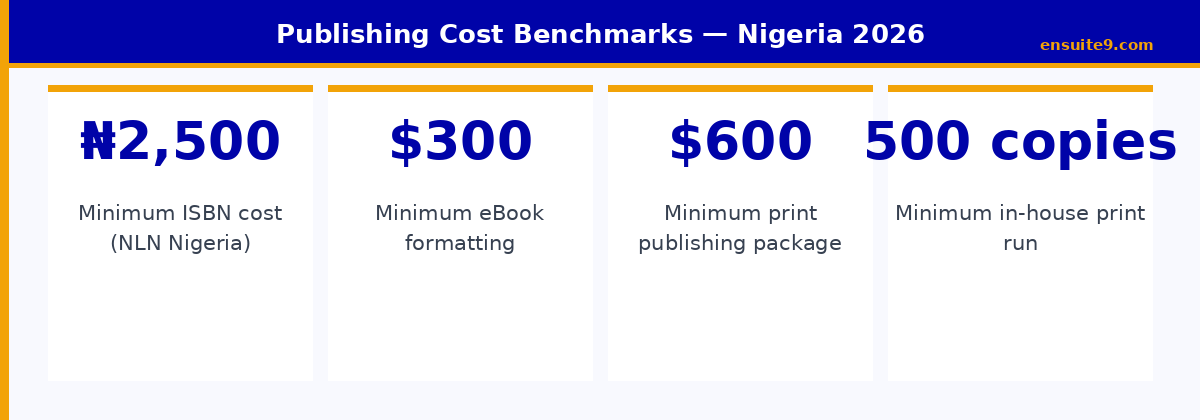
- Ensuite 9 rate: from $300, included in eBook publishing packages
Print interior formatting produces a print-ready PDF to the exact specifications of your chosen printer: Amazon KDP, IngramSpark, or a commercial Nigerian printer. KDP and IngramSpark have different specifications, and a file formatted for one typically needs adjustment before submission to the other. This is a common source of errors for authors managing production themselves.
- Nigerian market rate (2026): ₦20,000 – ₦80,000
- International rate: $150 – $400 for standard non-fiction
- Ensuite 9 rate: included in all print publishing packages
Cost 4: ISBN Registration
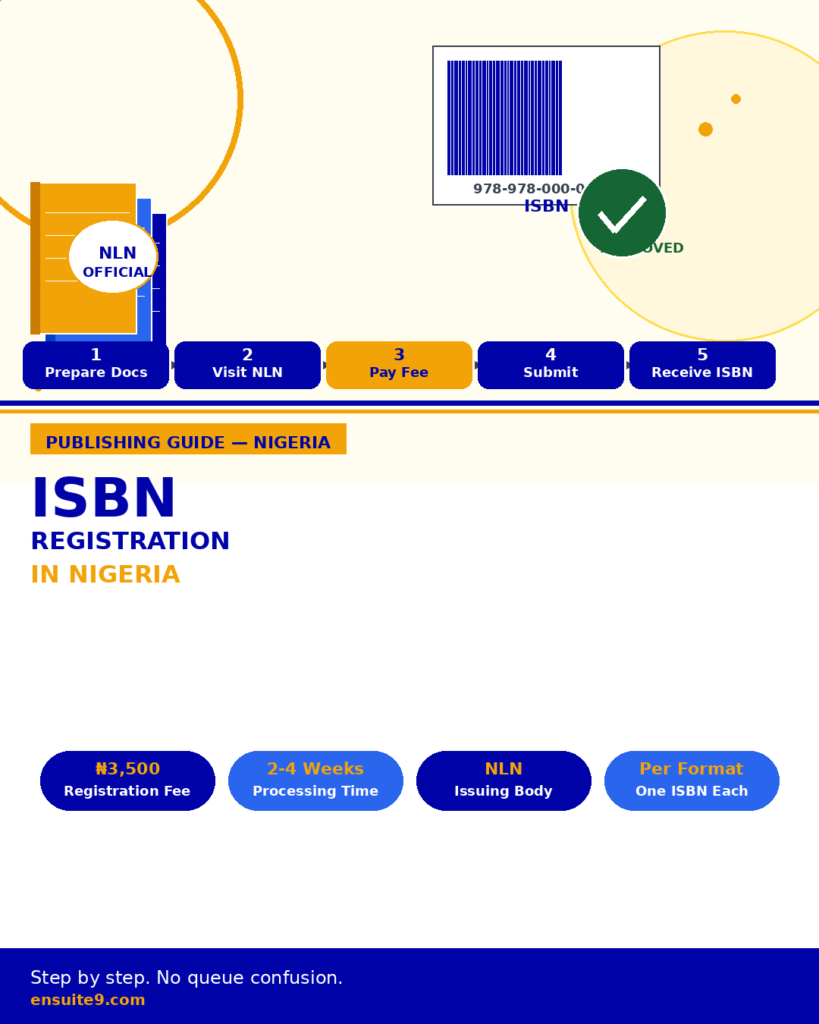
An ISBN — International Standard Book Number — is the unique identifier that connects your book to every retail, library, and distribution system in the world. Without one, your book cannot be listed on Amazon, stocked by a bookshop, or ordered by a library through standard acquisition systems. Every format of your book requires its own ISBN: paperback, hardcover, and eBook are three separate products that each need their own number.
In Nigeria, ISBNs are issued exclusively by the National Library of Nigeria (NLN). The process requires physical document submission at one of the NLN’s offices in Abuja (headquarters), Lagos, Ibadan, Enugu, Kaduna, Kano, Jos, or Port Harcourt.
Current NLN ISBN fees (2026):
- Single ISBN: ₦3,500 – ₦5,000
- Bulk ISBNs (10): ₦15,000 – ₦25,000
- Processing time: 2–4 weeks from date of submission
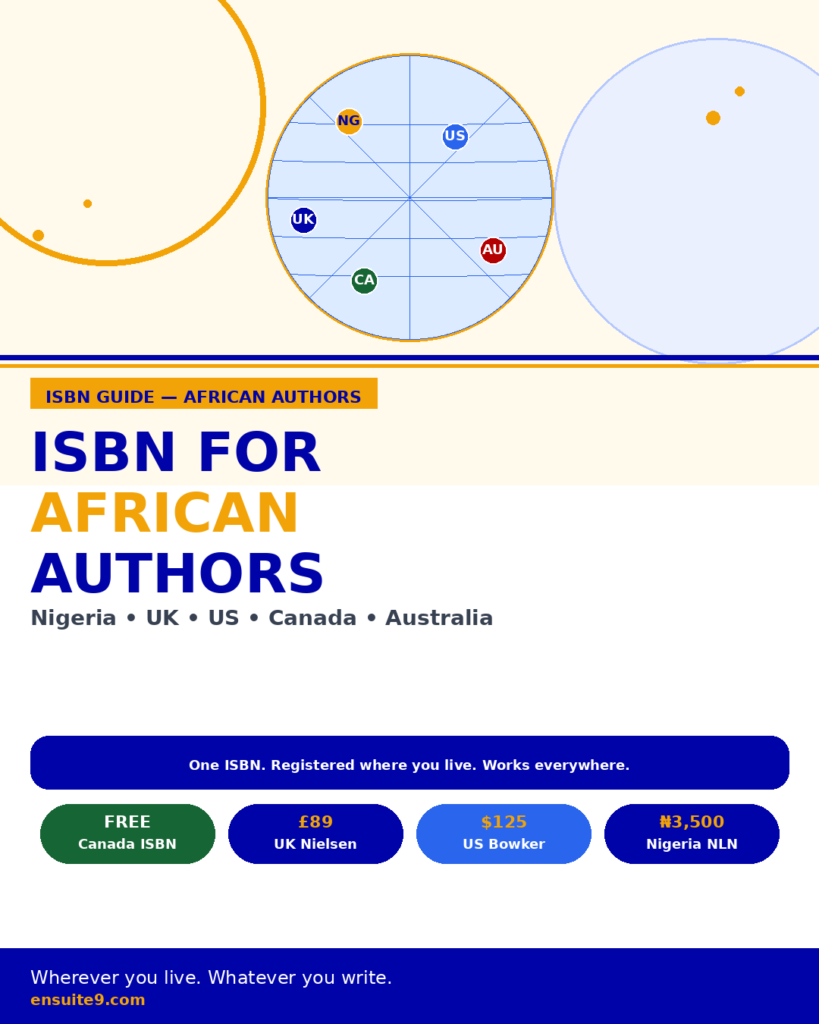
International comparison: ISBN costs vary significantly by country. In the US, a single ISBN through Bowker MyIdentifiers costs $125. In the UK, a single ISBN through Nielsen costs approximately £89. In Canada, ISBNs are free through Library and Archives Canada. Nigeria’s ISBN cost is among the most affordable in the world for a country with an official ISBN agency, a genuine cost advantage for Nigeria-based authors.
For authors based outside Nigeria who want a Nigerian ISBN specifically for submission to Nigerian libraries or the NLN’s national bibliographic database, it is possible to authorise a representative in Nigeria to submit on your behalf. However, most diaspora authors register through their country of residence and use that ISBN globally, which is both simpler and equally effective for international distribution. For a full breakdown of which ISBN to get based on where you live, see our guide: ISBN for African Authors — Nigeria, UK, US, Canada and Australia.
Cost 5: Printing Physical Copies
Physical printing costs in Nigeria are among the most complex to estimate because they depend on multiple variables: page count, paper type, binding style, print run volume, and the specific printer used. The cost per copy decreases significantly as volume increases — a fundamental economic reality that shapes every print publishing decision.
Commercial printing in Nigeria (2026) — indicative rates:
- 100-page book, white bond paper, 1,000 copies: approximately ₦350,000 – ₦400,000 for the full run (₦350 – ₦400 per copy)
- 200-page book, cream bond paper, 1,000 copies: approximately ₦500,000 – ₦700,000 (₦500 – ₦700 per copy)
- Minimum viable commercial print run: typically 200–500 copies depending on the printer
Ensuite 9’s in-house print coordination service works with a regional partner printer network covering Nigeria, the UK, the US, and the UAE. Our minimum print run is 500 copies. Per-copy costs through our network start at approximately $4 – $8 for a standard paperback at 500 copies and reduce significantly at 1,000 and 2,000+ copies. Copies are produced at a print facility near the author’s delivery region, meaning Nigerian authors receive Nigerian-printed copies while diaspora authors in the UK or US receive copies printed locally without international shipping costs.
Print-on-demand alternative: If you do not need physical copies in advance, for example, if your primary sales channel is online, Amazon KDP and IngramSpark both offer print-on-demand services where a copy is printed and shipped only when a customer orders one. There are no upfront printing costs. The trade-off is a higher per-copy production cost built into the pricing model, which reduces your royalty per copy compared to bulk printing.
Cost 6: Platform Setup and Distribution
Getting your book onto distribution platforms is not simply a matter of uploading a file. Professional platform setup includes metadata optimisation — ensuring your title, subtitle, description, categories, and keywords are set correctly to maximise discoverability, as well as account configuration, pricing strategy across markets, and correct file submission to each platform’s specifications.
Amazon KDP: Free to upload. No platform fee — Amazon takes a percentage of each sale. Professional setup service (Ensuite 9): included in all publishing packages. For authors setting up independently, the main decisions are pricing, category selection, keyword strategy, and the tax interview, which Nigerian authors must complete correctly to avoid unnecessary 30% US withholding tax on royalties. Our full guide to Amazon KDP for African authors covers this in detail: The African Author’s Complete Guide to Amazon KDP in 2026.
IngramSpark: Approximately $49 title setup fee payable directly to IngramSpark per title. This fee is separate from any service fees. Professional setup (Ensuite 9): $350 standalone, included in combined print packages. IngramSpark distributes your book to over 40,000 retailers, libraries, and platforms globally, including bookshops in the UK, Australia, and the US that Amazon KDP’s expanded distribution does not reliably reach. For a full comparison of the two platforms, see: IngramSpark vs Amazon KDP for African Authors.
Wide eBook distribution (Apple Books, Kobo, Google Play Books, Barnes and Noble, OverDrive library network): Free through aggregators like Draft2Digital or PublishDrive, which take a percentage of sales instead of charging upfront. Professional setup: included in Ensuite 9 eBook Authority packages.
Cost 7: Book Marketing and Launch
This is the phase most Nigerian authors underinvest in — and the one that determines whether a professionally produced book actually sells. A book without a marketing strategy is invisible within 72 hours of publication. Amazon’s algorithm does not surface new books without early sales signals. Nigerian readers do not discover books through Amazon search — they discover them through social media, recommendation, and direct author communication.
Marketing costs depend entirely on how much you want handled for you versus how much you manage yourself. At minimum, every published book needs an Amazon listing optimised for search, a consistent author social media presence, and a launch campaign that generates initial sales momentum.
- Amazon listing optimisation only: $150 – $400
- Launch Foundation package (listing, media kit, launch graphics, strategy document): from $450 (Ensuite 9)
- Managed launch campaign (social media content, press outreach, ARC reader coordination, email campaign): from $1,200 (Ensuite 9)
- Full Visibility System (launch + 2 months post-launch management + email sequences + Amazon A+ content): from $2,500 (Ensuite 9)

Nigeria vs International Publishing Costs: The Full Comparison
This is the comparison no other Nigerian publishing guide has produced. For diaspora authors and authors targeting international markets alongside Nigeria, understanding the cost difference between publishing in Nigeria versus publishing through international services is essential context.
The table below compares costs for a 50,000-word non-fiction book published professionally at each market level:
Nigeria-based production (all costs in NGN approximate):
- Copy editing: ₦100,000 – ₦250,000
- Cover design: ₦50,000 – ₦200,000
- Interior formatting (print + eBook): ₦30,000 – ₦140,000
- ISBN (x2 formats): ₦7,000 – ₦10,000
- Print run (500 copies, standard paperback): ₦500,000 – ₦800,000
- Platform setup (KDP + IngramSpark): ₦100,000 – ₦200,000
- Basic marketing: ₦50,000 – ₦150,000
- Total (print + eBook, 500 copies): approximately ₦837,000 – ₦1,750,000
International service production (costs in USD):
- Copy editing: $1,000 – $2,500
- Cover design: $400 – $1,000
- Interior formatting (print + eBook): $300 – $700
- ISBN (x2 formats, US Bowker): $250
- Platform setup (KDP + IngramSpark including $49 IngramSpark fee): $400 – $800
- Basic marketing: $450 – $1,200
- Total (digital-only, no physical print run): approximately $2,800 – $6,450
Ensuite 9 packages (USD, covering authors in Nigeria and internationally):
- eBook Essentials (formatting, cover, ISBN, KDP setup): from $300
- Print Publishing (formatting both files, cover, ISBN x2, KDP + IngramSpark): from $600
- In-house print coordination (design + 500 copies delivered to your region): from $2,500 total including print costs
- Launch Foundation (publishing + basic marketing): from $900
The conclusion from this comparison: Nigeria-based production is significantly more affordable per component, but the quality range is also wider, meaning the gap between the cheapest and most professional Nigerian provider is larger than the equivalent gap in international markets. The risk of underspending on production quality is higher in Nigeria because the market has more entry-level providers than professional ones.
The Most Common Mistakes Nigerian Authors Make With Publishing Budgets
Having worked with authors across Nigeria and the diaspora, Ensuite 9 sees the same budget mistakes repeatedly. Understanding them before you start can save you significant money and time.
Spending the majority of the budget on printing before the manuscript is ready. Printing 1,000 copies of a book that has not been professionally edited or properly designed is one of the most expensive mistakes an author can make. Those copies cannot be unprinted. The money is spent regardless of whether the book sells. Fix: complete all pre-press work to a professional standard before committing to a print run.
Using a free platform ISBN and calling it self-publishing. A free ISBN from Amazon KDP or another platform lists the platform as your publisher, not you. It also restricts where your book can be distributed. Fix: register your own ISBN through the National Library of Nigeria before publication.
Budgeting nothing for marketing. A common assumption among Nigerian authors is that publication is the end of the process and sales will follow automatically. They will not. Fix: budget a minimum of 20% of your total publishing spend for launch marketing, and treat that as a non-negotiable line item before the project begins.
Treating eBook and print as mutually exclusive. Many Nigerian authors publish only in print because “Nigerians prefer physical books,” or only as an eBook because “printing is too expensive.” The professional approach is to do both; digital distribution for global reach and residual income, physical copies for events, direct sales, and institutional sales. The cost of adding eBook distribution to a print project is modest relative to the additional reach it provides.
How to Budget for Your Book — A Practical Framework
Use this framework to build your publishing budget before approaching any service provider:
Step 1: Decide your publishing goals. Are you publishing to sell copies commercially, to use the book as a business authority asset, to reach a specific professional audience, or all three? Your goal determines which production elements are essential and which are optional. A book used primarily as a credibility tool for coaching clients needs a strong cover and clean interior — it does not necessarily need a 1,000-copy print run.
Step 2: Decide your distribution strategy. Digital only (Amazon KDP + wide distribution), print-on-demand (KDP print), in-house print run, or a combination? This decision shapes the majority of your production costs.
Step 3: Allocate proportionally across phases. A rough allocation that produces professional results: 40% on pre-press (editing, cover, formatting), 35% on press (printing or platform fees), 25% on post-press (marketing and distribution). Adjustments are made based on your specific goals.
Step 4: Get at least two specific quotes before committing. Not “what do you charge for publishing” but “I have a 45,000-word non-fiction manuscript. I want a professionally edited, professionally designed paperback and eBook distributed on Amazon KDP and IngramSpark with a 500-copy physical print run delivered to Lagos. What is the total cost and timeline?” Specific questions produce specific quotes.
Frequently Asked Questions
How much does it cost to publish a book in Nigeria in 2026?
A professionally published eBook costs approximately ₦200,000 – ₦500,000 all-in. A full print and eBook publication with 500 physical copies costs approximately ₦837,000 – ₦1,750,000 depending on specifications and service providers. These figures cover editing, cover design, formatting, ISBN, platform setup, printing, and basic marketing.
Can I publish a book in Nigeria for free?
You can upload a manuscript to Selar, Bambooks or Amazon KDP at no cost. However, free publishing means no professional editing, no professional cover design, and a platform-assigned ISBN that lists the platform as your publisher rather than you. For a book representing your professional expertise, this is rarely the right approach.
How long does it take to publish a book in Nigeria?
A complete professional publication — from manuscript submission to live book on Amazon and physical copies in hand — typically takes 6 to 12 weeks depending on the scope of work, the speed of feedback, and whether a physical print run is involved. ISBN processing at the NLN takes 2–4 weeks and is usually the longest single step in the timeline.
Is it cheaper to publish in Nigeria or internationally?
Nigeria-based production is cheaper per component — particularly for editing, cover design, and physical printing. ISBN registration is also significantly cheaper in Nigeria (₦3,500 – ₦5,000) compared to the US ($125) or UK (£89). However, some production elements, particularly platform setup for international distribution, cost similarly regardless of where you are based.
Do I need to print physical copies of my book?
No. eBook-only publishing is a completely viable professional option, particularly for authors targeting global audiences or using the book primarily as a business authority asset rather than as a commercial product sold in physical bookshops. Print-on-demand through Amazon KDP is also an option that eliminates upfront printing costs — copies are printed when ordered by customers.
Ready to get a transparent, specific quote for your book project? Book a free 30-minute discovery call with Ensuite 9. We will assess your manuscript, your goals, and your budget, and give you a complete, itemised quote with no vague language and no hidden costs.