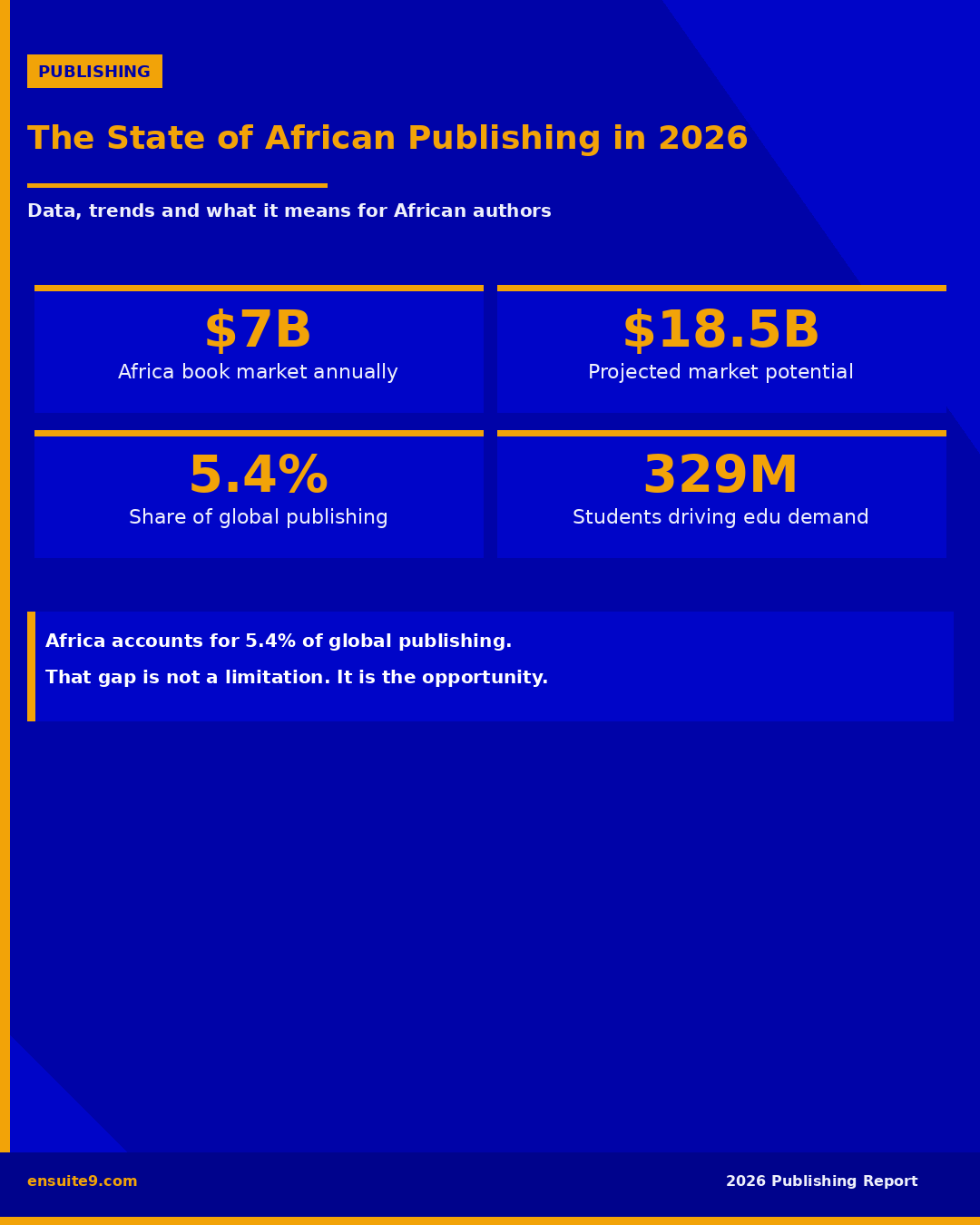
Africa’s publishing industry is at an inflection point unlike any in its history. According to the first comprehensive mapping of Africa’s book sector ever conducted, a 2025 UNESCO report covering all 54 African countries, the continent’s publishing industry currently generates approximately $7 billion annually, accounting for 5.4% of the global publishing market. That same report projects the industry could reach $18.5 billion in the coming years, with educational publishing alone representing a potential $13 billion, if the right policies are enacted and the right investments are made.
For African authors, independent publishers, and anyone building a business around books and written content on the continent, this is not an abstract statistic. It is the context in which every publishing decision is made in 2026. Understanding where the market is, where it is going, and what the specific structural opportunities are for individual authors and publishers is no longer optional background knowledge. It is the difference between positioning yourself correctly for what is about to happen in African publishing — and missing the window entirely.
This report draws on the 2025 UNESCO study, data from the global self-publishing market, and Ensuite 9’s direct experience working with authors and publishers across Nigeria, the UK, the US, Canada, and the diaspora. We update it annually.
The Global Publishing Context — What African Authors Are Entering
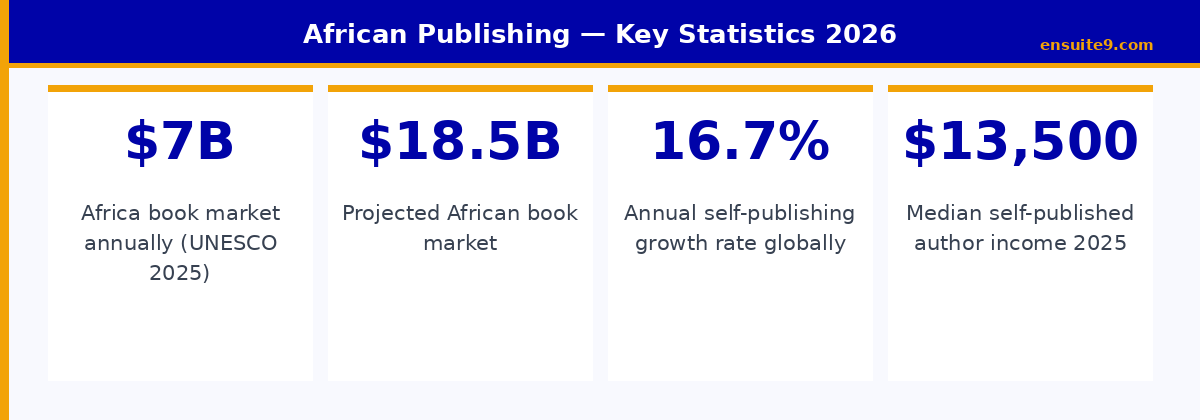
Before examining Africa specifically, the global backdrop is essential context. The global book publishing market was valued at approximately $129 billion in 2023. The self-publishing segment of that market reached $1.85 billion in 2024 and is growing at a compound annual growth rate of 16.7% — significantly faster than the traditional publishing sector. Industry analysts project the global self-publishing market will reach $6.16 billion by 2033.
In the United States alone, self-published titles accounted for 3.5 million books in 2024 — a 38.7% increase from the previous year. Self-publishing now represents approximately 30% of all eBooks sold in the US market. The median annual income for a self-published author in 2025 was $13,500 — higher than the $6,000 to $8,000 typically cited for traditionally published authors in comparable surveys.
These numbers establish the global backdrop: the self-publishing economy is real, growing faster than traditional publishing, generating genuine income for authors who understand how to use it, and increasingly accessible to authors anywhere in the world with a reliable internet connection. An author in Lagos, Accra, Nairobi, or London publishing through Amazon KDP and IngramSpark today has access to the same global distribution infrastructure as a New York publisher, at a fraction of the cost and with complete control over rights, pricing, and timing.
This is the global context African authors are stepping into. The question is not whether the infrastructure exists to support professional African publishing — it clearly does. The question is whether African authors have the knowledge and support to use it effectively.
Africa’s Publishing Market — The Current State in Detail
The 2025 UNESCO report titled “The African Book Industry: Trends, Challenges and Opportunities for Growth” is the most comprehensive analysis of African publishing ever produced. Its headline findings are significant:
- Africa’s book industry generates approximately $7 billion annually — representing 5.4% of the $129 billion global publishing market
- The industry has the potential to reach $18.5 billion in the coming years with appropriate investment and policy
- Educational publishing alone could represent $13 billion of that potential, based on a net student enrolment of approximately 329 million across the continent
- Africa imported books worth $597 million in 2023 while exporting books worth only $81 million — a significant trade deficit that represents both a structural weakness and an opportunity for local publishers
- 90% of African countries still lack specific legislation to support the book industry beyond basic copyright and legal deposit laws
- Africa has on average just one bookshop per 116,000 people and one public library per 189,000 inhabitants — figures that highlight both the infrastructure gap and the strategic importance of digital distribution
Nigeria is the largest book market in Sub-Saharan Africa by volume. The country is ranked the seventh largest country by online population globally — a combination of scale and digital connectivity that makes it the most commercially significant publishing market on the continent. South Africa, Kenya, Ghana, and Egypt are the other major publishing markets, each with distinct characteristics in terms of language, distribution infrastructure, and reader demographics.
West Africa, and Nigeria specifically, is particularly important for English-language publishing targeting African and diaspora audiences. The sheer scale of Nigeria’s English-speaking population — combined with its diaspora presence in the UK, the US, and Canada — means that a Nigerian author publishing professionally in English has access to one of the largest single-language readership communities in the world.
The Structural Challenges — Why the Gap Exists
Understanding why Africa only accounts for 5.4% of global publishing despite having 17% of the world’s population requires looking at the specific structural barriers the UNESCO report identifies.
Weak policy environment: As noted above, 90% of African countries lack specific legislation to support the book industry. Unlike the UK, France, or Germany — where book industries benefit from tax incentives, library funding, educational mandates, and cultural policy support — most African governments treat publishing as a residual sector rather than a strategic one. This means African publishers and authors operate without many of the institutional supports their counterparts in Europe and North America take for granted.
Import dependency: Africa’s book trade deficit — $597 million imported against $81 million exported in 2023 — reveals a deeper structural issue. For decades, African educational systems have relied on imported textbooks and curricula. This import dependency has suppressed the development of a domestic publishing ecosystem and concentrated publishing infrastructure in a small number of markets.
Distribution infrastructure: With only one bookshop per 116,000 people across the continent, physical book distribution is genuinely challenging in many markets. This is not simply a retail gap — it reflects the absence of the wholesale distribution networks, library acquisition systems, and retail chains that make physical book sales viable at scale in more developed markets.
Capital access: Traditional publishing requires significant upfront capital — for editorial development, production, printing, and distribution. Access to that capital has historically been limited for African publishers and authors, concentrating professional-quality publication in the hands of a small number of large publishers affiliated with international houses.
Each of these structural barriers is real. But each of them is also being disrupted — and the disruption is moving faster than most commentators anticipated even five years ago.
The Digital Transformation — Why Everything Is Changing Now
The most significant structural shift in African publishing over the past five years has been digital adoption, and the pace of that adoption is accelerating. This is not a gradual transition — it is a fundamental restructuring of who can publish, how they distribute, and how readers access content.
Smartphone penetration: Sub-Saharan Africa now has over 500 million smartphone users, with penetration rates growing at approximately 8–10% annually. In Nigeria specifically, smartphone penetration reached 45% in 2024 and is projected to exceed 60% before 2030. Every smartphone is a potential reading device — and crucially, it is a device that already exists in the reader’s pocket, requiring no additional hardware investment to access digital books.
Platform emergence: Digital publishing platforms specifically serving African readers are growing rapidly. Snapplify, based in South Africa, serves educational institutions across multiple African countries. AkooBooks in Ghana and eKitabu in Kenya are building audiobook and eBook ecosystems for their respective markets. The UNESCO report notes that these platforms are increasingly important in “bridging gaps where traditional distribution struggles” — reaching readers in markets where physical bookshops simply do not exist.
Global platform access: Beyond Africa-specific platforms, African authors have full access to the same global digital distribution infrastructure available to any author anywhere in the world. Amazon KDP, Apple Books, Kobo, Google Play Books, Barnes and Noble, OverDrive (the library lending network), and Draft2Digital are all accessible to authors publishing from Nigeria, Kenya, Ghana, or anywhere else on the continent. A properly formatted eBook published by a Nigerian author on Amazon KDP today is available for purchase in 35+ countries within 24–72 hours of upload.
The audiobook opportunity: Global audiobook revenue exceeded $1 billion in 2024 and is growing at over 25% annually. African authors are beginning to enter this space. The infrastructure barriers — recording equipment, distribution platforms — are lower than ever, and the market is genuinely untapped. A Nigerian author producing a professional audiobook of their non-fiction book in 2026 faces almost no competition from other African authors in their category on major platforms. The first mover advantage is significant and the window is still open.
African Authors on the Global Stage — The Literary Moment
The commercial opportunity in African publishing is inseparable from a broader cultural moment in which African literary voices are receiving unprecedented global recognition. The UNESCO report highlights this explicitly:
In 2021, the three most prestigious literary prizes in the world all went to African writers. Abdulrazak Gurnah from Tanzania received the Nobel Prize for Literature. Mohamed Mbougar Sarr from Senegal won the Prix Goncourt — France’s most prestigious literary award. Damon Galgut from South Africa won the Booker Prize. This was not a coincidence. It was a signal of a shift in global literary recognition that had been building for a generation.
Beyond literary prizes, African authors are finding commercial audiences at a scale that was not available to previous generations. Chimamanda Ngozi Adichie’s work has sold millions of copies globally and her TED talks have been viewed hundreds of millions of times. Teju Cole, NoViolet Bulawayo, Leila Aboulela, and dozens of other African authors have built genuinely international readerships. The diaspora market — particularly Nigerian, Ghanaian, Kenyan, and South African communities in the UK, the US, and Canada — represents a substantial, digitally connected readership hungry for African perspectives and stories.
For independent authors and self-publishers, this cultural moment matters because it has created a receptive global audience for African voices in non-fiction as well as fiction. A Nigerian coach publishing a business book, a Kenyan consultant publishing a leadership framework, or a Ghanaian entrepreneur publishing a memoir is operating in a market where African professional voices have genuine demand — not just domestically but internationally.
The Self-Publishing Opportunity — What the Numbers Mean for Individual Authors
The structural context above is important. But what does it mean in practice for an individual African author making decisions about their book in 2026?
The traditional route to publication for African authors — submitting to established publishers, waiting for acceptance, receiving a modest advance, hoping for adequate distribution — remains slow, competitive, and often disappointing in terms of financial return. Advances from African publishers are typically modest. Distribution is often limited to the domestic market. The author retains little control over pricing, positioning, or secondary rights. And the timeline from accepted manuscript to published book typically runs 18 to 36 months.
Self-publishing changes this equation fundamentally. An African author who self-publishes professionally retains 100% of intellectual property rights, sets their own pricing across all markets, reaches 35+ global distribution platforms directly, and receives royalty rates of 35% to 70% on digital sales — compared to the 8% to 15% typically offered by traditional publishers. They publish on their own timeline, control their own positioning, and own the customer relationship.
The median income for a self-published author globally in 2025 was $13,500 — but this figure conceals significant variation. Authors who publish consistently, build an audience, and treat publishing as a business rather than a one-time event earn significantly more. Authors who publish once without a strategy and wait for Amazon’s algorithm to discover them earn almost nothing. The difference is entirely in the quality of production and the strategy behind the publication.
The barriers to self-publishing for African authors in 2026 are not technological. The platforms are accessible, the payment infrastructure exists (Payoneer, Grey, and similar services solve the cross-border payment challenge), and the global distribution networks are open to any author regardless of their location. The barriers are knowledge and infrastructure: understanding how to format a manuscript to professional publishing specifications, how to design a cover that competes in a global marketplace, how to register an ISBN correctly, how to set up and optimise a KDP account from Nigeria, and how to market a book after publication.
These are solvable problems. They are exactly what a professional publishing service exists to solve.
The Five Key Markets — Nigeria, South Africa, Kenya, Ghana, Egypt
Africa is not a single market and it would be misleading to treat it as one. The five most significant publishing markets on the continent each have distinct characteristics that shape how authors and publishers should approach them.
Nigeria is the largest and most dynamic publishing market in Sub-Saharan Africa. Its combination of scale (220 million people), digital connectivity (7th largest online population globally), English-language literacy, and an increasingly affluent urban professional class makes it the most commercially significant market on the continent for professional non-fiction. The Nigerian diaspora in the UK and the US adds a further layer of internationally accessible, digitally engaged readership.
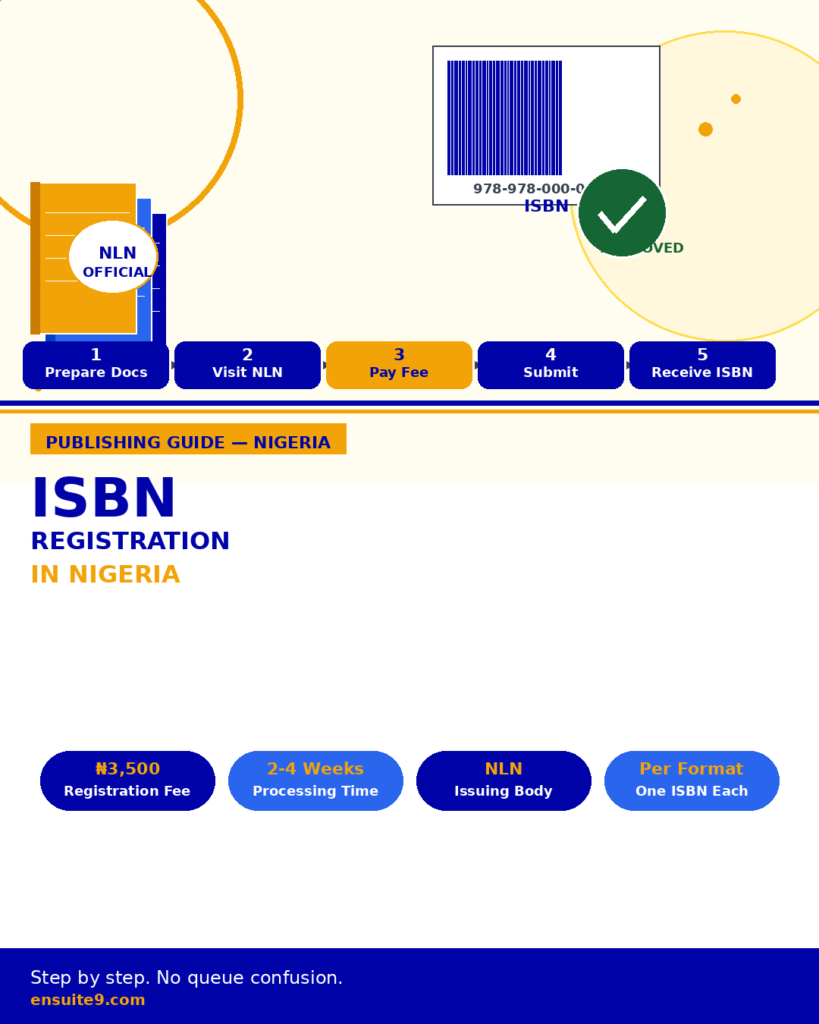
READ ALSO: ISBN Registration in Nigeria: Step-by-Step Guide for Authors & Publishers
South Africa has the most developed traditional publishing infrastructure on the continent, including established distribution networks, a professional trade publishing sector, and stronger institutional support for the book industry. The South African market was valued at approximately $680 million in 2021 and has the continent’s most developed bookshop network in relative terms. It is also the most internationally connected African publishing market, with strong links to UK and US publishers.
Kenya has a growing digital publishing ecosystem and a well-educated, English-reading population concentrated in Nairobi and other urban centres. Platforms like eKitabu have made Kenya a significant market for digital book distribution. The country also has one of the most active literary cultures in East Africa, with Nairobi hosting multiple literary festivals annually.
Ghana is an increasingly significant publishing market with a growing middle class, strong literacy rates, and an English-speaking professional community that overlaps significantly with diaspora audiences in the UK and the US. AkooBooks, based in Ghana, is building one of the continent’s most promising audiobook platforms.
Egypt is the largest Arabic-language publishing market on the continent and one of the largest in the world. While less directly relevant to English-language publishing, Egypt’s size and cultural influence make it significant for publishers considering pan-African or multilingual strategies.
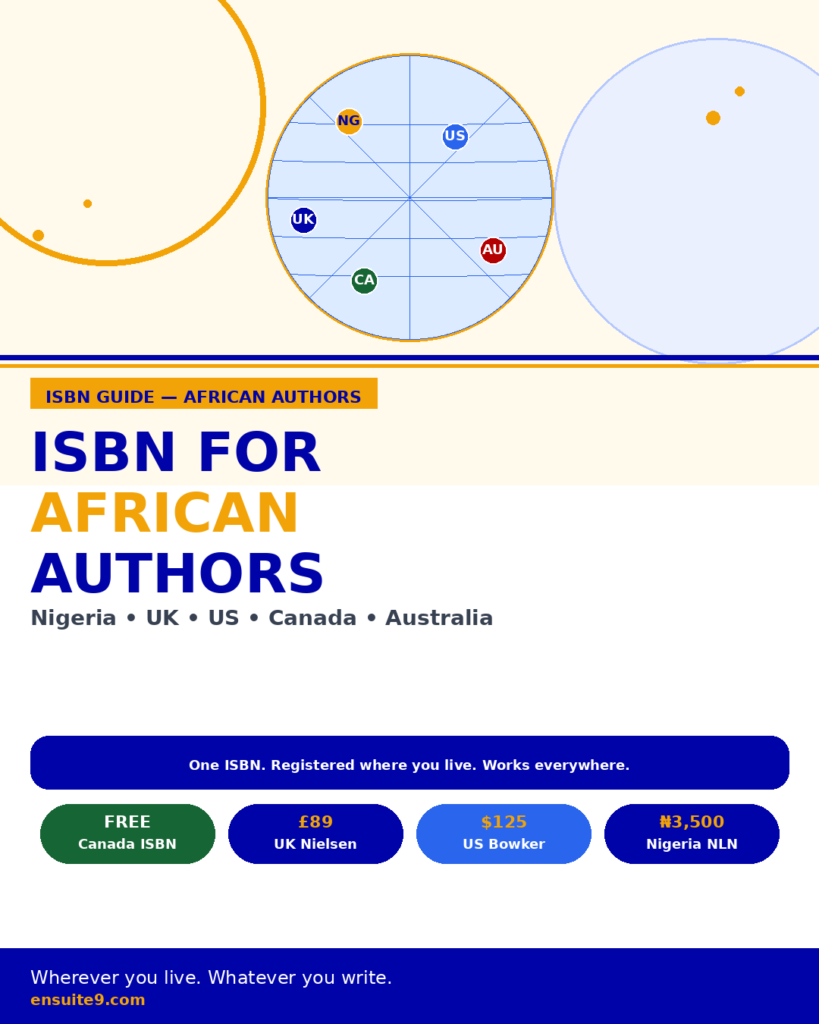
READ: ISBN for African Authors — Do You Need a Nigerian ISBN, a UK ISBN, or Both?
What African Authors Should Do With This Information in 2026
The data above points to a clear strategic conclusion for African authors publishing in 2026: the infrastructure to publish professionally and reach a global audience has never been more accessible, but the window for building a position in an emerging market is always finite. The authors who invest in professional publishing infrastructure now — quality production, correct distribution, strategic positioning — are building assets that will compound in value as the market grows.
Specifically, this means:
Publish to global standards from the first book. The African publishing market is growing, but the competition your book faces is global. A reader on Amazon looking for a business book about leadership is not choosing between Nigerian books and American books — they are choosing between books that look professional and books that do not. Cover design, interior formatting, and metadata quality are not optional extras. They are the price of entry to a global marketplace.
Build for multiple markets simultaneously. An African author publishing in English in 2026 has a potential readership in Nigeria, the UK, the US, Canada, Australia, and across the African diaspora. A book published exclusively through the National Library of Nigeria and sold at Jazzhole reaches a tiny fraction of that potential audience. A book published through KDP and IngramSpark, with a professionally produced cover and correctly optimised metadata, reaches all of those markets from day one.
Use the book as a business asset, not just a product. For coaches, consultants, and professionals — the primary audience Ensuite 9 works with — a book is not primarily a revenue stream. It is an authority asset. It changes how clients perceive you, changes what you can charge, and changes who approaches you. Publishing a book that positions you correctly for your market is one of the highest-leverage decisions a professional can make.
Start building your direct sales infrastructure now. The platforms and payment tools to sell books directly to readers, Gumroad, Payhip, WooCommerce with Paystack, are accessible and functional. Authors who build an email list and a direct sales channel alongside their Amazon presence are not dependent on any single platform’s algorithms or policies. They own the relationship with their readers.

How Ensuite 9 Works With African Authors
Ensuite 9 is a digital authority agency working with coaches, consultants, authors, and founders across Nigeria, the UK, the US, Canada, Australia, and the UAE. Our publishing service handles the full production infrastructure for authors who want to publish professionally without navigating the technical complexity alone.
We produce professionally formatted eBooks and print books, manage ISBN registration through the National Library of Nigeria and international agencies, set up and optimise distribution on Amazon KDP and IngramSpark, design book covers that compete in global marketplaces, and develop book marketing and launch strategies that treat a book as the business asset it is.
Every engagement starts with a discovery call where we assess your manuscript, your market, and your goals – and give you a transparent breakdown of exactly what professional publication will cost and what it will achieve. There is no vague quoting and no hidden costs.
The African publishing market is about to grow significantly. The authors who are positioned correctly when it does will have built that position now. Book a free 30-minute discovery call and we will tell you exactly what your book needs.
Frequently Asked Questions
How big is the African publishing market in 2026?
According to the 2025 UNESCO report, Africa’s book industry generates approximately $7 billion annually, representing 5.4% of the $129 billion global publishing market. The same report projects the industry could reach $18.5 billion in the coming years with appropriate policy and investment.
Which country has the largest publishing market in Africa?
Nigeria is the largest book market in Sub-Saharan Africa by volume and is ranked the seventh largest country by online population globally, making it the most commercially significant publishing market on the continent for English-language publishing. South Africa has the most developed traditional publishing infrastructure.
Can African authors publish on Amazon KDP?
Yes. Amazon KDP is fully accessible to authors based in Nigeria and across Africa. Nigerian authors typically use Payoneer to receive royalty payments, as direct Nigerian bank account transfers are not currently supported by KDP. With a Nigerian Tax Identification Number, authors can also reduce the default 30% US withholding tax on royalties to 7.5% under the Nigeria-US tax treaty.
Is self-publishing growing in Africa?
Yes, significantly. Digital platform adoption, increasing smartphone penetration, and the emergence of Africa-specific platforms like Snapplify, and AkooBooks are all contributing to self-publishing growth across the continent. The removal of traditional distribution barriers through digital publishing is particularly transformative in markets where physical bookshop infrastructure is limited.
What are the main challenges for African publishers and authors?
The 2025 UNESCO report identifies weak policy support (90% of African countries lack specific book industry legislation), import dependency ($597 million in imports against $81 million in exports in 2023), limited distribution infrastructure (one bookshop per 116,000 people on average), and restricted access to publishing capital as the primary structural challenges. Digital publishing addresses several of these barriers directly.