If you are an African author, whether you are sitting in Lagos, London, Toronto, Houston, or Melbourne, one of the most confusing parts of publishing professionally is the ISBN question.
Which country’s ISBN do you register with? Do you need a Nigerian ISBN and a UK ISBN? What happens if you want to sell your book in both Nigeria and internationally? Does a free ISBN from Amazon actually work? And if you are part of the African diaspora living abroad, do the rules change?
These are not simple questions, and most of the guides that claim to answer them are written for one market. They tell a US author where to get a US ISBN, a UK author where to get a UK ISBN, and they stop there. They were not written for the author, who is, for instance, Nigerian by origin, UK-based by residence, and wants their book in bookshops in Lagos, on Amazon globally, and distributed through IngramSpark to libraries worldwide.
This guide considers this peculiarity.
By the end you will know exactly which ISBN to get, where to get it, how much it costs, how long it takes, and what the right decision is for your specific situation. You will also understand the free versus paid ISBN question clearly enough to make the right call the first time, because getting this wrong is expensive to undo.
What an ISBN Actually Is — and Why It Matters More Than People Realise
An ISBN stands for International Standard Book Number. It is a unique 13-digit code assigned to a specific edition of a specific book. Think of it as your book’s permanent identity card in the global publishing system.
Every time a retailer, library, distributor, or reading platform needs to reference your book, they use the ISBN. It is how Amazon finds your book in its catalogue, how IngramSpark lists it for bookshops to order, how the British Library catalogues it, and how the National Library of Nigeria records your publication.
Without an ISBN, your book may struggle to be listed on major online platforms such as Amazon, Google Books, and Apple Books, or included in international book catalogues.
For the self-publishing author in 2025, the ISBN is not just an administrative formality. It is the infrastructure that connects your book to every system in global publishing. Retailers, libraries, distributors, and aggregators all run on ISBN data. An author without a proper ISBN is invisible to a significant portion of the distribution ecosystem regardless of how good the book is.
ISBNs are allocated in the country where the book is published, but they can be used internationally — you do not need a separate ISBN to distribute your book in overseas markets.
This single fact answers the most common question African diaspora authors ask. One ISBN, properly registered, gets your book into Amazon US, Amazon UK, Amazon Australia, IngramSpark’s global network of 40,000+ retailers and libraries, Apple Books, Kobo, Google Play Books, and any bookshop in Nigeria that orders through a distribution system. You do not need to register separately in every country you want to sell in.
What you do need is to register in the right country, and that depends on where you are based.
The Rule That Governs Every ISBN Decision
You must get your ISBN from the agency that serves your country of residence, regardless of where you plan to sell your book.
Your country of residence is the determining factor. Not your nationality, not the language of your book, not where your primary audience is. Where you live when you publish is where you register.
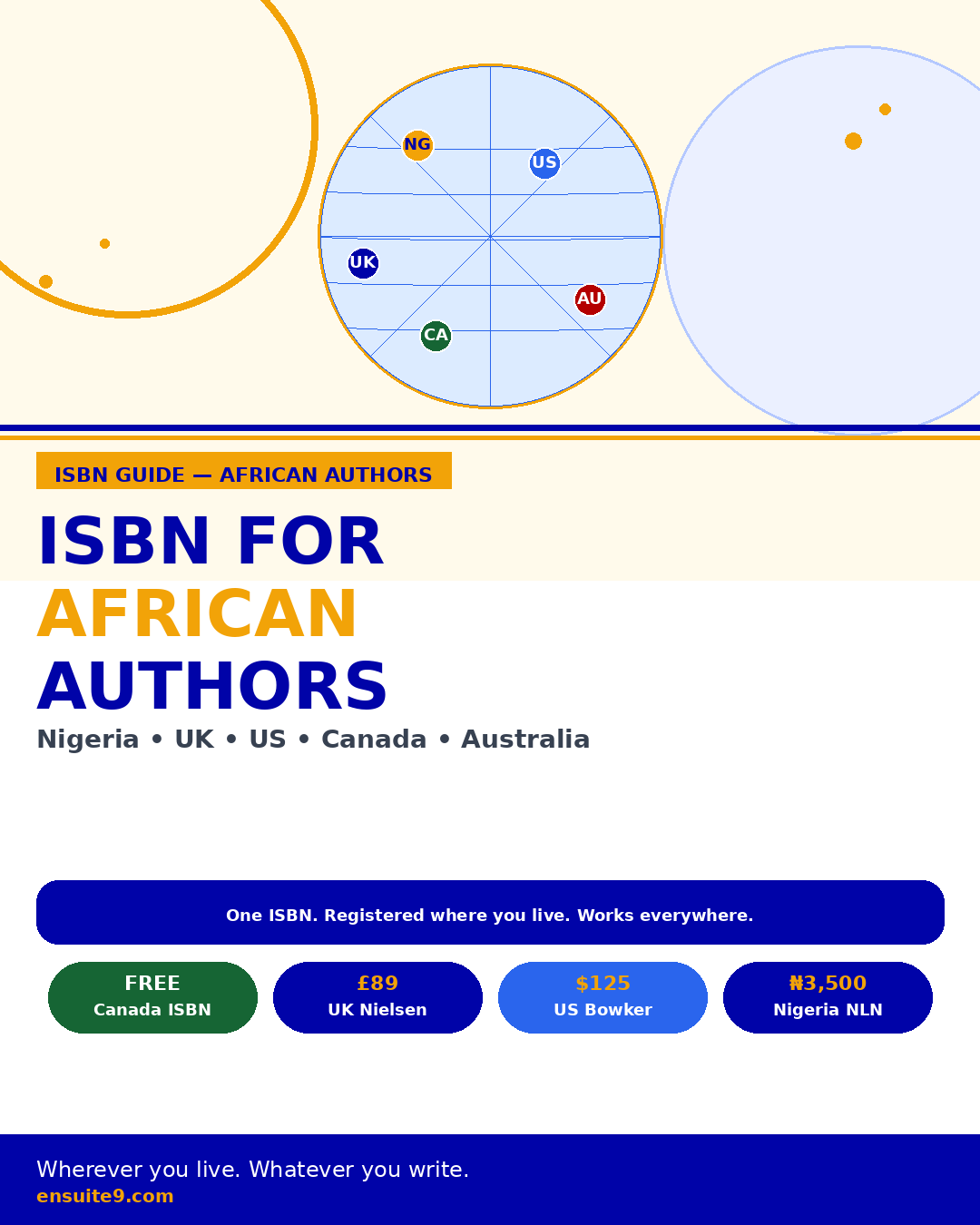
This is the rule that clears up most of the confusion for African diaspora authors. If you are Nigerian and living in the UK, your ISBN comes from Nielsen UK, not the National Library of Nigeria. If you are Ghanaian and living in Canada, your ISBN comes from Library and Archives Canada — for free. If you moved from Lagos to Houston last year, your ISBN comes from Bowker in the US.
The Nigerian ISBN is for Nigeria-based authors. The UK ISBN is for UK-based authors. And both work everywhere.
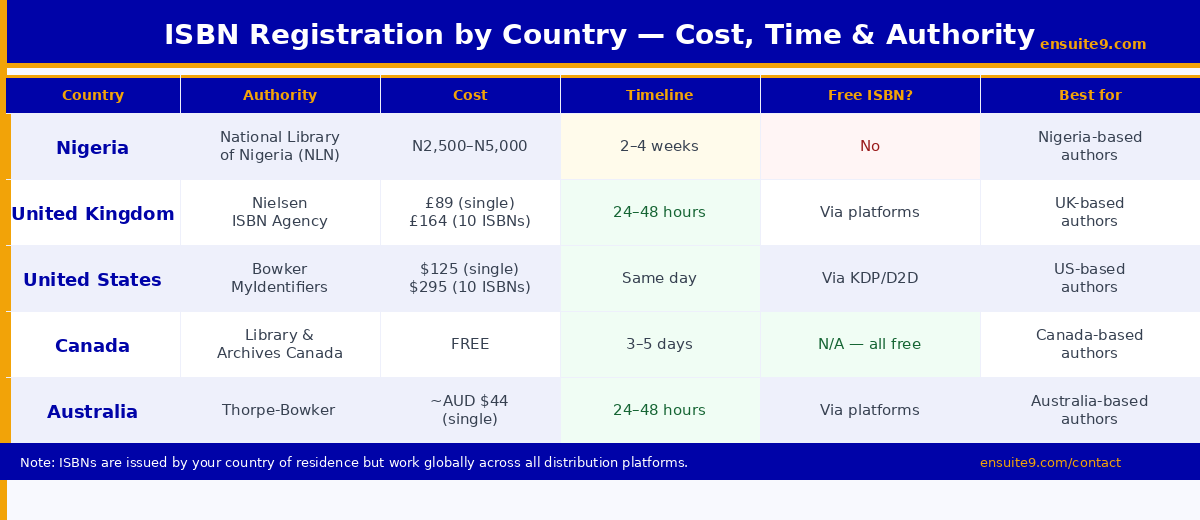
ISBN Registration by Country — The Complete Breakdown
Nigeria — National Library of Nigeria
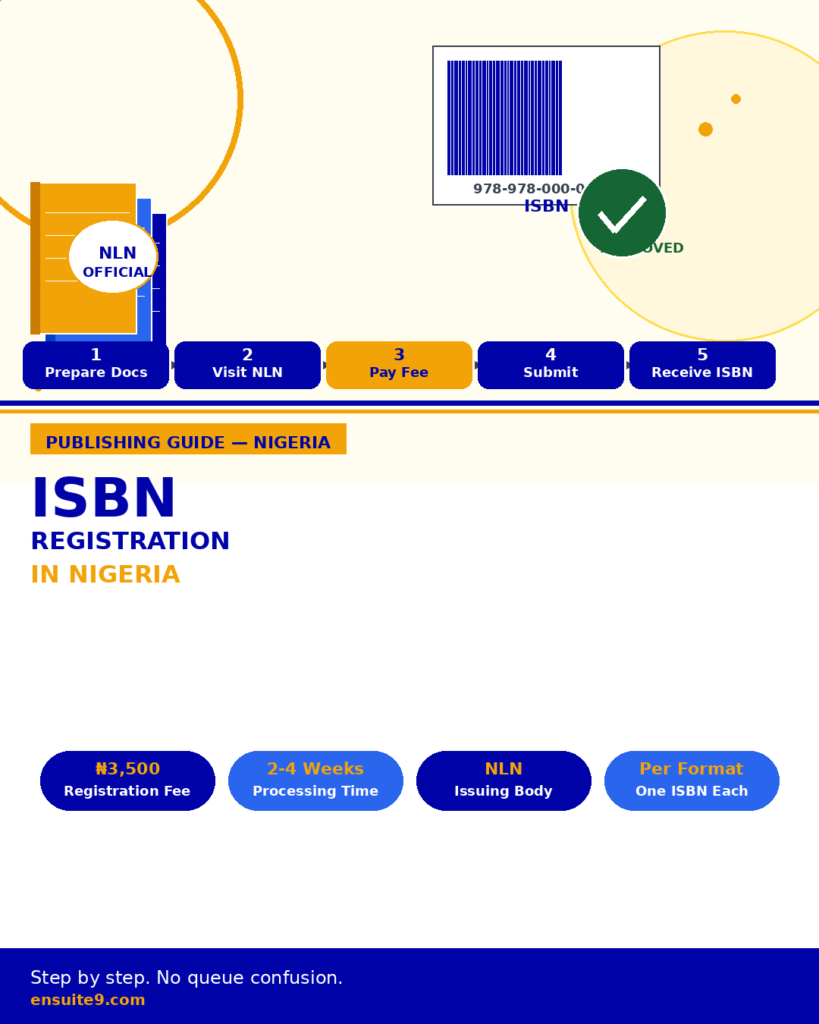
For authors based in Nigeria, the National Library of Nigeria (NLN) is the sole official authority for ISBN registration. There is no alternative. You cannot register a Nigerian ISBN online through a third-party agency: the NLN manages the process directly.
The NLN has offices in Abuja (headquarters), Lagos, Ibadan, Enugu, Kaduna, Kano, Jos, and Port Harcourt. Whether you are an independent author or a publishing company, you must apply through the National Library. Applications can be submitted in person at the NLN office closest to you.
What you need to bring to the NLN:
A letter of intent stating your name, the book title, and the format you are publishing in. A photocopy of a valid government-issued ID — your voter’s card, NIN slip, driver’s licence, or international passport. The first two chapters of your manuscript or a sample of the content. Your payment receipt confirming you have paid the registration fee directly into the NLN’s designated account.
The cost is approximately ₦4,500 for the ISBN and an optional barcode. Some branches charge modestly different amounts — budget between ₦2,500 and ₦5,000 for a single ISBN. Bulk ISBNs for publishers are available at discounted rates.
Processing time at the NLN is typically two to four weeks from the date of submission, though this varies by branch and by demand. The Lagos branch on Herbert Macaulay Way in Yaba is one of the most active. If you are not able to visit in person, you can authorise a representative to submit documents on your behalf — though they should carry a letter authorising them to act for you.
Once your application is processed, you receive a 13-digit ISBN, a barcode for your back cover, and a confirmation letter from the NLN. That ISBN is immediately valid for use on Amazon KDP, IngramSpark, and every major distribution platform globally.
United Kingdom — Nielsen UK ISBN Agency
For authors based in the UK, including Nigerian and African authors living in Britain, the official ISBN provider is the Nielsen UK ISBN Agency. Unlike Nigeria’s in-person process, UK ISBN registration is done entirely online at nielsenisbnstore.com.
Cost: approximately £89 for one ISBN or £164 for ten. Processing is typically completed within 24 to 48 hours after online submission. You register with your name and publishing company name (which can simply be your own name followed by “Press” or “Publishing”), and the ISBN is assigned to you immediately in most cases.
For African diaspora authors in the UK who want their book available in Nigerian bookshops and on Nigerian platforms: your Nielsen UK ISBN works exactly as a Nigerian ISBN would for global distribution. The NLN and major Nigerian distributors recognise internationally registered ISBNs without issue.
United States — Bowker MyIdentifiers
For authors based in the United States, Bowker MyIdentifiers is the only company authorised to administer ISBN numbers. You can register at myidentifiers.com. A single ISBN costs approximately $125 in the US. Bulk purchases of ten ISBNs are significantly more cost-effective. Processing is same-day online. You are immediately registered as the publisher of record.
The US ISBN system is the most commercially important for authors targeting the American market, but it is also the most expensive for individual ISBNs. If you are a Nigerian author based in the US planning to publish multiple titles or multiple formats of the same book, purchasing a block of ten ISBNs upfront is the smarter investment.
Canada — Library and Archives Canada
Canada provides ISBNs completely free of charge through Library and Archives Canada. This makes Canada the most author-friendly ISBN jurisdiction in the world. There is no cost, no bulk pricing to calculate — every Canadian-based author or publisher registers for free.
Apply online at bac-lac.gc.ca. Processing typically takes three to five business days. The ISBN is assigned to you as the publisher with full ownership and portability across all platforms.
For African authors in Canada — Nigerian, Ghanaian, Kenyan, South African, or otherwise — this free system is a genuine advantage. Your ISBN works globally, costs nothing, and is registered in your name permanently.
Australia — Thorpe-Bowker
In Australia, ISBNs are issued through Thorpe-Bowker. The cost is approximately AUD $44 for a single ISBN, with bulk options available. Registration is online and typically processed within 24 to 48 hours. The process is similar to the US Bowker system, though significantly cheaper per unit.
The Free ISBN Question — And Why Most Professional Authors Say No
Every major self-publishing platform offers a free ISBN. Amazon KDP will assign one. IngramSpark will assign one. Draft2Digital will assign one. Smashwords, Barnes and Noble Press, Kobo Writing Life — all of them will give you a free ISBN if you use their platform.
The temptation is obvious. Why pay for something you can get for free?
Here is the answer to that.
When you use a free platform-assigned ISBN, the platform is listed as the publisher of record. This tethers your book’s identifier to that specific platform. You cannot take that KDP-assigned ISBN and use it to print your book at IngramSpark or any other printer. It also signals to bookstores and libraries that it is a KDP-only publication, which can limit their willingness to order it.
When you own your own ISBN, purchased through your country’s official agency, you are the publisher. That ISBN belongs to you, and you can use it across all platforms: KDP, IngramSpark, Barnes & Noble Press, local printers, anywhere.
For authors in Nigeria, the UK, or anywhere in Africa who want their book in physical bookshops, in library systems, and distributed through IngramSpark’s global network, a platform-assigned free ISBN is not a viable option. IngramSpark requires an ISBN that you own. Bookstores that order through Gardners or Bertrams in the UK, or through distribution networks in Nigeria, need an ISBN registered to a real publisher, not to Amazon.
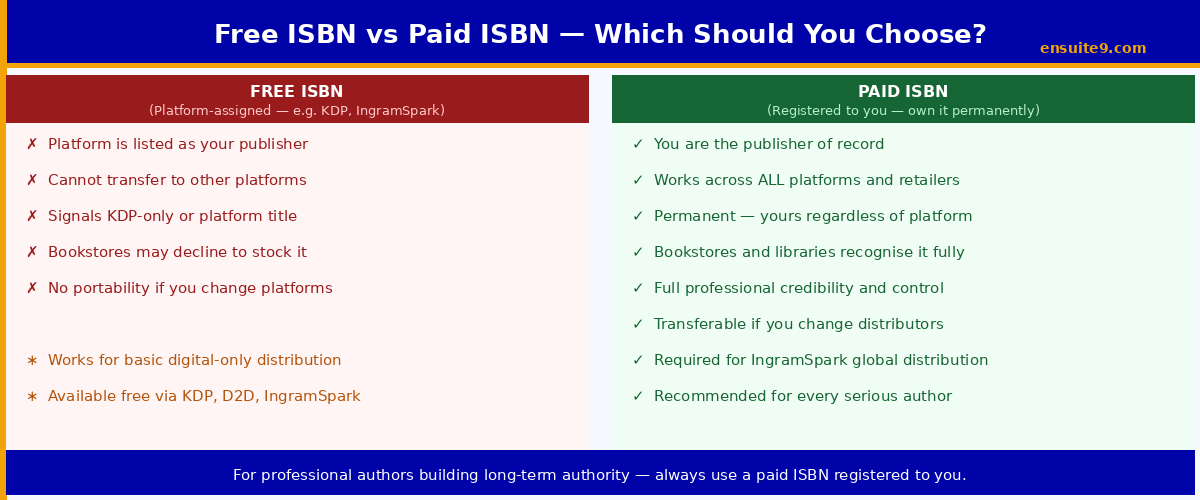
For digital-only authors who plan to sell exclusively through Amazon Kindle and have no intention of distributing elsewhere, the free KDP ISBN is functional. But for any author building a professional publishing presence, the kind of presence that holds up when you are pitching to a corporate client, applying to speak at a conference, or submitting to a library acquisition programme, owning your ISBN is not optional.
How Many ISBNs Does Your Book Actually Need?
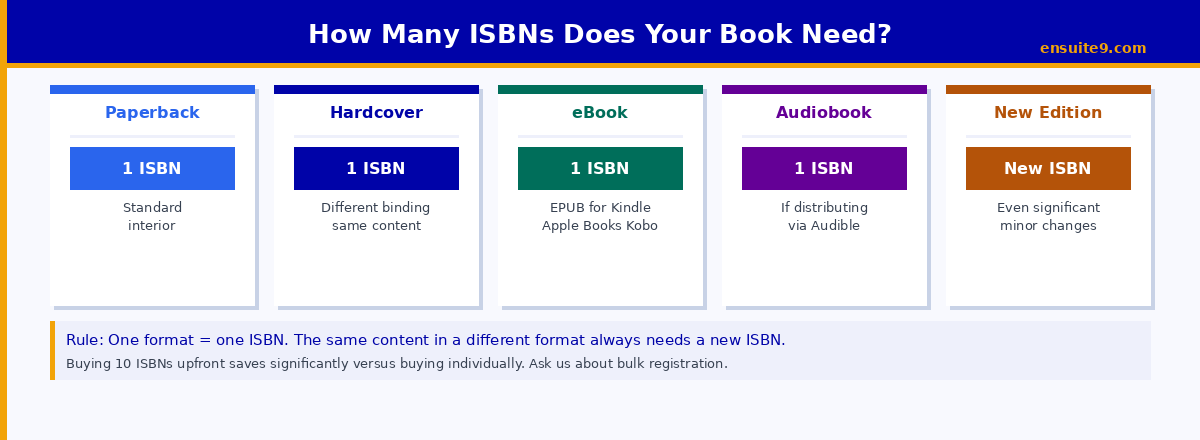
This is where many first-time authors are caught off guard. A book is not one product in the publishing system. Each format of your book is treated as a separate product and requires its own unique ISBN.
A paperback edition: one ISBN. A hardcover edition: one ISBN. An eBook (EPUB format): one ISBN. An audiobook: one ISBN. A second edition with significant changes: a new ISBN, even for the same format.
Each format requires its own ISBN to differentiate it in databases and retail systems.
This means an author publishing a paperback, an eBook, and a hardcover edition of the same title needs three ISBNs before a single copy is sold. This is why buying ISBNs in blocks rather than individually is almost always the smarter decision for authors publishing more than one title or in more than one format.
In the US, ten ISBNs through Bowker cost $295 compared to $125 for one, that is $29.50 per ISBN versus $125. In Nigeria, the NLN offers bulk pricing for publishers registering multiple titles. In Canada, of course, all of this is free regardless of volume.
Questions African Diaspora Authors Ask Most
“I grew up in Nigeria, I live in the UK now, and I want my book available in both markets. Which ISBN do I get?”
You register through Nielsen UK as a UK-based publisher. That ISBN is valid and recognised on every platform, including Amazon Nigeria and any Nigerian distributor. You do not need a Nigerian ISBN as well. One ISBN covers both markets and every other market globally.
“My book is written in Yoruba. Does that change which ISBN I need?”
No. The language of your book does not determine where you register. Your country of residence does. A Yoruba-language book published by an author in the UK registers through Nielsen UK.
“I want to donate copies of my book to Nigerian university libraries. Do I need a Nigerian ISBN for that?”
Not necessarily. Universities and institutional libraries generally accept internationally registered ISBNs for cataloguing. However, if you want your book included in the NLN’s national bibliographic database and accessible through Nigerian national library systems specifically, registering through the NLN has that additional institutional benefit. For authors based in Nigeria, this is standard. For diaspora authors, it is an optional extra step rather than a requirement.
“Can I register my ISBN in Nigeria from abroad?”
The NLN currently requires physical document submission at one of its branches. If you are abroad and want a Nigerian ISBN specifically, you would need to authorise someone in Nigeria to submit on your behalf. In practice, most diaspora authors register through their country of residence and use that ISBN globally, which is both simpler and equally effective for distribution.
“I published a book two years ago without an ISBN. Can I get one now and add it to the book?”
Technically yes, you can register an ISBN for an existing publication. However, if your book is already live on platforms like Amazon KDP without an ISBN, you will need to update the listing with the new ISBN, which may involve creating a new edition entry. If your book is not yet widely distributed, adding an ISBN now before broader distribution is the cleanest approach. If it is already selling without one, the process is more complex and worth discussing on a discovery call before proceeding.
The Nigerian ISBN Process — What a Recent 2025 Applicant Experienced
One of the most useful things we found in researching this guide was a first-hand account from a Nigerian author who submitted an ISBN application at the NLN’s Lagos branch in July 2025. The process required a letter of intent, a photocopy of a government-issued ID, a few chapters of the manuscript, and a payment receipt for the registration fee.
The practical reality of the NLN process in 2026 is that it remains largely paper-based and in-person. This is not a criticism, it is the current reality that authors need to plan for. If you are in Lagos, the Yaba branch on Herbert Macaulay Way is the most commonly used. If you are outside Lagos, your nearest zonal office handles the same process.
The NLN does not currently offer a fully digital application process. Most branches require physical presence or a physical submission of documents. For authors who cannot attend in person — whether due to location, time, or health — authorising a representative to submit on your behalf is the standard workaround.
This is precisely why many Nigerian authors choose to work with a publishing service that handles the NLN process on their behalf. It eliminates the queues, the repeated visits, and the uncertainty about whether everything was submitted correctly, and it gets the ISBN processed within a reliable timeline tied to your publishing schedule.
What Happens After You Get Your ISBN
Your ISBN is permanent. Once registered, it belongs to your book forever. It does not expire. It does not need to be renewed. Even if the NLN changes its systems or fees in the future, your existing ISBNs are permanently valid.
Here is what to do with it once you have it:
Add it to your copyright page in the standard format: usually listed as “ISBN: 978-XXX-XXXX-XX-X” with a note of the edition and format. Have your cover designer embed the barcode on the back cover of your print edition. The barcode is generated from your ISBN and is what retailers scan at point of sale. Submit it to your platform of choice — Amazon KDP, IngramSpark, Draft2Digital, or whichever distributor you are using. Ensure the ISBN you enter on the platform matches the edition and format exactly. Submit the book’s metadata — title, author, ISBN, publisher, publication date, and description — to your country’s national bibliographic agency if they require it. In Nigeria, this is part of the NLN process. In the UK, it is handled through Nielsen.
Why Working With a Publishing Service Saves Time and Mistakes
ISBN registration is one part of a larger publishing process. Authors who try to manage it alone often run into problems at the handover between steps: the ISBN is registered for the wrong format, the barcode is generated at the wrong resolution for print, or the metadata submitted to the platform does not match the ISBN registration exactly.
Ensuite 9 handles ISBN registration as part of every publishing project. For Nigeria-based clients, we manage the NLN application, document preparation, submission, and follow-up through to receipt of the ISBN — no queues, no repeated visits, no uncertainty about timelines. For clients in the UK, US, Canada, Australia, and UAE, we advise on the right agency for your location and handle the registration as part of your production schedule.
Every ISBN we register is in your name as the publisher. We hold no claim over it. You own it permanently, and it transfers to you completely upon project completion.
If you are ready to publish professionally and want an experienced team to handle the technical infrastructure while you focus on the work, book a free 30-minute discovery call, and we will map out exactly what your publishing project needs.
Frequently Asked Questions
Can I use a Nigerian ISBN to sell my book on Amazon internationally?
Yes. A Nigerian ISBN registered through the National Library of Nigeria is fully valid for distribution on Amazon KDP, IngramSpark, Apple Books, Kobo, and every major global retail platform. The country of ISBN origin does not restrict where your book can be sold or distributed.
Do I need a separate ISBN for Nigeria and the UK?
No. One ISBN registered in your country of residence covers global distribution. You do not need separate ISBNs for each market you want to sell in. A UK-registered ISBN works in Nigerian bookshops and on Nigerian platforms without restriction.
Can I get a free ISBN and still sell everywhere?
You can use a free platform ISBN to distribute through that specific platform. However, free ISBNs list the platform as your publisher and cannot be transferred to other platforms. For professional authors who want full ownership, maximum distribution flexibility, and access to physical bookstore distribution, purchasing your own ISBN is strongly recommended.
How long does ISBN registration take — Nigeria versus UK or US?
In Nigeria, the NLN takes two to four weeks from the date of submission. In the UK through Nielsen, registration is typically completed within 24 to 48 hours online. In the US through Bowker, same-day processing is standard. In Canada, Library and Archives Canada typically processes within three to five business days.
What is the difference between an ISBN and an ASIN?
An ISBN is a globally recognised book identifier registered with an official national agency. It is portable across every platform and retailer worldwide. An ASIN (Amazon Standard Identification Number) is an Amazon-specific identifier automatically assigned to every product listed on Amazon. Your book will have both an ISBN you own and an ASIN Amazon assigns. Only the ISBN works outside Amazon.
What is the difference between an ISBN and an ISSN?
An ISBN is assigned to books and one-time publications. An ISSN (International Standard Serial Number) is assigned to periodicals — magazines, journals, and newspapers published on a recurring basis. If you are publishing a book, you need an ISBN. If you are publishing a magazine or recurring journal, you need an ISSN.
Can I register an ISBN for a book that is already published?
Yes, technically. However, if your book is already live on platforms without an ISBN, the process of adding one retrospectively involves updating existing listings and may require creating a new edition entry. It is significantly cleaner to register your ISBN before publication. Contact us if you are navigating this situation, and we can advise on the best approach for your specific case.