Amazon KDP (Kindle Direct Publishing) is the most accessible publishing platform in the world and the most important one for African authors targeting a global audience. It gives you access to Amazon’s 300 million or more active customers across every market simultaneously, from the moment your book is live.
Setting up KDP correctly from Nigeria, or from any African country, involves a set of decisions that most generic KDP guides do not address. How to handle the tax interview as a non-US person. How to receive royalty payments without a US bank account. Which royalty rate applies to your situation. How to optimise your book for discovery in Amazon’s search algorithm, and what it actually costs to get a manuscript publication-ready before any of that even matters.
This guide covers all of it. By the end, you will know exactly how to set up and use Amazon KDP as an African author in 2026, from your very first login through to a fully optimised, properly priced, correctly distributed book.
What Amazon KDP Actually Offers African Authors
Amazon KDP allows you to publish both eBooks (Kindle format) and print books (paperback and hardcover) on demand. Here is what that means in practice.
For eBooks: Your eBook is available for purchase on Amazon globally, on Amazon.com, Amazon.co.uk, Amazon.de, Amazon.co.jp, and every other Amazon marketplace, from the moment it is approved. No print run, no inventory, no upfront cost. You upload the files, set the price, and Amazon handles the rest.
For print books: Amazon prints a copy only when a customer orders one. This means you carry no inventory, pay no printing costs upfront, and your book is available for purchase globally on Amazon print on demand. The trade-off is that Amazon’s print on demand per copy cost is built into the pricing model, which reduces your royalty per copy compared to a commercial print run where you order in bulk upfront.
For African authors specifically, this on-demand model removes one of the biggest historical barriers to international publishing. You do not need capital to print a thousand copies and ship them to warehouses abroad. You do not need a distribution deal with an international publisher. You need a correctly formatted file and a correctly configured account, and your book becomes available to readers in London, Toronto, Lagos and Sydney at the same moment.
Setting Up a KDP Account from Nigeria
Go to kdp.amazon.com and sign in with your Amazon account or create one. Your account setup requires your full name or publisher name, your address in Nigeria, a payment method for receiving royalties, and completion of the tax interview.
Use a name and address that match your other publishing documentation, including your ISBN registration if you have registered one independently of KDP. Inconsistent details across your publishing accounts, your Payoneer account, and your ISBN registration can cause delays during identity verification or payment processing later on, so it is worth getting this right at the start rather than correcting it after your book is already live.
The Tax Interview: What to Do as a Nigerian Author
The tax interview is the step that confuses most non-US authors. Amazon is required to collect tax information from all publishers. As a Nigerian author, here is what you need to know.
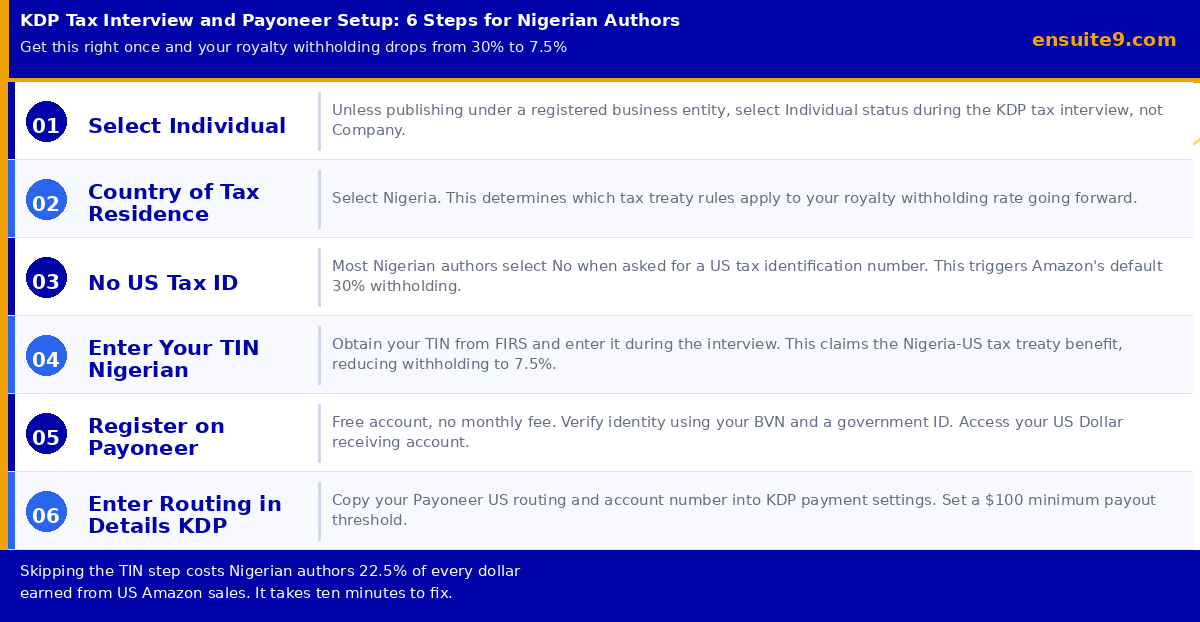
Select Individual, not Company, unless you are publishing under a registered business entity. Select your country of tax residence as Nigeria. You will be asked whether you have a US tax identification number. Most Nigerian authors do not, so select No. Amazon will then apply a 30% withholding tax on your US royalties by default.
To reduce this withholding rate, Nigeria has a tax treaty with the US that reduces the withholding rate on royalties to 7.5%. To claim this treaty benefit, you need to enter your Nigerian Tax Identification Number (TIN) during the tax interview. Your TIN can be obtained from the Federal Inland Revenue Service (FIRS) in Nigeria. With a TIN entered and the treaty benefit claimed, your US royalty withholding drops from 30% to 7.5%.
Note that withholding tax only applies to royalties earned from US Amazon customers. Royalties from Amazon UK, Amazon Australia, Amazon Canada, and other non-US marketplaces are not subject to US withholding tax. This is a detail many Nigerian authors miss, assuming the 30% figure applies to all their earnings globally when it only applies to the portion sold through Amazon’s US store specifically.
If you are publishing as a registered Nigerian business rather than as an individual, the tax interview process is slightly different, and you may need to provide your company registration details and a different tax form. Most first-time authors and coaches publishing under their own name should select Individual.
How to Receive KDP Royalty Payments in Nigeria
This is the most practically important question for Nigerian authors. Amazon pays royalties by bank transfer, cheque, or Amazon gift card. Direct bank transfer to a Nigerian bank account is not supported.
The most widely used solution for Nigerian KDP authors is Payoneer. Payoneer provides Nigerian authors with a US virtual bank account number, a routing number and account number that Amazon treats as a standard US bank account for payment purposes. You register a free Payoneer account, receive your US account details, enter them into KDP, and your royalties are deposited into your Payoneer account. You then transfer from Payoneer to your Nigerian bank account in naira.
Setup steps: register at payoneer.com for a free account with no monthly fee. Complete identity verification with your BVN and government ID. Access your Receiving Accounts and select the US Dollar account. Note your US routing number and account number. Enter these in your KDP account under Payment Settings. Set a minimum payout threshold, a minimum of $100 before Amazon transfers.
Alternative: Grey (formerly Aboki Africa) and some other Nigerian fintech platforms also provide US virtual account numbers compatible with KDP payouts. Payoneer remains the most widely tested and reliable option for KDP specifically, and is what most established Nigerian authors use.
One detail that catches many first-time authors out: your name on Payoneer must match your name on KDP exactly, including spelling and order. A mismatch between the two, even something as small as a missing middle name or a different name order, can delay or block your payout entirely until you correct the discrepancy with Payoneer’s support team. Set both accounts up with identical name formatting from the start.
Royalty Rates: What You Actually Earn
eBook royalties: A 70% royalty is available for eBooks priced between $2.99 and $9.99 in the US market. This is the standard rate for most professionally published non-fiction eBooks. A 35% royalty applies to eBooks priced below $2.99 or above $9.99, and to sales in certain markets where the 70% rate is not available. If you enrol in KDP Select (Kindle Unlimited), which requires Amazon exclusivity for 90 days, you also earn from Kindle Unlimited page reads. The KDP Global Fund pays approximately $0.004 to $0.005 per page read, meaning a 300-page book fully read generates approximately $1.20 to $1.50 in KU earnings.
Print royalties: Your royalty is calculated as list price minus printing cost minus Amazon’s distribution fee. A 250-page paperback priced at $12.99 in the US market typically earns approximately $2.00 to $3.50 in royalties depending on trim size and whether it is sold on Amazon.com or through expanded distribution. Expanded distribution through the IngramSpark network has lower royalty rates than direct Amazon sales, so understanding which channel a given sale came through matters when you are reviewing your royalty statement.
Pricing Strategy for African Authors
Pricing your book correctly affects both your royalty rate and your competitiveness in the market. For most non-fiction titles aimed at coaches, consultants, and business readers, pricing between $4.99 and $9.99 keeps you within the 70% royalty band while remaining competitive against similar titles in your category.
Resist the temptation to price low to attract more buyers. A book priced at $2.99 earning 70% royalty nets you roughly $2.09 per sale. A book priced at $7.99 earning 70% royalty nets you roughly $5.59 per sale. You would need almost three times the sales volume at the lower price to match the revenue of the higher price. Price reflects perceived value, and a non-fiction book priced too low can signal lower quality to a potential buyer rather than affordability.
For print books, your pricing flexibility is more constrained because Amazon’s print on demand cost is fixed by page count and trim size, and your royalty is whatever remains after that cost and Amazon’s distribution fee are deducted. A common mistake is pricing a print book too close to its print cost, leaving almost no royalty per sale. Always calculate your actual print cost using Amazon’s royalty calculator before setting a final price, rather than guessing at a round number.
Consider pricing your eBook and print edition with a meaningful gap between them, often $5 to $8 apart, so readers who prefer a physical copy do not feel the eBook is overpriced by comparison, while readers price-sensitive to digital purchases are not discouraged from buying the eBook.
Cover Design and Discoverability
Your cover is the first signal a potential reader receives about your book, and on Amazon it appears as a small thumbnail in search results long before anyone reads your description. A cover that looks unprofessional at thumbnail size will be scrolled past regardless of how good the writing inside is. For African authors competing in a global marketplace, a generic or DIY-looking cover places your book at an immediate disadvantage against professionally produced competitors in the same category.
Invest in a cover designer who understands your specific genre. A business book cover should look like it belongs next to other business bestsellers on a shelf. A memoir cover should signal the emotional register of the book inside. Review covers in your target category on Amazon directly and identify the visual conventions readers expect before commissioning your own design.
Your book description also plays a significant role in discoverability and conversion. Write it the way a publisher would write jacket copy, leading with the problem your reader has or the transformation your book promises, not a dry chapter-by-chapter summary. The first two or three lines matter most, since that is what shows before a reader clicks to expand the full description.
Before you think about what you will earn, here is what it costs to get there. Use the calculator below to estimate your total publishing budget based on the choices that affect your final cost most.

Category and Keyword Strategy: How to Get Your Book Found
Amazon is a search engine. When a reader searches for a book on a topic, Amazon’s algorithm determines which books to show based on relevance, sales velocity, and customer satisfaction signals. Your metadata, title, subtitle, description, categories, and keywords are what tell the algorithm what your book is about.
Categories: You select two BISAC categories when uploading your book. These determine which bestseller lists your book is eligible to appear on. The strategy is to select specific subcategories rather than broad ones. It is better to be ranked first in a specific subcategory than ranked 500th in a broad one. After your book is live, you can request up to 8 additional categories by contacting KDP support directly.
Keywords: You have 7 keyword fields, each accepting up to 50 characters. These are not visible to readers, they are signals to Amazon’s search algorithm. Use all 7 fields. Research what phrases your target readers actually search for using the Amazon search bar (type your topic and note the autocomplete suggestions) and tools like Publisher Rocket or KDSpy.
Avoid using keywords that are already in your title or subtitle, since Amazon already indexes those. Use your keyword slots to capture additional search phrases your title does not already cover, including phrases specific to your audience, such as terms African or Nigerian readers might search alongside more general industry terms.
KDP Select vs Wide Distribution: The Key Decision for African Authors
KDP Select requires you to publish your eBook exclusively on Amazon for 90-day periods in exchange for access to Kindle Unlimited earnings and promotional tools (Kindle Countdown Deals and Free Book Promotions). If you are enrolled in KDP Select, your eBook cannot be sold on Apple Books, Kobo, Google Play Books, or any other platform.
Wide distribution, publishing on Amazon plus other platforms simultaneously, gives up KU earnings in exchange for access to the full global eBook market, including Apple Books (the dominant eBook platform in markets like Australia, the UK, and parts of Africa) and library systems via OverDrive.
For most African authors publishing non-fiction, wide distribution is the recommended approach. Your readers are not primarily Kindle Unlimited subscribers, they are professionals, coaches, consultants, and business people who buy books rather than subscribe to reading services. Being available on every platform maximises your reach to that audience, particularly readers in markets where Kindle Unlimited has limited penetration but Apple Books or Kobo are more commonly used.
A practical compromise some authors use is enrolling in KDP Select for the first 90 days after launch to take advantage of the promotional tools while building initial momentum, then switching to wide distribution once the launch period ends. This is a valid strategy but requires you to actively manage the switch, since KDP Select does not expire automatically into wide distribution, you must opt out manually.
Common Mistakes African Authors Make on KDP
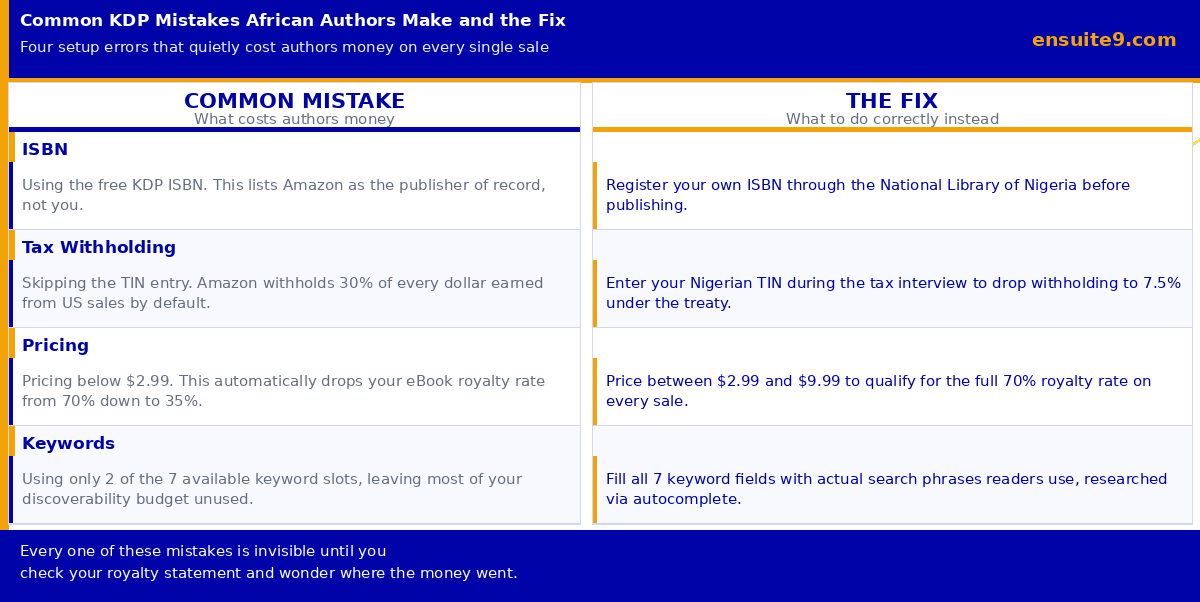
- Using the free KDP ISBN instead of registering their own, which lists Amazon as the publisher
- Not completing the tax interview correctly, resulting in unnecessary 30% withholding
- Setting prices too low, since pricing below $2.99 drops the royalty rate from 70% to 35%
- Using only 2 of the 7 keyword slots
- Writing a book description that summarises the book instead of selling it
- Selecting broad categories instead of specific ones
- Uploading a KDP-formatted file to IngramSpark, where the specifications are different
- Mismatched names between Payoneer and KDP accounts, delaying or blocking payouts
- Publishing without a professional cover, underestimating how heavily thumbnail appearance affects clicks
Frequently Asked Questions
Do I need a US bank account to publish on Amazon KDP from Nigeria? No. Payoneer provides a US virtual account number that KDP accepts for royalty payments, removing the need for an actual US bank account.
How long does KDP take to approve a book? Most eBooks are reviewed and approved within 72 hours of submission. Print books can take slightly longer due to additional file checks for print specifications.
Can I update my book after it is published? Yes. You can update your manuscript, cover, price, and metadata at any time after publication. Updates typically go live within a few hours to a few days depending on the type of change.
What happens if I do not enter my Nigerian TIN? Amazon will withhold 30% of your US royalties by default instead of the treaty rate of 7.5%. You can add your TIN at any point, but the reduced rate only applies going forward, not retroactively.
Should I publish in KDP Select or go wide immediately? For most African authors publishing professional non-fiction, going wide from the start is the better strategy, since your audience is more likely to purchase books directly than to read through a Kindle Unlimited subscription.
Why does my Payoneer payment keep getting delayed? The most common cause is a mismatch between the name on your Payoneer account and the name on your KDP account. Make sure both are formatted identically, including middle names and spelling, and contact Payoneer support if a payout has already been held up.
Can I sell my book directly in Nigeria as well as through Amazon? Yes. Many African authors publish on Amazon KDP for global reach while also selling directly to Nigerian readers through platforms that accept local payment methods. These are not mutually exclusive and most successful African authors use both.
Is it worth registering my own ISBN instead of using the free KDP one? Yes, particularly if you intend to distribute your print book beyond Amazon through platforms like IngramSpark. The free KDP ISBN ties your book to Amazon as the listed publisher and limits your flexibility to distribute elsewhere under the same identifier.
If you want a professional team to handle your KDP setup correctly, including tax interview guidance, metadata optimisation, and category strategy, book a free discovery call with Ensuite 9. We manage the full process and ensure your book is set up to be found.