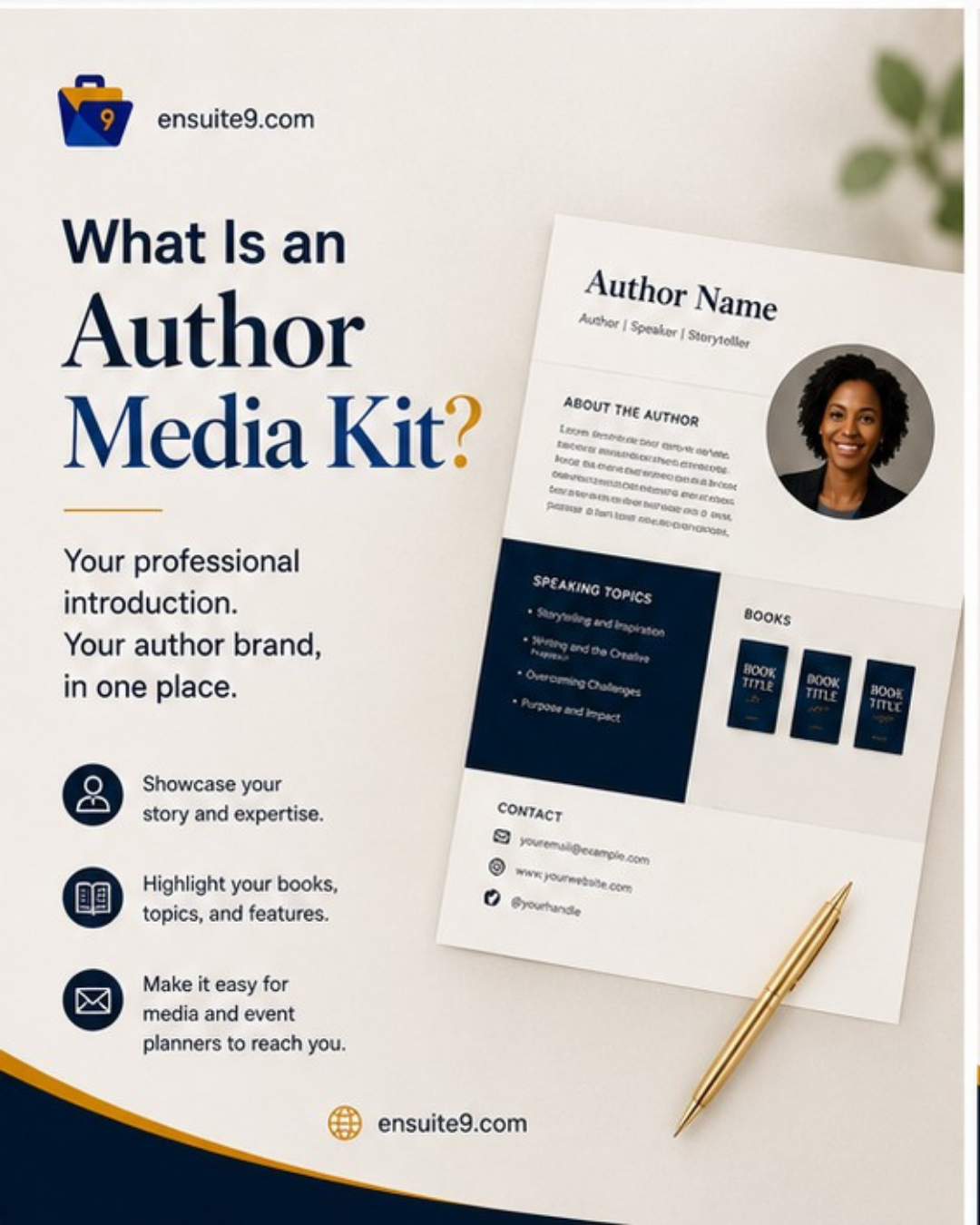
An author media kit is a collection of materials that gives journalists, podcast hosts, event organisers, book bloggers and potential collaborators everything they need to feature you, without having to follow up and ask for more information. It is, in the clearest terms, a document that makes your job of getting publicity significantly easier and everyone else’s job of featuring you as straightforward as possible.
The reason media kits matter is simple. Every time a journalist, podcast producer, or event organiser considers featuring you, they ask the same question: is there enough here to work with? Without a media kit, the answer is usually no. Not because you are not worthy of coverage, but because you have made their job harder than it needs to be. Journalists work fast. They gravitate toward the author who makes it effortless to write about them.
This guide covers what an author media kit is, what the seven essential elements are, how to build one from a standing start with no existing coverage, what format it should take in 2026, and what African authors and coaches specifically need to consider when building theirs.
What an Author Media Kit Actually Is
A media kit is a concise collection of materials that you share with journalists, bloggers, event organizers, and other media outlets to make it easier for them to write about your work or invite you for interviews. It is also called a press kit, and the two terms refer to the same thing.
Think of it as your writing resume combined with a ready-to-use feature package. A journalist writing a piece about your topic can pull your bio directly from the kit, lift a quote, use your headshot, and have a complete story without interviewing you at length or chasing down additional materials. A podcast host can read your bio on air, use your suggested questions as the backbone of the interview, and publish your headshot alongside the episode without any back-and-forth. An event organiser can pull your speaker bio, your photo, and your talk topics directly into the event programme without a single additional email.
This is the commercial value of a media kit. It does not get you coverage by itself. But it removes the friction that was standing between your pitch and a yes.
Who Needs an Author Media Kit
Any author who intends to seek media coverage, podcast appearances, speaking invitations, or bookshop events needs a media kit. This is true regardless of whether you are traditionally published or self-published, whether you have significant existing coverage or none at all, and whether you are based in Nigeria, the UK, the US, or anywhere else.
Even if you are a new or self-published author, a polished author press kit helps close the gap between “still building” and “serious enough to feature.” The media kit signals professionalism before you have met anyone. It tells a podcast host or journalist that you understand how their industry works and that you have prepared appropriately. This signal alone increases your probability of being featured.
For coaches and consultants who have published a book as an authority asset, a media kit is specifically important because it is the mechanism through which the book creates downstream opportunities. A published book without a media kit is an asset without a distribution channel. A published book with a strong media kit is an asset that generates speaking invitations, podcast bookings, and media features on an ongoing basis. For more on the book as a business asset, see: How to Write and Publish a Book as a Coach or Consultant in 2026.
The Seven Elements of an Author Media Kit
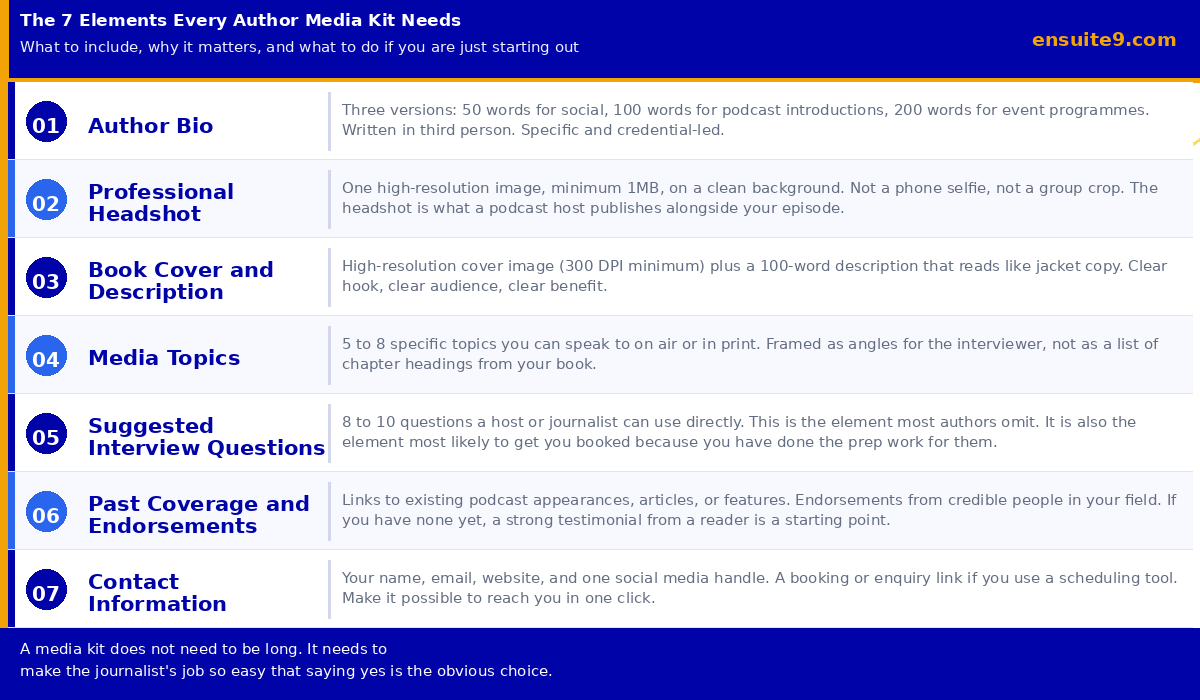
1. Author bio in three lengths. Your bio is the element that will be used most frequently and in the most different contexts. You need three versions: a 50-word version for social media introductions and short listings, a 100-word version for podcast introductions and event promotional material, and a 200-word version for event programmes, speaker listings, and feature articles. All three should be written in the third person, since they will be read out loud by someone introducing you or published as descriptive text about you. Each version should be self-contained, not a truncated version of the longer one. Write the 200-word version first, then distil it progressively.
The most common mistake in author bios is writing a career summary. A bio for a media kit is not a CV. It is a pitch that tells the journalist or host why you are the right person to speak to their audience about your specific topic. Lead with your most relevant credential for the context you are targeting. For a business author targeting business podcasts, the credential is your professional background and the book’s commercial relevance. For a memoir author targeting lifestyle media, the credential is the specific lived experience the book explores.
2. Professional headshot. A high-resolution photograph, minimum 1MB file size, on a clean and uncluttered background. This is not a phone selfie. It is not a group photograph where you have been cropped out. It is a professionally taken or at minimum professionally framed portrait that a magazine, podcast website, or event flyer can publish without editing. A high-quality author headshot makes a bigger difference than many writers expect. It instantly helps you look more polished and gives people something they can easily use if they want to feature you. If budget is a constraint, a camera-phone photograph taken in good natural light against a plain wall, with another person operating the camera, is significantly better than a selfie. Invest in a professional shoot when you can.
3. Book cover and description. A high-resolution cover image at 300 DPI minimum, suitable for print reproduction as well as digital use. Alongside the image, a 100-word book description written in the style of jacket copy rather than a summary. This description should communicate the hook of the book, the intended reader, and the specific value the reader gets from it. A journalist who reads the 100-word description should be able to understand immediately why the book is relevant to their audience. If they have to read it twice to understand what the book is about, the description needs rewriting.
4. Media topics. A list of five to eight specific topics you can speak to in an interview, article, or panel discussion. These should be framed as angles for the journalist or host, not as chapter headings from your book. The difference: “Chapter 3: Building Your Brand” is a chapter heading. “Why most coaches are building their brand on the wrong platform in 2026” is a media angle. The media topics tell a potential host or journalist what story they can tell by featuring you and make the pitch from your book to their audience visible without them having to figure it out themselves.
5. Suggested interview questions. This is the element most authors omit and the element most likely to get you booked. Including a list of suggested interview questions is an extremely beneficial aspect of a press kit. For one, it makes it easier for potential interviewers to say “Yes!” to hosting you since you have taken the initiative to do part of their job for them. Provide eight to ten questions a host or journalist can use directly or adapt as starting points. Write the questions to draw out the most interesting, counterintuitive, or practically useful content from your expertise. The questions should make a host excited to ask them, not feel like they are running through a Q&A with the author’s publicist.
6. Past coverage and endorsements. Links to existing podcast appearances, articles, or features where you have been covered. Endorsements from credible people in your field, with their name and relevant credential. If you have no existing coverage yet, this section is not a blocker. A strong testimonial from a reader or client who can speak specifically to the impact of your work is a legitimate starting point. As you accumulate appearances, add them. The section grows over time. Starting without it is better than not having a media kit at all.
7. Contact information. Your name, professional email address, website URL, and one primary social media handle. If you use a scheduling tool for media enquiries, include a direct booking link. The goal is to make it possible to reach you in a single click from within the media kit itself. Do not make a journalist or host search for your contact details after reading your kit. The last thing in the kit should be an invitation and a path to take action on it.
What Format Your Media Kit Should Take in 2026
There are two formats and most authors should have both.
A dedicated press page on your author website. Most authors should start with a dedicated press page on their author website. It is always current, easy to update, and findable via search. The press page contains all seven elements and is the URL you include in pitch emails. When your follower counts change, when you add a new appearance, or when you publish a new book, you update the page once and every link to it is automatically current. No sending new PDFs every time something changes.
A downloadable PDF version. For pitching podcasts and conferences, some hosts and organisers prefer to have a document they can open, forward internally, and review without navigating to a website. A PDF version of your media kit, well-designed and professionally laid out, serves this purpose. Keep it to two to four pages maximum. The PDF does not need to contain everything on your press page, just the elements most relevant to the specific opportunity you are pitching.
For design, Canva provides professional media kit templates that can be customised without a design background. The design goal is clean, readable, and consistent with your existing brand, not decorative or complex. One of the fastest ways to weaken a good author media kit is to overcomplicate it. If it is cluttered, too long, messy, or hard to skim, people are less likely to use it.
What Happens With and Without a Media Kit
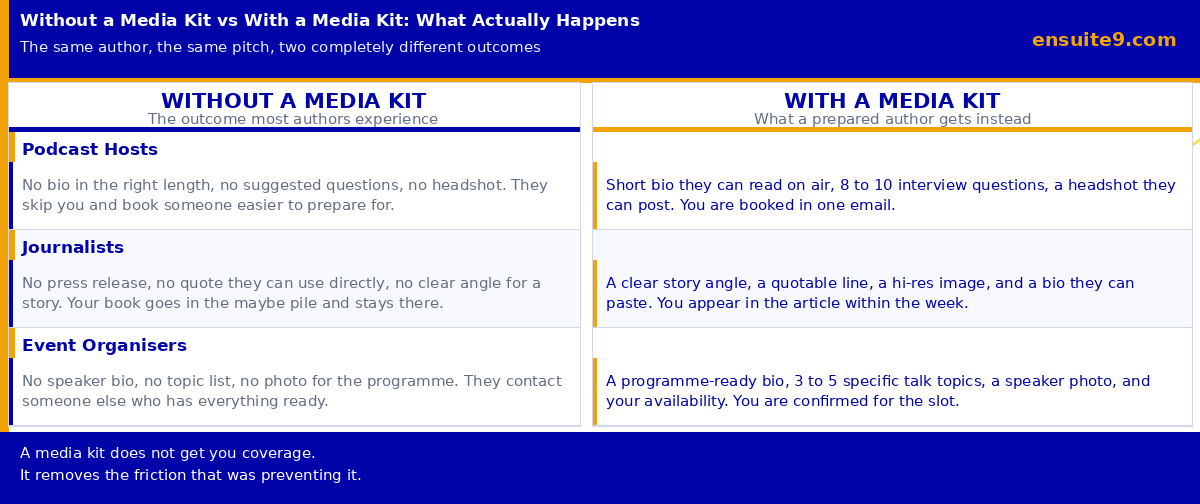
The practical difference between pitching with and without a media kit is not subtle. A podcast host who receives a pitch email with a link to a well-built press page has everything they need to make a decision in under five minutes. A podcast host who receives a pitch email and has to reply asking for a bio, then a headshot, then suggested questions, and then waits for each response, is unlikely to complete the booking even if the initial interest was genuine. The friction kills the momentum.
The same dynamic applies to journalists and event organisers. A journalist writing a feature on a topic your book addresses who can pull a quote, a bio, and a headshot from your press page in one visit is far more likely to include you than one who has to send three emails and wait for responses between each. An event organiser who can pull your speaker bio, your topic list, and your photo directly into the event programme without any additional communication is far more likely to book you than one who has to chase you for the material after the initial yes.
The media kit does not create the opportunity. But it converts the opportunity into an outcome at a dramatically higher rate than the absence of one.
How to Build a Media Kit When You Have No Coverage Yet
The most common reason first-time authors do not build a media kit is that they believe they need existing coverage before they can create one. This is circular reasoning that prevents you from getting the coverage that would populate the kit.
The sections that require existing coverage are past appearances and endorsements. Every other section, which is the majority of the kit, can be built before your first media appearance. Your bio, your headshot, your book cover and description, your media topics, your suggested interview questions, and your contact information can all be created from scratch before anyone has featured you.
For the past coverage section, start with what you have. A strong testimonial from a client or reader who can speak specifically to the impact of your book or your expertise is a legitimate starting point. A guest article on any platform, even a relatively small one, is a coverage link. A local media appearance, a panel discussion, a conference presentation, all of these count as prior coverage and can be linked from your press page.
The first few appearances you generate will come from pitching without existing coverage. Once you have those first appearances, the media kit gets stronger, which makes the next round of pitching more successful, which generates more coverage. The kit compounds over time. But it has to start somewhere, and that start does not require anything you do not already have.
The African Author and Coach Context
For African authors and coaches in the diaspora, a media kit has an additional strategic function beyond the standard pitch use case. It is a credibility signal in markets where you may not have an established reputation and where the default assumption about self-published African authors is that the production quality and professional infrastructure are not at the level of traditionally published authors.
A professionally designed media kit with a strong headshot, a well-written bio, and a clearly positioned book description communicates immediately that you are a professional operating at an international standard. It removes the question of credibility before it is asked. For an African coach seeking speaking opportunities at UK conferences or podcast appearances with US business hosts, the media kit is the instrument through which you establish that credibility in the first interaction.
The media topics section is also specifically important for African authors targeting international media. The angle that makes you most bookable to an international podcast or journalist is often the specific African professional or cultural context you bring to a universal topic, the perspective from inside the African business environment, the diaspora experience, the specific challenges and advantages of building a coaching or consulting practice in Nigeria or from Nigeria. This specificity is a competitive advantage in a market full of generic experts on generic topics. Your media topics should make this angle explicit and frame it as a story worth telling to audiences who have not heard it.
For more on building authority and visibility as an African professional, see: How to Build Authority Online as a Coach or Consultant Without a Large Following and LinkedIn Ghostwriting for Coaches and Consultants.
Frequently Asked Questions
How long should an author media kit be?
A press page on your website can be as long as needed to include all seven elements comfortably. A PDF version should be two to four pages maximum. The goal in both cases is that every piece of information is easy to find and easy to use. Length is not a virtue in a media kit. Clarity is.
Do I need a media kit before my book is published?
Yes. You can begin building your media kit as soon as you have a finalised book cover, a completed author bio, and a clear book description. Many authors prepare their media kit during the final production stage of their book so it is ready at the point of launch. Building it before launch means you can pitch podcast appearances and media coverage to coincide with or precede the publication date, which is when coverage drives the most sales.
Should I send my full media kit with every pitch email?
No. A pitch email should be short, specific, and include a link to your press page rather than attaching the full PDF. The PDF version is most useful when a host or organiser specifically requests a document they can download and share internally. Leading with a link keeps the initial pitch email clean and lets the recipient explore as much or as little as they want.
What is the difference between an author media kit and an author press kit?
They are the same thing. Media kit and press kit are used interchangeably in publishing and communications. Some guides use one term and some use the other. The contents and purpose are identical regardless of what the document is called.
How often should I update my media kit?
Update it whenever something significant changes: a new book, a significant media appearance, a new endorsement from a credible person, or a change in your professional positioning. The press page version should be reviewed every three to six months. The PDF version should be updated before each major pitching campaign so the information is current at the moment of contact.
If you have a book published or in production and want help building your author press page and media kit, book a free 30-minute discovery call with Ensuite 9. We work with African coaches, authors and consultants to build the publishing infrastructure that generates ongoing visibility and opportunity.