The most persistent myth in personal branding for coaches and consultants is that authority is a function of audience size. It is not. Authority is a function of how the right people perceive you, and the right people is a much smaller number than most coaches assume. A consultant with 800 LinkedIn followers, a professionally positioned website, and a published book can generate more inbound enquiries than a coach with 20,000 followers and a vague positioning. The mechanism is different. The outcome (clients) is what matters.
The global coaching industry generated $5.34 billion in 2025 according to the ICF Global Coaching Study conducted by PricewaterhouseCoopers. The number of active coach practitioners worldwide rose 15% to 122,974. More than 44,000 active coaches now operate in North America alone. In this environment, generic positioning like “life coach,” “business coach,” “executive coach” is invisible. The coaches and consultants who are consistently attracting the right clients in 2026 are those who have built specific, recognisable authority in a defined niche. So the question is really not whether you need authority. The question is how you build it when you do not yet have a large platform to build from.
This article answers that question specifically. It covers what online authority actually is, the four infrastructure pillars that create it regardless of audience size, why the authority strategy is fundamentally different from the content strategy that most coaches are pursuing, and the specific assets that build compounding authority for African coaches and consultants in 2026.
What Online Authority Actually Is, And What It Is Not
Online authority is the perception that you are the credible, competent, specific expert for a specific problem. It is not the perception that you are popular. Popularity is built through volume and reach, how many people see you. Authority is built through depth and specificity, how clearly the right people understand what you do, why you are the person to do it, and what it is like to work with you.
These are not the same thing and they are not built the same way. A coach with 50,000 Instagram followers who posts motivational content about mindset and success has popularity. A coach with 800 LinkedIn followers who consistently writes about the specific financial pressures facing mid-career professionals transitioning from corporate employment to independent consulting, with a book, a website that ranks for relevant search terms, and testimonials from four clients who have made exactly that transition, that coach has authority in a defined market. When a professional in that specific situation is looking for a coach, the second person is found. The first is not relevant to them regardless of how many people follow their account.
The 2025 ICF study found that 73% of coaching clients and organisations now expect their coach to hold a credential. But when nearly everyone is certified, the credential becomes a baseline, not an advantage. What differentiates one certified coach from another is the specificity of their positioning, the depth of their visible expertise, and the quality of the evidence that their approach works for people like the potential client. These are authority signals, not popularity signals.
You Do Not Need a Big Audience to Get Your First Clients, But You Do Need Authority to Scale
One of the most useful clarifications in the current coaching market comes from Coach Guido’s 2026 analysis of 500+ coach launches: the first 10 clients come almost exclusively from direct outreach — LinkedIn DMs, cold email, and networking. Organic content becomes a scaling lever beyond 30 to 50 clients served, never at the launch stage.
This means two things. First: if you are a new coach or consultant trying to get your first clients, you do not need to build a large audience first. Direct, personal outreach to people who match your ideal client profile is significantly more efficient than waiting for organic content to build an audience that eventually converts. You can sign your first 10 clients with 200 connections and a clear, specific offer.
Second: once you are working with 30 to 50 clients and want to scale beyond what direct outreach can fill, you need an authority infrastructure that generates inbound demand without you actively hunting for every client. This is the transition from hustle to leverage, and it is made by building the infrastructure assets that this article covers, not by simply posting more content.
The mistake most coaches make is either waiting until they feel “ready” to build authority assets before doing any outreach (wrong; start with outreach immediately), or continuing with direct outreach indefinitely without building the infrastructure that makes inbound possible (also wrong; at some point the outreach ceiling is hit and you need authority to scale). Both phases are necessary. Understanding which phase you are in determines what to focus on.
The Four Pillars of Online Authority
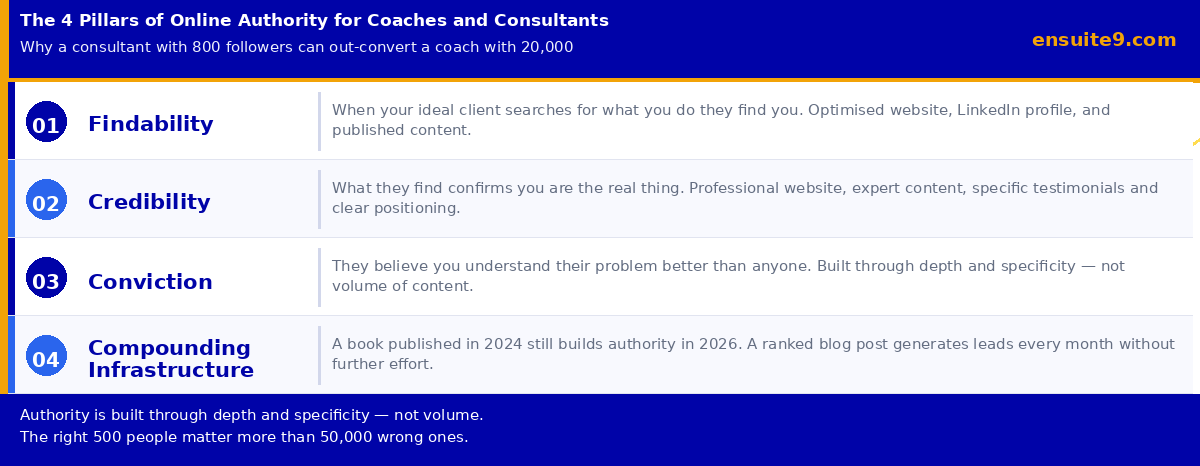
Authority without a large audience is built on four pillars. All four need to be in place for the authority to be genuinely functional, meaning that it generates the right inbound enquiries without you actively driving every single one.
Pillar 1: Findability. When your ideal client looks for what you do, through Google search, LinkedIn search, or increasingly through AI tools like ChatGPT and Perplexity, they find you. Findability requires that your name and expertise appear in the contexts where your ideal clients are actively looking. This means your website ranks for the search terms your ideal clients are actually using, your LinkedIn profile is optimised for the searches your target market makes, and your name appears in publications, podcasts, and communities where your ideal clients look for solutions.
On the AI discoverability point: according to Wynter’s 2026 B2B Buyer Research, 84% of B2B buyers now use AI tools for vendor discovery. When a potential client asks ChatGPT or Perplexity to recommend a coach for their specific situation, the AI synthesises everything it has indexed about available coaches. Coaches with a consistent, specific, well-documented presence across multiple content touchpoints get cited and recommended. Coaches with scattered or generic content do not appear in these recommendations regardless of their follower count. For African coaches specifically targeting international clients, this dynamic makes content quality and consistency more commercially important than it has ever been.
Pillar 2: Credibility. When your ideal client finds you, what they see confirms that you are the real thing. Credibility is built through professional presentation (your website looks and functions like a professional practice, not a side project), content quality (your written or recorded content demonstrates genuine expertise, not just enthusiasm), social proof quality (your testimonials describe specific outcomes in real terms, not generic praise), and positioning clarity (it is immediately obvious from everything on your digital presence who you serve, what you do for them, and why you are the right person to do it).
Credibility does not require a large audience. A website with five specific, outcome-focused testimonials from real clients is more credible than a website with 50,000 followers and no client evidence. A blog with 20 deeply expert articles on a specific topic is more credible than an Instagram account with 5,000 followers and daily motivational posts. Quality of evidence consistently outperforms volume of followers in converting a specific ideal client.
Pillar 3: Conviction. When your ideal client has read enough to be interested, they believe you understand their problem better than anyone else they have encountered. This is the deepest level of authority and the one that most directly determines whether a potential client books a call or keeps searching. Conviction is built through the specificity and accuracy of your content — the degree to which what you write or say demonstrates that you have sat inside the exact problem your ideal client is experiencing and understand its specific texture, not just its general category.
This is why content strategy alone does not build authority. Posting consistently on a broad topic builds familiarity. Writing one deeply specific, accurate, empathetic piece about the precise situation your ideal client is in builds conviction. One produces followers. The other produces clients.
Pillar 4: Compounding Infrastructure. The fourth pillar is what distinguishes an authority strategy from a content strategy — the assets you build compound in value over time without continuous input. A book published in 2024 is still building authority in 2026. A blog post that ranks on Google for a relevant search term generates inbound enquiries every month without further effort. A LinkedIn profile optimised for specific searches continues to appear in those searches whether or not you posted that week. A guest article in a respected industry publication reaches its audience indefinitely after publication.
Social media content, by contrast, has an extremely short half-life. A LinkedIn post reaches its audience within 24 to 72 hours and then essentially disappears. You cannot point a potential client to a LinkedIn post from three months ago and expect it to be findable or legible in their feed. Infrastructure assets like a website, book, ranked content, published articles, do not expire. They accumulate.
Authority Strategy vs Content Strategy; The Critical Distinction
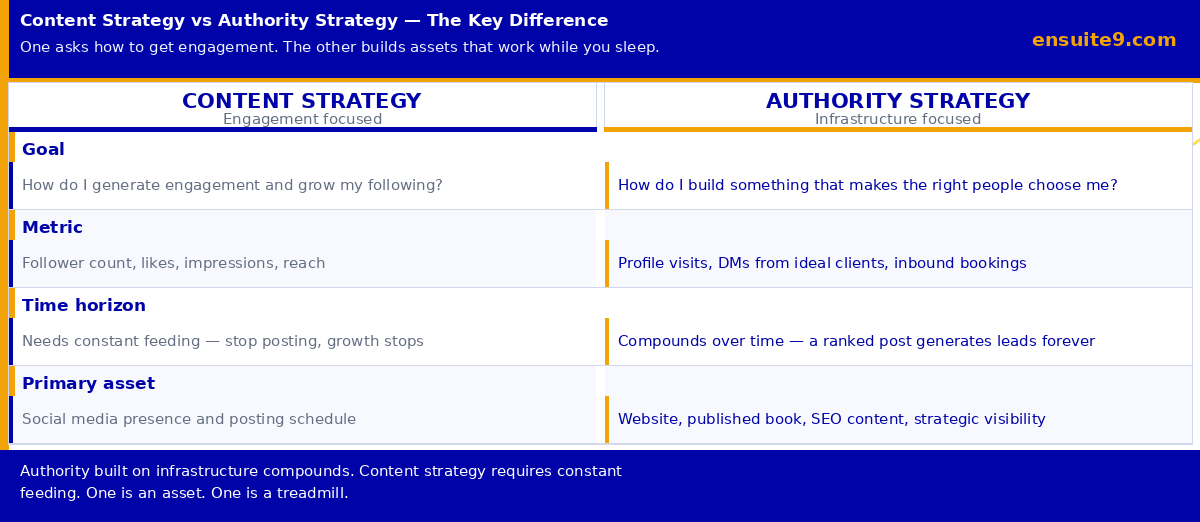
Most coaches and consultants pursuing online visibility are running a content strategy. They are producing regular content (posts, videos, newsletters) and measuring success by engagement metrics: followers, likes, comments, impressions, reach. This is not wrong. Consistent, high-quality content is a component of authority. But it is not the same as an authority strategy and it does not produce the same outcomes.
A content strategy asks: how do I generate engagement and grow my following? It optimises for reach and response. An authority strategy asks: how do I build something that makes the right people choose me, whether or not I posted this week? It optimises for compounding assets.
The practical distinction: a coach who stops posting on LinkedIn for a month loses essentially all the momentum they have built on the platform. A coach who stops posting for a month but has a website that ranks in search, a published book on Amazon, and a guest article in an industry publication continues to generate authority signals and occasionally inbound enquiries during that month of silence. The second coach has built infrastructure. The first has built a treadmill.
Both are valuable. LinkedIn content builds relationships and demonstrates ongoing relevance. Infrastructure builds findability and conviction that compounds over time. The coaches and consultants generating genuinely consistent inbound in 2026 are running both simultaneously, not choosing one at the expense of the other.
The Specific Infrastructure Assets That Build Authority Without a Large Audience
A professionally built, conversion-optimised website. Not a brochure, a system designed to move a visitor from awareness to enquiry. Specific headline that passes the three-second test, visitor-oriented copy, specific social proof placed correctly, and a frictionless booking mechanism. A potential client who lands on a well-built website knows within 30 seconds whether you are the right person for their problem. For more on what this looks like in practice, see: How to Build a Website That Converts, Not Just One That Exists.
A published book. A book does something that no social media presence can replicate at the same speed; it forces you to articulate your methodology completely, signals a level of commitment and expertise that social media content cannot signal, and positions you as the author of your intellectual framework. A client who has read your book arrives at a discovery call already convinced of your expertise. This dynamic is available to any author regardless of their following size at the time of publication. The book is the authority signal, not the follower count that exists when it is published. For a complete guide, see: How to Write and Publish a Book as a Coach or Consultant in 2026.
Consistent content in a defined lane. Not ten topics across multiple platforms, but one to three topics published consistently on one or two platforms. The coaches and consultants who build authority fastest are the ones whose audience always knows what they are going to get, specific expertise on a specific problem, consistently expressed. Content in a defined lane also gives Google and AI tools a clear signal about your specific expertise, which directly affects search and AI discoverability.
Strategic visibility in specific contexts. Guest articles in publications your ideal clients read, podcast appearances on shows they listen to, speaking slots at events they attend, and contributions to communities where they gather. One well-placed guest article in a respected industry publication reaches more of the right people than 100 posts on a general LinkedIn feed. Strategic visibility is about being found in the specific contexts where your ideal clients are looking, not about being visible to the largest possible general audience.
An email list. A list of people who have actively opted in to hear from you is the only audience asset you own outright. LinkedIn can change its algorithm, Instagram can throttle reach, platforms can shut down; your email list is yours regardless. For coaches and consultants, an email list of 500 engaged subscribers who match the ideal client profile is more commercially valuable than 10,000 social media followers who have never actively chosen to engage with you. Building your list from the beginning, through a lead magnet on your website, through content upgrades in your blog posts, is infrastructure building, not content creation.
The African Coach and Consultant Advantage: Why Now Is the Right Time
African coaches and consultants building authority in 2026 occupy a market position that is genuinely advantageous and significantly underexploited. There are 122,974 active coaches globally but relatively few African professionals who have built the kind of consistent, professionally presented, infrastructure-backed online presence that positions them for international visibility.
The global coaching industry is growing at 8.53% compound annually and is projected to reach $5.8 billion by the end of 2026. The online coaching market is projected to reach $11.7 billion by 2032. African professionals who establish their authority infrastructure now — website, published content, book, strategic visibility — are building assets that will compound in value as the market grows and as international buyers increasingly use AI tools that will surface consistently positioned experts.
Niche specialisation has also shifted from optional to essential in this market. The 2026 coaching market research shows that specificity directly affects pricing, average coaching rates jump from $244 per session for generalists to $350 to $700 per session for specialists with a defined niche. An African coach who positions themselves as the expert in a specific, well-defined problem for a specific, well-defined audience is not competing with 122,974 coaches globally. They are competing with the handful of coaches who serve their specific niche, a dramatically more winnable competition.
For context on how the African professional market is evolving and what the broader opportunity looks like, see: The State of African Publishing in 2026 and the authority building resources on ensuite9.com.
Where to Start: A Practical Sequence
The question most coaches ask at this point is “where do I start?” The answer depends on which phase you are in.
If you have fewer than 10 clients: Do not prioritise content or authority infrastructure yet. Start with direct outreach: LinkedIn DMs, referral asks from existing contacts, cold email to specific people who match your ideal client profile. Your first 10 clients will come from personal relationship building, not from content discoverability. Use that time to validate your offer and collect the testimonials that will become your first credibility assets.
If you have 10 to 30 clients and want to scale: Begin building the authority infrastructure in this order: first, a professionally built website with specific positioning, social proof, and a booking mechanism. Second, a brand voice document and consistent content on one platform (LinkedIn for most coaches and consultants). Third, an email list started through a lead magnet. Fourth, a book project initiated — even if the book is 12 months away from completion, starting it now means it is published before you hit the capacity ceiling of direct outreach.
If you have 30 to 50+ clients and are hitting a ceiling: Focus on the compounding assets: the book, the ranked website content, the guest visibility in specific publications and podcasts. These are the assets that generate demand while you are serving existing clients, and they are what breaks the dependence on continuous outreach.
Frequently Asked Questions
Do I need a large social media following to get clients as a coach or consultant?
No, particularly not in the early stages. Research from 500+ coach launches shows that the first 10 clients come almost exclusively from direct outreach. A large social media following becomes a scaling lever beyond 30 to 50 clients served, not a prerequisite for starting. What matters more than follower count is the specificity of your positioning, the quality of your visible expertise, and the evidence that your approach works.
How long does it take to build genuine online authority?
Authority infrastructure takes 6 to 18 months to produce consistent inbound results. A website takes weeks to build but months to rank. A book takes months to write and publish but generates authority indefinitely after publication. LinkedIn consistency typically produces measurable inbound results between months four and six. The timeline is longer than content strategy, but the compounding effect means authority assets are still generating results years after they were created, whereas social media content disappears within days of posting.
Is a book really necessary for authority?
Not necessary, but nothing else does what a book does. A published book is the fastest single authority signal available to a coach or consultant because it signals a level of developed thinking and commitment that social media content cannot replicate. Clients who have read your book arrive at discovery calls already convinced. Speaking bureaus, media, and conference organisers treat published authors differently from unpublished coaches regardless of their social media presence. If writing a book is the bottleneck, ghostwriting is a legitimate solution. For more, see: How to Hire a Ghostwriter.
How do I build authority if I am just starting out and have no testimonials yet?
Start with content authority, publish specific, expert content that demonstrates your thinking on your ideal client’s problem. Offer your services to two to three initial clients at a reduced rate or pro bono in exchange for detailed, outcome-specific testimonials. The testimonials from those initial engagements become your first credibility assets and they compound from there. The sequence is: content demonstrates expertise → initial clients engaged → testimonials collected → credibility established → inbound begins.
Ensuite 9 builds the infrastructure that creates compounding authority for coaches, consultants, and founders: websites, published books, and ghostwritten content that positions you correctly before your ideal clients find you. To discuss what an authority infrastructure looks like for your specific situation, book a free 30-minute discovery call.