A ghostwriter is a professional writer hired to produce content that is published under someone else’s name. The ghostwriter writes, and the client is credited as the author. The arrangement is legal, contractual, and has been standard practice in publishing, speechwriting, business, and professional communication for over a century.
More than 75% of non-fiction works, including business books, memoirs, and biographies, are written in collaboration with a professional writer. The books you read by CEOs, coaches, and public figures are, in the majority of cases, not written solely by the person whose name appears on the cover. The speeches given by senior politicians are written by speechwriters. The articles published by industry executives in business publications are frequently produced by professional writers working from the executive’s ideas and perspective.
This is not a secret, and it is not a scandal. It is a professional service with a long, mainstream history. What has changed in 2026 is the introduction of AI into this conversation, specifically the question of whether AI tools can perform the same function as a human ghostwriter and what the legal implications are for authors who use them. The answer to both questions matters significantly for coaches, consultants, and authors who are considering ghostwriting as a path to published content.
What a Ghostwriter Actually Does
A ghostwriter’s core skill is voice matching, that is the ability to capture how another person thinks, speaks, and writes, and render that in polished prose that reads as authentically theirs. A good ghostwriter does not impose their own style on the client’s material. They disappear into the client’s voice, producing content that is indistinguishable from what the client would have written themselves if writing were their primary skill and their full-time focus.
The process for a book engagement typically works like this: the ghostwriter conducts a series of recorded interviews with the client, that is conversations structured to draw out the client’s ideas, stories, frameworks, opinions, and experiences. These recordings form the raw material. The ghostwriter then structures, writes, and refines a manuscript from that material, returning drafts to the client for review, adjustment, and approval. The result is a book that is entirely the client’s thinking, perspectives, and stories, professionally written.
According to Dan Gerstein, CEO of Gotham Ghostwriters, the core work of ghostwriting is something AI is fundamentally poorly suited for: “A technology that relies on human prompts cannot come up with concepts and book hooks that are original to the author’s unique ideas and life experience. It cannot extract insights and stories that exist only in the author’s head. And perhaps most notably, it cannot win the author’s trust, break down their walls, and get them to be vulnerable and go deep in a way they would never do on their own.”

What Types of Content Ghostwriters Produce
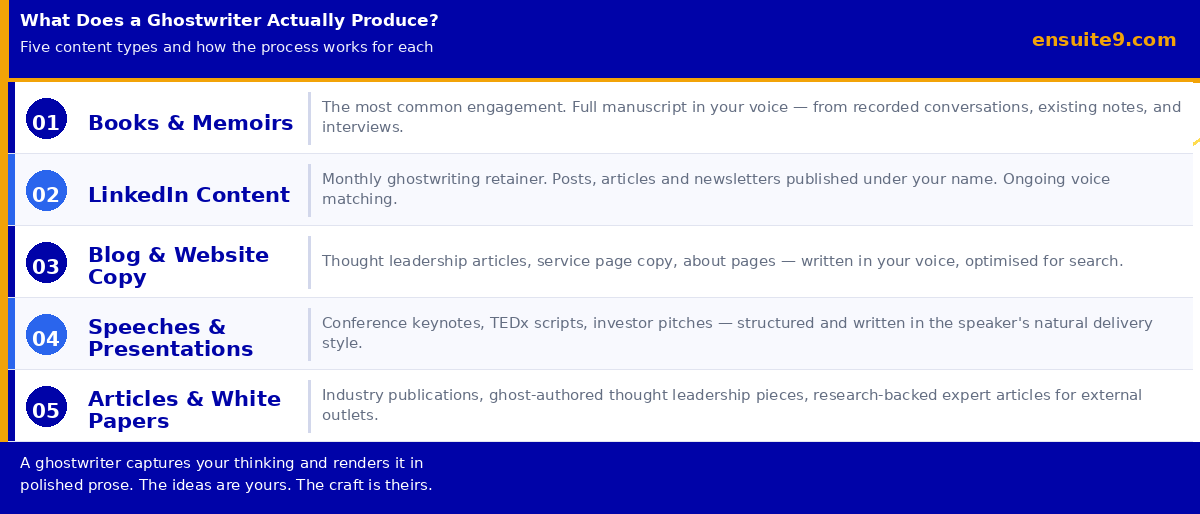
Books and memoirs remain the most common ghostwriting engagement. A coach, consultant, or executive has the expertise and the stories; the ghostwriter produces the manuscript. Rates for professionally ghostwritten books range from $5,000 at the entry level to $200,000 or more for top-tier ghostwriters with bestseller credentials. The 2026 market rate for a quality ghostwritten business book is typically $25,000 to $95,000, according to data from Reedsy's platform of completed projects. For a full guide to the book publishing process after the manuscript is complete, see: How to Write and Publish a Book as a Coach or Consultant in 2026.
LinkedIn content has become one of the fastest-growing ghostwriting niches. Coaches, consultants, and executives hire ghostwriters on a monthly retainer to produce posts, articles, and newsletters published under their name. Rates range from $250 per month at the entry level to $10,000 per month for experienced ghostwriters serving senior executives. The engagement typically begins with a voice discovery session and produces three to five posts per week consistently. For a full guide to this specific service, see: LinkedIn Ghostwriting for Coaches and Consultants.
Blog posts, articles, and website copy are produced by ghostwriters for clients who want a consistent online content presence without the time investment that writing requires. The ghostwriter produces content in the client's voice, aligned to their brand positioning, and optimised for search and readability. For more on how brand voice affects all content production, see: What Is a Brand Voice and Why Every Business Needs One.
Speeches and presentations like conference keynotes, TEDx scripts, investor pitches, award acceptance speeches are ghostwritten to the speaker's natural delivery style and calibrated to the specific audience and context. A speechwriter producing a conference keynote typically works from detailed briefing conversations, a clear understanding of the audience's expectations, and the speaker's existing public record.
Articles, white papers, and thought leadership pieces for external publications are frequently ghostwritten. When a senior executive publishes an opinion piece in a business publication, the piece is typically produced by a professional writer working from the executive's stated position, supporting evidence, and key messages. The executive reviews, refines, and approves before publication.
Is Ghostwriting Ethical?
Yes. Ghostwriting is ethical. The concern most people raise is that it involves publishing something under a name other than the writer's and that there is a deception involved. The response to this concern is that ghostwriting is an arrangement in which the client's genuine expertise, ideas, experience, and perspective are the substance of the work. The ghostwriter provides the craft of writing, not the intellectual content. A ghostwritten book about your methodology and experience is genuinely yours in the way that matters — the thinking, the knowledge, and the perspective are yours. The professional assistance is in rendering those things into polished prose.
The legal framework supports this: ghostwriting is a contractual arrangement in which copyright is transferred to the client upon payment. The client owns the work completely and unconditionally. There is no deception in law, and there is no deception in the long-standing professional practice that governs publishing, communications, and professional writing across industries globally.
The context in which ghostwriting raises genuine ethical questions is academic work, where the submission is intended to demonstrate the student's own learning and capability, and ghostwriting defeats the purpose of the assessment. Outside of academic contexts, the ethical case against professional ghostwriting is weak and is not supported by the mainstream publishing, communications, or professional writing industries.
The AI Ghostwriting Problem: What Changed in 2025-2026
The introduction of AI writing tools has created a new category of question in ghostwriting: whether AI tools can perform the ghostwriter's function, and what the implications are for authors who use them. The 2025-2026 industry data gives clear answers on both points.
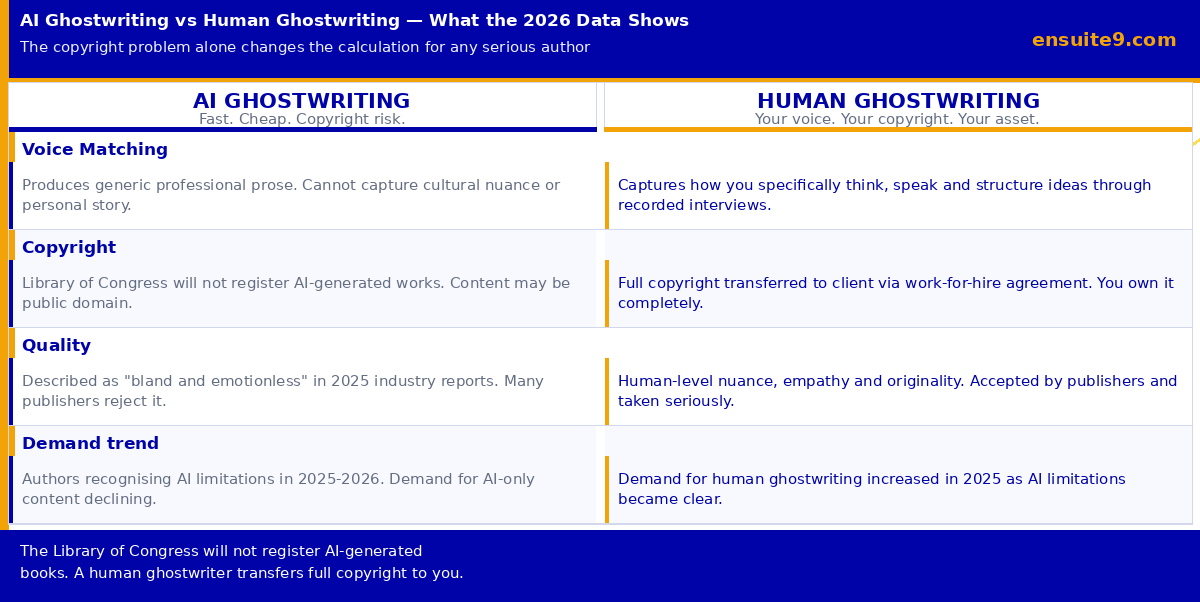
The copyright problem. The most significant practical issue with AI-generated content for authors in 2026 is copyright. The Library of Congress will not register AI-generated works, meaning content produced primarily by AI may effectively be in the public domain. A coach who publishes a book produced primarily by AI may not own it in any legally enforceable sense. A human ghostwriter, by contrast, transfers full copyright to the client through a work-for-hire agreement; the client's ownership is complete and legally clear. For any author who intends to use their book as a business asset, a speaking credential, or a long-term IP asset, this distinction is commercially significant.
The quality reality. According to the Association of Ghostwriters' 2025 Industry Report, the difference in quality between human-generated and AI-generated writing became significantly clearer in 2025. AI-generated content was widely described in the industry as "bland and emotionless." Many publishers now flat-out reject AI-generated manuscripts. The LinkedIn algorithm has begun deprioritising content identified as AI-generated, with agencies using AI for first drafts seeing 40 to 50% lower engagement rates on client content.
How professional ghostwriters use AI. The distinction between AI as a ghostwriting tool and AI as a ghostwriting replacement is important. According to a 2025 study by Josh Bernoff and Gotham Ghostwriters, 61% of writers use AI for support tasks like research, brainstorming, generating title options, and structural suggestions. Only 7% use AI to generate final content. Professional ghostwriters who use AI as a support tool are using it the same way a journalist uses a search engine, to assist the human work, not to replace it. Ghostwriters who are using AI to generate the content they deliver to clients without disclosing this are acting unethically, and the copyright implications affect their clients directly.
The demand picture. Despite predictions that AI would replace ghostwriters, demand for human ghostwriting increased in 2025 as authors recognised AI's limitations. The Association of Ghostwriters noted that the market dip experienced in 2024, when many potential clients experimented with AI tools themselves, reversed in 2025 as those clients discovered that AI could not capture their voice, could not extract their unique stories and insights, and produced content that did not represent them well. The ghostwriting market is projected to reach $2.23 billion by 2031.
How to Tell If a Ghostwriting Service Is Using AI
As the ghostwriting market has grown, a significant number of services have entered offering what they describe as ghostwriting while using AI tools to generate most or all of the content. The practical difference between human-first ghostwriting and AI-heavy ghostwriting is significant in voice authenticity, quality, and copyright implications, and it is worth knowing how to identify which type of service you are engaging before you pay.
Ask directly: "Does a human writer produce the first draft of my content, or does AI?" A confident, human-first service answers this directly. An AI-heavy service tends to respond with vague language about "AI-assisted" or "AI-supported" processes that does not clarify who or what is doing the primary writing.
Ask about the voice discovery process: "What does your voice discovery process involve?" A human-first service describes a recorded conversation, an actual interview conducted by a human writer specifically to capture how you think and speak. An AI-heavy service describes a questionnaire or a request to share existing content that the AI will "analyse."
Ask for a contract that specifies AI use: "Can the contract specify the extent to which AI tools may be used to generate content?" A professional service either has clear policies on this or will negotiate clear terms. A service that resists specifying AI use in the contract is likely using AI more heavily than they are disclosing.
Ask about copyright: "Can you confirm that the copyright transfer in your contract covers work produced using AI tools?" This question reveals whether the service has thought through the copyright implications of their production process. Given that the Library of Congress will not register AI-generated works, any ghostwriting service that cannot answer this question clearly represents a copyright risk for the client.
For a complete guide on what to look for and what to ask when engaging a ghostwriter, see: How to Hire a Ghostwriter: What to Look For, What to Avoid, and What to Ask.
Ghostwriting for African Coaches, Consultants, and Authors
For African professionals, whether based in Nigeria or in the diaspora, ghostwriting addresses a specific set of challenges that are particularly serious in this market.
The time constraint is the most common. A coach or consultant with an active practice, family, and professional obligations who knows they need a book, a consistent LinkedIn presence, or a stronger content output but cannot find the hours to produce, is the core market for professional ghostwriting. The ideas, the expertise, and the authority to write are all present. The bottleneck is the act of writing itself, which ghostwriting removes.
The cultural specificity advantage is less commonly discussed but commercially significant. An African professional's unique context, that is the specific experience of building a practice or a business in Nigeria, the dual-audience challenge of speaking to both local and international readers, and the cultural references and professional formation that are specifically their own, is a genuine differentiator in a crowded market. A good ghostwriter helps the client articulate this specificity clearly and compellingly, rather than flattening it into generic professional content. For more on how this connects to brand voice, see: What Is a Brand Voice and Why Every Business Needs One Before They Post Anything.
The publishing infrastructure question is also specifically relevant. African coaches and consultants who ghostwrite a book need to navigate ISBN registration, publishing platform setup, and distribution — all of which look different from Nigeria and the diaspora than they do from the UK or the US. Ensuite 9 handles all of this as part of complete publishing packages. For more, see: ISBN Registration in Nigeria and How Much Does It Cost to Publish a Book in Nigeria in 2026?
Frequently Asked Questions
Is it legal to hire a ghostwriter?
Yes, completely. Ghostwriting is a standard professional service with a legal framework: a work-for-hire contract that transfers copyright from the writer to the client upon payment. There is nothing legally ambiguous about it. The client owns the work in its entirety once payment is complete.
Do I have to disclose that I used a ghostwriter?
In most contexts, no. Professional ghostwriting operates under confidentiality, i.e., the ghostwriter is not credited and is contractually obligated not to disclose the engagement. Exceptions exist in specific academic contexts where independent authorship is required, and Amazon KDP requires disclosure of AI involvement (though this applies to AI-generated content, not human ghostwriting). Outside of those specific contexts, disclosure is a personal choice, not a legal requirement.
How much does a ghostwriter cost?
For LinkedIn content, monthly retainers typically range from $250 to $1,500 depending on the ghostwriter's experience and output volume. For books, the range is wide: $5,000 at the entry level, $25,000 to $95,000 for quality professional ghostwriting, and $200,000 or more for top-tier writers with bestseller credits. For a full cost breakdown across all content types, see: How Much Does Ghostwriting Cost in 2026?
Will a ghostwriter capture my voice accurately?
A skilled human ghostwriter, through a thorough voice discovery process, can produce content that is indistinguishable from your own writing. The first month of any engagement is typically a calibration period; the ghostwriter produces drafts, you give feedback, and the voice becomes progressively more accurate. By the end of month two, most well-matched ghostwriting relationships produce content that reads exactly like the client.
Can I use AI instead of a ghostwriter?
You can, but with significant limitations and one serious legal risk. AI cannot match your specific voice through the interview process that human ghostwriting relies on, cannot extract the specific stories and insights that exist only in your experience, and produces content widely described as generic and emotionally flat. More importantly, content produced primarily by AI cannot receive copyright protection from the Library of Congress, meaning you may not legally own what you publish. For a serious business or authority asset, human ghostwriting is the appropriate choice.
Ensuite 9 provides human-first ghostwriting for books, LinkedIn content, and thought leadership articles; all engagements begin with a recorded voice discovery session and operate under a signed NDA with full IP transfer. Book a free 30-minute discovery call here to discuss your project.