Brand voice is one of those terms that circulates constantly in marketing conversations and gets defined almost never. Most businesses know they should have one. Most cannot describe what theirs actually is. And most produce content that sounds inconsistent, generic, or like it was written by a different person for every platform, because, in many cases, it was.
This post explains what brand voice actually is, why it matters more in 2026 than it did even two years ago, what the research says about its commercial impact, and how to define yours in five practical steps that work whether you are a solo coach, a growing consultancy, or a small agency.
There is also a dimension of brand voice that almost nobody is talking about yet — one that has significant implications for every coach and consultant trying to build visibility in 2026. We cover that too.
What Brand Voice Actually Is
Brand voice is the consistent personality, tone, and style expressed across everything your business writes. It is not your logo, your colour palette, or your tagline, those are brand identity elements. Brand voice is the character that comes through in the words you choose, the sentences you construct, the positions you take, and the way you address your audience.
A practical test: if you printed out ten pieces of content from your business, blog posts, social media posts, emails, your website copy, and removed every logo and name, would a reader be able to tell they all came from the same organisation? If yes, you have a strong brand voice. If not, you do not have one yet.
Brand voice answers questions like: Does this business speak formally or conversationally? Does it use technical language or plain language? Does it make bold claims or carefully qualified ones? Does it show vulnerability or project confidence? Does it use humour, and if so, what kind? Does it reference specific cultural contexts, and whose? Is the writing dense or economical? Long-form or direct?
These are not aesthetic preferences. They are strategic decisions that determine whether your ideal client recognises your content as theirs, trusts it as credible, and returns to it as a reliable source — or scrolls past it as one more piece of noise in an already overcrowded feed.
Brand Voice vs Tone of Voice: The Distinction That Matters
These two terms are often used interchangeably, and the confusion leads to poorly built voice guidelines. They refer to different things and understanding the distinction makes the practical work of defining and applying your voice significantly clearer.
Brand voice is constant. It is the underlying character of your brand that does not change based on context or platform. Think of it as your brand’s personality — who it fundamentally is, what it believes, how it engages with the world. A person’s personality is stable whether they are in a boardroom or at dinner with friends. Your brand voice should be equally stable whether you are writing a blog post, an email sequence, or an Instagram caption.
Tone of voice is situational. It is how your brand voice adapts to different contexts without changing its fundamental character. A business with a direct, confident brand voice might be warmer and more encouraging in an email to a new client and sharper and more challenging in a thought leadership article — but both pieces still sound like the same brand, the same underlying personality, just adapted for the relationship and the context.
Confusing these two leads to the most common brand voice mistake: a business that has documented a tone for social media but has no consistent underlying voice, resulting in content that feels different across every channel even though the tone on each individual channel is internally consistent.
Why Brand Voice Matters: The Commercial Case
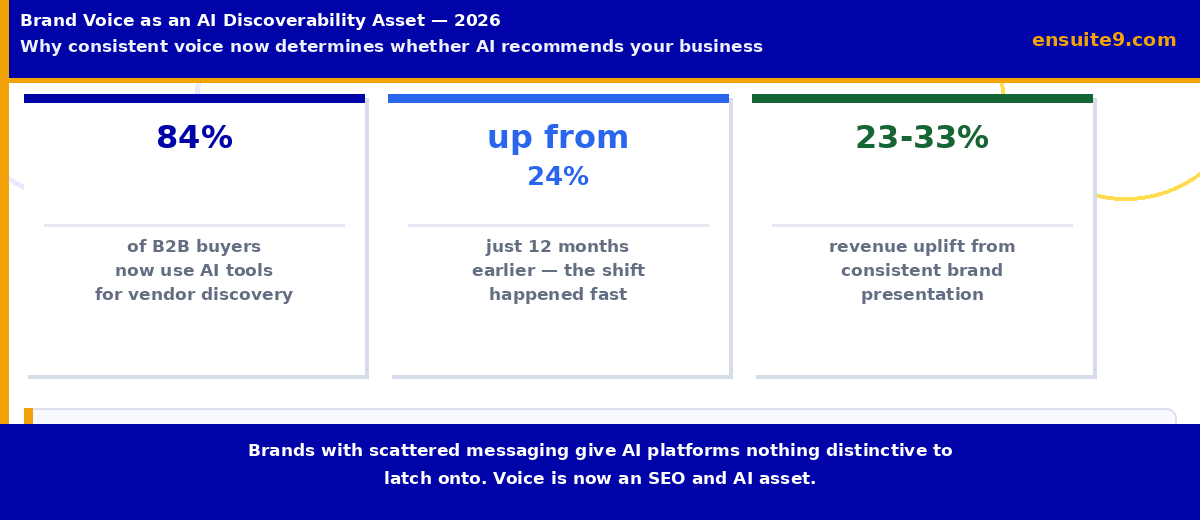
Brand voice is not a creative nicety. It is a commercial asset with measurable impact. The 2026 Gitnux Brand Consistency Report found that consistent brand presentation across channels increases revenue by 23 to 33%. That is not a marginal improvement — it is a structural commercial advantage that compounds over time as your audience becomes more familiar with and confident in how you communicate.
The mechanism is straightforward. Consistency builds familiarity. Familiarity builds trust. Trust accelerates purchase decisions. A potential client who has encountered your content across three different platforms and found it consistently recognisable, consistently high-quality, and consistently relevant to their situation is significantly further along the trust journey than one who encountered three pieces of content that seemed to come from three different organisations. The first client needs far less convincing when they eventually book a call. The second may never book one at all.
According to the 2026 brand voice study by Envive, 60% of marketing materials fail to conform to brand guidelines even when those guidelines exist, and 81% of companies struggle with off-brand content. The problem is not lack of awareness — most businesses know they should be consistent. The problem is that most voice guidelines are aspirational documents rather than operational systems. They describe how the brand should sound but do not give writers enough specific, actionable guidance to actually produce content that sounds that way.
For coaches and consultants specifically, the trust dynamic is even more acute. You are selling your own expertise and judgement — often before a client has met you. Your content is the primary mechanism through which a potential client forms a view of whether you understand their situation, whether your thinking is sophisticated, and whether your perspective is one they want access to. A brand voice that is consistent, specific, and authentically yours accelerates this trust-building at every touchpoint. A brand voice that is inconsistent or generic slows it down or eliminates it entirely.
The 2026 Dimension Nobody Is Talking About: Brand Voice as an AI Discoverability Asset
Here is the brand voice consideration that is genuinely new in 2026 and that almost no brand voice guide has addressed yet: your brand voice is now a determinant of whether AI tools recommend you to potential clients.
According to Wynter’s 2026 B2B Buyer Research, 84% of B2B buyers now use AI tools — ChatGPT, Claude, Perplexity, and similar — for vendor discovery. That figure was 24% just twelve months earlier. The shift is structural and accelerating. When a potential client asks an AI tool to recommend a content ghostwriting agency, a web designer in Nigeria, or a coach specialising in leadership development for African founders, the AI synthesises everything it has indexed about available providers and produces a recommendation.
What the AI indexes: blog posts, website copy, case studies, social media presence, third-party mentions, and any other content it can find associated with your business. And here is the critical point: brands with a consistent, distinctive voice across that content give AI platforms a clear signal. This business has a coherent story, a defined expertise, and a recognisable way of communicating. That clarity translates into citations, recommendations, and visibility in AI-generated vendor suggestions.
Brands with scattered messaging — a voice that shifts between every blog post and every platform, generic language that sounds like every competitor, content that lacks a specific point of view — give AI platforms nothing distinctive to latch onto. They are present in the index but indistinguishable from the noise. They do not get cited. They do not get recommended.
This dynamic adds a new commercial dimension to brand voice that goes beyond traditional SEO and social media visibility. It means that defining and consistently expressing a distinctive brand voice is now an investment not just in human recognition but in AI-mediated discoverability — the channel that 84% of your potential clients are increasingly relying on before they ever look at your website directly.
Why Most Brand Voice Guidelines Fail in Practice
The gap between having brand voice guidelines and having content that consistently reflects them is wide. The Envive research cited above , 81% of companies struggling with off-brand content despite having documented guidelines, tells you that documentation alone is not the answer.
The failure almost always comes from one of three places.
Adjectives without definition. The most common brand voice documentation mistake is a list of three to five adjectives — “professional, approachable, innovative” — with no further elaboration. These adjectives describe half of all businesses and give a writer no actionable guidance. “Professional” could mean anything from a highly formal legal brief to a warm but competent email. “Approachable” could mean conversational and humorous or simply not intimidating. Without a definition of what each characteristic means in practice and what it explicitly does not mean, the guideline is decorative rather than functional.
Guidelines that are never referenced. Even well-written voice guidelines fail if nobody refers to them. For coaches and consultants who are producing content themselves or working with a ghostwriter, the voice document needs to be actively used, referred to before every piece of content is written, not filed away in a shared drive and consulted once every six months.
AI content production without voice constraints. As the Envive data shows, the widespread adoption of AI writing tools has dramatically accelerated the off-brand content problem. AI tools are fast and grammatically competent but inherently generic — they default to the most common language patterns associated with your topic unless they are given explicit constraints. Teams that deploy AI content tools without building their brand voice into the prompting process are systematically producing content that sounds like everything else. Visual brand consistency — logos, colours, layouts — survives AI adoption relatively well. Verbal brand consistency collapses without active governance.
How to Define Your Brand Voice: A Practical Five-Step Framework
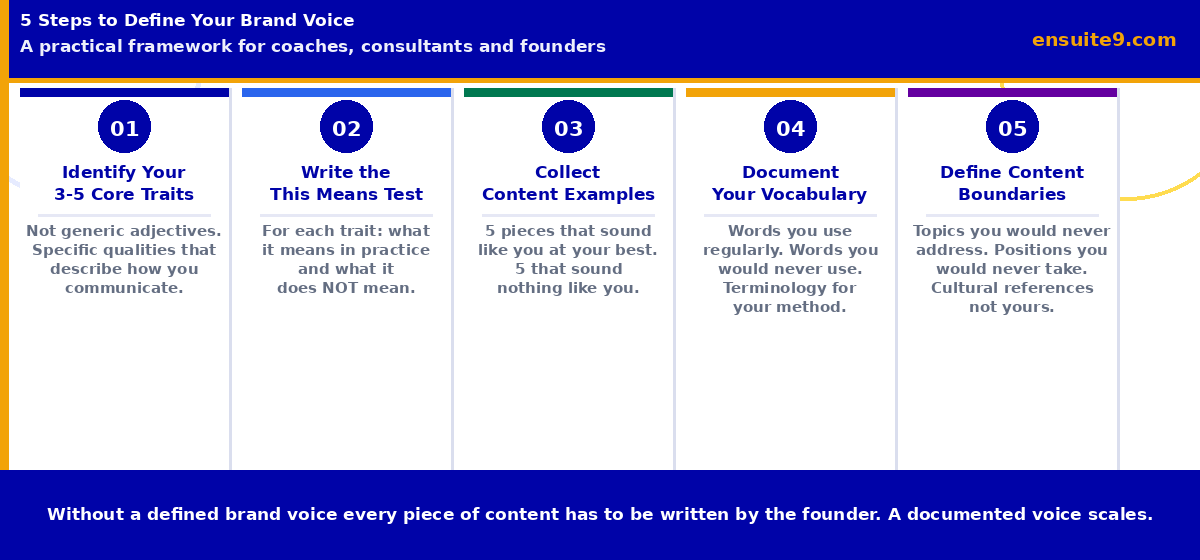
The framework below is designed to produce a brand voice document that is actually operational — specific enough that a writer who has never met you could use it to produce content that sounds like you, rather than like a generic professional.
Step 1: Identify your three to five core characteristics. Not a list of positive adjectives you aspire to, but the specific qualities that genuinely describe how you communicate when you are at your best. If you are unsure, ask the people who know your work well. Ask five to ten clients, colleagues, or peers: how would you describe how I communicate? What is distinct about how I write or speak? Their answers will tell you things an internal brainstorm never will — because they are describing what is actually coming across, not what you intend to project.
The characteristics you land on should be specific enough to be meaningful. Not “professional” but “direct — I say what I think without excessive qualification.” Not “approachable” but “conversational — I write the way I talk, without jargon or corporate language.” Not “innovative” but “contrarian — I consistently challenge the conventional wisdom in my field and explain why.”
Step 2: Write the “this means / does not mean” definition for each characteristic. This is the step that turns an aspirational list into an operational brief. For each characteristic, write two short paragraphs: what this characteristic means in your writing, with a specific example, and what this characteristic explicitly does not mean, with a specific counter-example.
Example: “We are direct. This means we state our positions clearly without hedging when we have a genuine point of view — ‘most coaches get this wrong’ rather than ‘some coaches may find it helpful to consider’. It does not mean we are blunt or dismissive of nuance — we still acknowledge complexity, we just do not hide behind it.”
This single exercise, done for each characteristic, produces a document that is immediately useful to any writer trying to produce content in your voice.
Step 3: Collect content examples — both positive and negative. Find five pieces of content — from your own archives, from other writers you admire, or from anywhere — that sound like you at your best. Then find five pieces that sound nothing like you — either because the tone is wrong, the vocabulary is wrong, or the approach to the reader is different from yours. Write a brief note on each explaining why it is or is not your voice.
The contrast between the two sets is often more clarifying than any amount of description. A writer who has read your positive and negative examples has a significantly clearer mental model of your voice than one who has only read the characteristic definitions.
Step 4: Document your vocabulary. Words and phrases you use regularly and naturally. Words and phrases you would never use. Any terminology specific to your methodology, your framework, or your field that needs to be used consistently. Common phrases or analogies you reach for when explaining your most important ideas. Words that belong to your competitors’ positioning that you deliberately avoid.
This vocabulary list is particularly important if you are working with a ghostwriter or a content team — it gives them the specific language toolkit that makes content feel like yours rather than like a competent professional writing on a topic they understand.
Step 5: Define your content boundaries. Topics you would never address publicly. Positions you would never take. Cultural references, humour styles, or language registers that are not part of your voice. Specific competitors, controversies, or debates you stay out of. The things you would not say even if asked.
Content boundaries are as important as content characteristics — perhaps more so, because they are the guardrails that prevent the voice document from being used to produce content that is technically consistent with your described characteristics but goes somewhere you would never go.

When to Define Your Brand Voice
The answer is before you produce content at scale — before you hire a ghostwriter, before you bring in a content team, before you build your website copy, and before you commit to a consistent posting strategy.
If you have been producing content without a defined brand voice and the result feels inconsistent, the fix is to define the voice now and use it to audit existing content — identifying which pieces are on-brand and using them as the benchmark, and revising or replacing pieces that are significantly off-brand. This is not a rebuild from scratch. It is a realignment around what your best existing content already demonstrates.
For coaches and consultants who are also considering a ghostwriting engagement for LinkedIn, articles, or a book, the brand voice document is the essential prerequisite. A ghostwriter who does not have a brand voice document to work from will produce content that may be technically competent but will not sound like you — and the calibration period will be longer and more frustrating than it needs to be. For more on the ghostwriting process, see: How to Hire a Ghostwriter — What to Look For, What to Avoid, and What to Ask.
Brand Voice for African Coaches and Consultants: What Is Specific to Your Context
For African coaches and consultants, whether based in Nigeria or in the diaspora in the UK, the US, or Canada, brand voice has a specific dimension that generic brand voice guides do not address.
The most significant is cultural specificity as a competitive advantage. An African professional's brand voice can and should reflect their specific cultural context; the references, the communication style, the relationship to professional authority, the view from inside the African professional experience, in a way that is distinctive in a global market where most professional content sounds like it comes from the same cultural template. This specificity is not a limitation. It is a differentiator.
The AI discoverability point is also specifically relevant to African coaches and consultants building visibility in international markets. When a potential client in London or New York asks an AI tool to recommend a leadership coach with experience building businesses in emerging markets, or a ghostwriter who understands the diaspora professional experience, the AI is synthesising content from across the web. African professionals with a consistent, distinctive, well-documented brand voice expressed across their website, blog, and social presence are far more likely to surface in those recommendations than those whose content is generic or inconsistent.
At Ensuite 9, every ghostwriting engagement begins with a brand voice discovery session before a single word of content is written. The brand voice document produced from that session is yours permanently — it travels with every content engagement you have with us, and it is the foundation of everything we produce for you. For more on how the ghostwriting process works, see: LinkedIn Ghostwriting for Coaches and Consultants.
Frequently Asked Questions
What is the difference between brand voice and brand identity?
Brand identity refers to the visual elements of your brand — logo, colours, typography, imagery style. Brand voice refers to the verbal elements — how your brand sounds in words. Both contribute to brand recognition, but they operate in different channels. A strong brand identity is immediately recognisable visually. A strong brand voice is immediately recognisable textually. The most powerful brands have both.
Does a small business or solo coach need a brand voice document?
Yes — arguably more than a large business. A large business has multiple people producing content and needs a voice document to maintain consistency across contributors. A solo coach is the brand — their voice is inherently theirs — but they need a voice document when they start working with ghostwriters, content teams, or marketing agencies, and when they begin using AI tools to assist with content production. Without a documented voice, these collaborations inevitably produce inconsistent output.
How often should a brand voice document be updated?
Review your brand voice document annually and after any significant change in positioning, audience, or service offering. The core characteristics should be relatively stable — if they are changing significantly every year, they are not yet reflecting your genuine brand character. What typically evolves is the vocabulary section (as your methodology and terminology become more refined) and the content boundaries (as you develop clearer positions on what you do and do not want to be associated with).
Can I use AI to define my brand voice?
AI tools can be useful for structuring and articulating a brand voice document once you have gathered the raw material — client feedback, content examples, and your own reflections. They should not be the primary source of your brand voice characteristics, because AI will produce characteristics based on what sounds like a reasonable professional brand rather than what is actually true of you. Use AI as a formatter and editor for your brand voice work, not as the generator of it.
How does brand voice affect SEO?
A consistent, distinctive brand voice contributes to SEO in two ways. First, it helps search engines categorise and understand your content — Google's algorithms favour content with clear topical authority and consistent expertise signals, both of which are reinforced by a distinctive voice applied consistently across your content. Second, as discussed above, brand voice is increasingly a factor in AI-powered vendor discovery — the mechanism through which 84% of B2B buyers now research potential service providers.
If you want to develop a brand voice document for your business with Ensuite 9's guidance, or if you are considering a ghostwriting engagement that begins with a brand voice discovery session, book a free 30-minute discovery call. We will walk you through our process and tell you exactly what your first session would produce.