Hiring a web designer in Nigeria is one of the most common and most frequently regretted decisions a small business owner, coach, or consultant makes. This does not mean good web designers do not exist in Nigeria. They absolutely do. But most clients do not know what to ask before paying and discover too late that they do not own their website files, their domain name is registered in the designer’s account, their hosting credentials were never shared, and the designer has gone quiet after delivering a site that does not convert a single visitor.
This guide gives you seven specific questions to ask before you pay anything. Each question protects a different part of your investment. Together they are the complete due diligence checklist for any web design engagement in Nigeria in 2026.
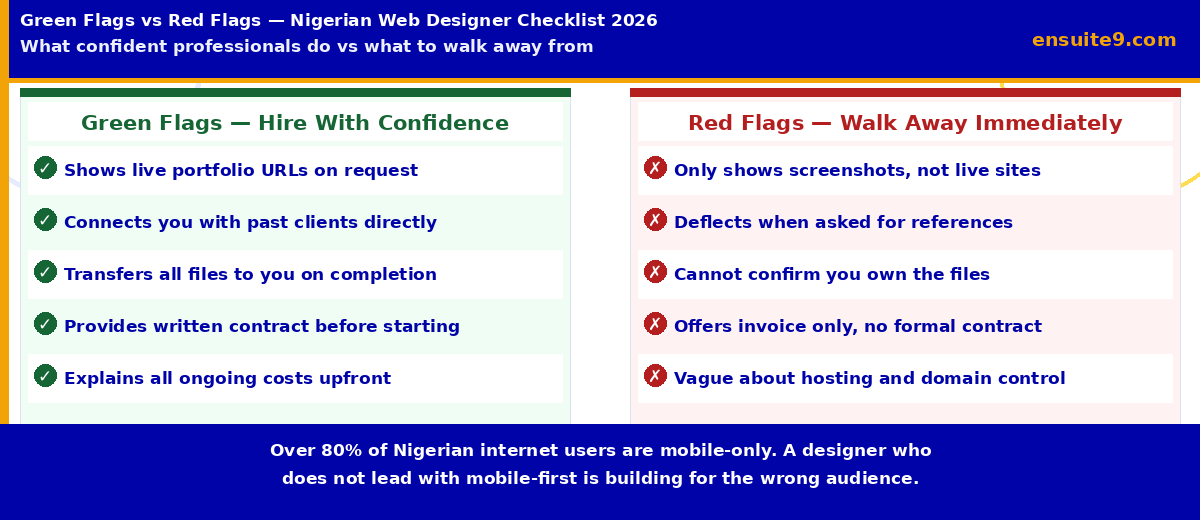
Two contextual points before the questions. First: over 80% of Nigerian internet users access the web exclusively through smartphones. Any web designer building Nigerian business websites in 2026 who does not lead with mobile-first design is building for an audience that barely exists in the Nigerian market. This is not a preference or a nice-to-have — it is the primary technical reality of Nigerian web development. Second: Google’s Core Web Vitals update now directly affects search ranking. A website that loads slowly or performs poorly on mobile measures like Largest Contentful Paint and Cumulative Layout Shift will rank lower on Google than a technically optimised competitor. The designer you hire is making decisions that directly affect your Google visibility, not just your aesthetic presentation.
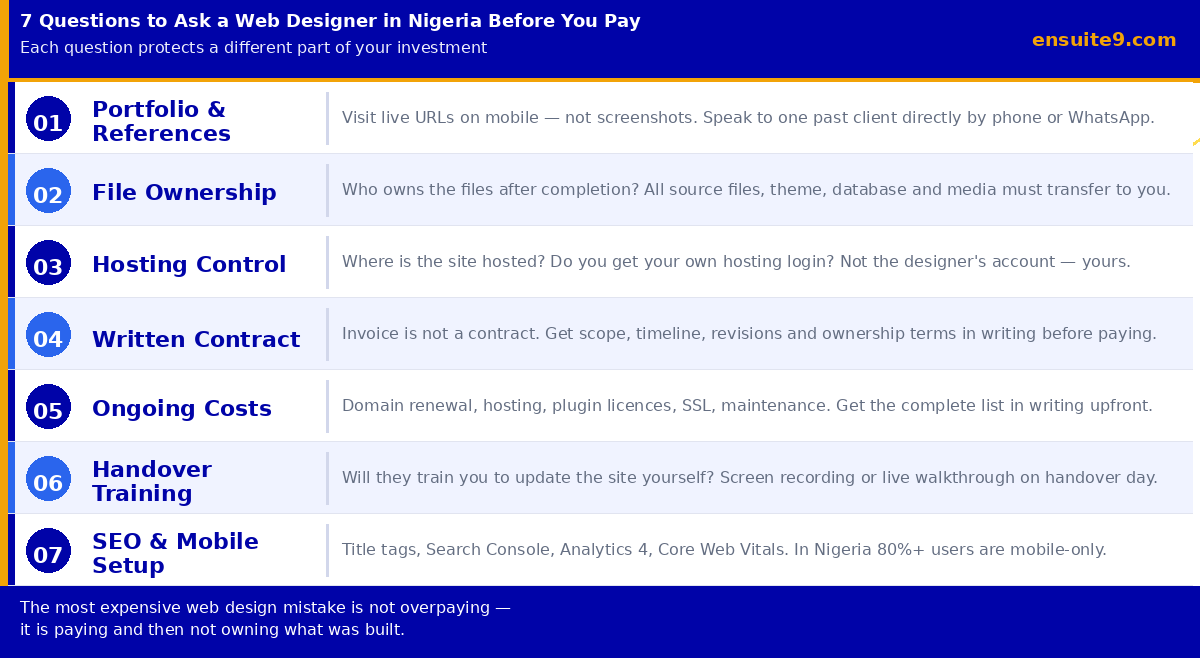
Question 1: Can I See Your Portfolio and Speak Directly to a Past Client?
Any web designer with a legitimate track record has a portfolio of live websites they have built. Ask for it — and then do not just look at screenshots. Visit the actual live URLs. Load each one on your phone (not just on a desktop computer). Check how quickly it loads. Navigate through it as a typical visitor would. Does the design look professional on mobile? Does the site load without delay? Is the navigation intuitive? Is there a clear call to action?
Beyond the portfolio, ask whether you can speak directly to one past client by phone or WhatsApp. A confident designer with satisfied clients facilitates this immediately. A designer who deflects, offers only email-based testimonials, or says their clients are not available for reference calls is not confident in their client relationships. Speaking to a past client tells you things a portfolio never will: whether the designer communicated reliably during the project, whether they delivered on time, what the experience of working with them was like day to day, and whether the client would hire them again.
If the portfolio shows websites that look outdated, load slowly, or are not mobile-responsive, stop there. Your website will look exactly like their past work. Portfolio quality is not a historical record; it is a preview of your future website.
Question 2: Who Owns the Website Files After the Project Is Complete?
This is the most important question on this list and the one most Nigerian clients never ask. It is the question that protects you from the single most common Nigerian web design disaster: paying for a website and then discovering that you have no access to the files that make it work.
When a designer builds your website, the files — theme files, custom code, database, uploaded images — are created specifically for your project. In a professional engagement, those files belong entirely to you. In many Nigerian web design arrangements, they remain in the designer’s control — either deliberately as a retention mechanism or simply because nobody thought to discuss it explicitly.
Ask this question directly and specifically: “After the project is complete, will you transfer all website files to me — including the WordPress database export, all theme files, any custom plugin files, and all uploaded media?” The answer should be an unqualified yes, with confirmation that the transfer will happen on the day of launch or on receipt of final payment.
If the designer says something like “you own the content but the framework or theme is mine,” or “I’ll keep the files but you can always contact me for updates,” walk away. You do not own a website you cannot access independently. You are renting it.
The same principle applies to your domain name. Your domain — yourcompany.com — should be registered in your own name using your own account at a domain registrar (Namecheap, GoDaddy, Google Domains). If your designer registered your domain in their own account, your most valuable digital asset is legally in someone else’s name. Insist on immediate transfer to your personal account before any work begins or as part of project completion.
Question 3: Where Will My Website Be Hosted and Who Controls the Hosting Account?
Hosting is the server infrastructure that makes your website accessible on the internet. Where it is hosted and who controls the account determine whether you have independent access to your site at any time or whether you are dependent on your designer for every change, update, or emergency.
There are three common hosting arrangements in the Nigerian market, ranging from acceptable to problematic:
Best arrangement: The designer helps you set up your own hosting account directly with a hosting provider — Namecheap, SiteGround, Bluehost, or another reputable service — in your own name, with payment going directly from you to the hosting company. The designer builds your website on your hosting account. You have full administrative access. If the relationship with the designer ends for any reason, your website continues to run because you control the infrastructure it runs on.
Acceptable arrangement: The designer hosts client websites on a reseller account they manage, you pay a monthly or annual hosting fee to the designer, and — critically — you have been given your own login credentials for cPanel or the hosting control panel and can access, back up, or migrate your site independently. The red flag is removed by the presence of your own access credentials.
Red flag arrangement: The designer hosts your site, charges you a monthly fee, and you have never been given any hosting login credentials. You cannot access your site’s files independently, you cannot create a backup, and you cannot move your website to a different host without the designer’s cooperation. This arrangement creates complete dependency. If the designer becomes unavailable — or decides to increase the hosting fee significantly — your only option is to rebuild the website from scratch.
Ask directly: “Can you give me my own login credentials to the hosting control panel?” If the answer is no, or if it comes with conditions, that is the answer to question 3.
Question 4: Is There a Written Contract Before Work Begins?
A professional web designer provides a written contract before any work begins and before any money is paid. This is not a bureaucratic formality. It is the document that determines what you agreed to, what you are entitled to, and what happens if something goes wrong.
A professional web design contract covers: the exact scope of work (number of pages, specific features and functionality, what is included and what is not), the timeline with specific milestones, the payment schedule (deposit amount, milestone payments, final payment trigger), what constitutes a revision and how many rounds are included, what happens if the project is delayed by either party, and who owns the files at each stage of the project.
An invoice — even a detailed one — is not a contract. A WhatsApp conversation where you agree to the project is not a contract. An email saying “let’s start” is not a contract. Without a signed written agreement, you have no legal basis for any dispute about what was promised, what was delivered, or what should happen next. The specific payment and revision terms need to be explicit: “two rounds of design revisions” is specific; “as many revisions as needed” is meaningless and will cause conflict.
If a designer tells you a contract is not necessary, that they work on trust, or that their word is sufficient — that tells you exactly how they handle disputes. Their word is all you have, and you will discover the limits of that when something goes wrong. Because something always goes wrong.
Question 5: What Are the Complete Ongoing Costs After the Site Launches?
The project fee is not the only cost of a website. After launch, you will have ongoing costs that recur annually or monthly. A professional designer discloses all of these upfront, unprompted. If they do not, ask specifically and get the answers in writing.
The ongoing costs you need to know about:
- Domain renewal: typically ₦5,000 to ₦20,000 per year depending on the registrar and the domain extension (.com vs .ng vs .com.ng). If the designer registered your domain, confirm who pays for renewal and what happens if they do not renew it — a lapsed domain means your website disappears from the internet
- Hosting: ₦15,000 to ₦120,000 per year for quality shared hosting on providers like SiteGround or Namecheap. Very cheap hosting (under ₦10,000 per year) is typically slow, unreliable, or lacks the technical performance required for good Core Web Vitals scores
- Premium theme or plugin licences: some websites are built using premium themes or plugins that require annual licence renewals to receive updates and security patches. If your site is built on a premium theme, ask what the annual renewal cost is and whether failure to renew affects your site’s functionality
- SSL certificate: the security certificate that makes your site show as “secure” in browsers. Most quality hosting providers include this free. Confirm it is included before paying separately for it
- Maintenance retainer: if you want the designer to continue managing WordPress updates, plugin updates, security monitoring, and backups — this is a separate ongoing cost, typically ₦15,000 to ₦50,000 per month depending on scope
Ask for a complete list of every recurring cost, in writing, before you sign the contract. A designer who is unwilling to provide this is either poorly organised or deliberately vague — neither is a characteristic you want in a long-term web partner.
Question 6: Will You Train Me to Update the Site Myself?
You will need to update your website regularly after launch — adding blog posts, updating service descriptions, changing prices, adding testimonials, publishing news. If your designer has not trained you to make these updates independently, every minor change requires contacting them, waiting for a response, and potentially paying for their time.
A professional website delivery includes a handover session — either a recorded screen walkthrough or a live video session — showing you exactly how to log into the WordPress backend, navigate the dashboard, edit page content, add new pages, publish blog posts, and update images. This session should be sufficient for you to manage day-to-day content updates without designer involvement.
If this is not included in the stated scope, ask for it to be added before signing. Most professional designers include it as standard because a client who can manage their own basic updates is less likely to generate support requests about minor content changes.
Note the distinction between content updates (which you should be able to handle) and technical updates (WordPress core updates, plugin updates, security patches) — the latter is typically handled by a maintenance retainer and is appropriate to leave to a professional. You should not need to understand PHP to update your phone number on your contact page.
Question 7: How Is the Site Optimised for Search and Mobile Performance?
A website that cannot be found in search and performs poorly on mobile is a brochure that nobody reads. In the Nigerian context — where over 80% of users are accessing websites on mobile devices and where Google’s Core Web Vitals now directly affect search ranking — technical SEO and mobile performance are not optional add-ons. They are the foundation of a website that actually generates business.
Ask the designer specifically what technical SEO work is included in the project. The minimum acceptable answer in 2026 includes all of the following:
- Title tags and meta descriptions: set correctly for every page of the site, incorporating the target keyword for each page
- XML sitemap: generated and submitted to Google Search Console so Google can crawl and index the site efficiently
- Google Search Console setup: the site connected and verified, initial coverage report reviewed
- Google Analytics 4 installation: connected and confirmed tracking correctly before handover
- Image compression and alt text: every image on the site compressed for fast loading and labelled with descriptive alt text
- Mobile-first design: the site designed and tested on mobile first, not adapted from a desktop design — there is a significant technical and performance difference between these two approaches in the Nigerian mobile environment
- Page speed optimisation: caching plugin installed and configured, unnecessary scripts removed, hosting selected for performance not just cost
If the designer responds to this question by saying “SEO is a separate service” or cannot clearly articulate what technical SEO work the project includes — assume none is being done. You can verify independently after launch using Google’s free PageSpeed Insights tool (pagespeed.web.dev) and Google Search Console. A score below 70 on mobile PageSpeed means your site is actively losing potential visitors before they ever read your content.
What a Professional Web Design Engagement in Nigeria Looks Like
A properly run web design project in Nigeria in 2026 looks like this: a discovery call where the designer asks about your business, your customers, your goals, and your competitors — before talking about what the site will look like. A detailed written proposal covering scope, timeline, payment schedule, revision policy, and ownership terms. A signed contract before any work begins or any deposit is paid. Regular communication throughout the build with design reviews at defined milestones. A technical delivery that includes mobile-first design, Core Web Vitals compliance, on-page SEO foundations, and Analytics and Search Console setup. A handover session. Full transfer of all files, credentials, and access.
If a designer’s process does not include all of these elements, the missing elements are where problems will emerge. The question is not whether you will experience the consequences of a poorly structured engagement — it is which specific consequence and at which stage of the project.
For a broader view of what a converting website needs beyond the technical setup, see: How to Build a Website That Converts — Not Just One That Exists. For the WordPress vs Wix vs Webflow decision that often comes before hiring a designer, see: WordPress vs Wix vs Webflow — Which One Should Your Nigerian Service Business Use?
What to Do If You Have Already Paid and Something Has Gone Wrong
This section is for the significant number of readers who arrived here after experiencing a problem rather than before it.
The most common situation: you paid a deposit, communication has slowed or stopped, deadlines have passed without delivery, and you are unsure whether to push through or cut your losses. The practical advice for this situation: send one clear written message (email or WhatsApp, with read receipts) stating specifically what you are waiting for, what the deadline is, and that you will be requesting a refund of unused deposit if that deadline is not met. Keep this message professional and factual, not emotional. The response — or absence of one — tells you whether to proceed or to formally request a refund.
If you have received a site that does not match what was agreed: compile the specific discrepancies between what the contract or proposal describes and what was delivered. Present this in writing as a list of outstanding items. Give a specific deadline for resolution. A professional designer addresses genuine scope discrepancies. A non-professional goes quiet.
If you need to rebuild: document everything you have — any access credentials, any files you have been given, your domain registrar login if you have it — and engage a new designer with a proper contract, starting with all seven questions in this guide.
Frequently Asked Questions
How much should a website cost in Nigeria in 2026?
A professionally built WordPress website for a service business or coach in Nigeria costs between ₦300,000 and ₦800,000 for a 5 to 8 page website with proper mobile-first design, SEO foundations, and a written contract. Quotes significantly below this range typically mean template use without customisation, no SEO work, no proper handover, or offshore production with local reselling. Quotes significantly above this range require specific justification in the scope. For a full cost breakdown, see: WordPress vs Wix vs Webflow for Nigerian Service Businesses.
Should I use WordPress or another platform for my Nigerian business website?
For most service businesses, coaches, and consultants in Nigeria, WordPress is the right choice — it provides full file ownership, a large local support ecosystem, strong SEO capabilities, and no platform lock-in. Wix and Squarespace are easier to use independently but come with significant limitations on file ownership and customisation. Webflow is appropriate for design-led businesses with a larger budget and ongoing design support. For a detailed comparison, see: WordPress vs Wix vs Webflow.
How long should a website project take in Nigeria?
A properly scoped 5 to 8 page service website should take 4 to 8 weeks from signed contract to launch. A one-page site or simple brochure website can be completed in 2 to 3 weeks. Any designer who cannot provide a specific week-by-week timeline before work begins does not have a defined process — and a project without a defined process runs on the designer’s schedule, not yours.
What is a mobile-first website and why does it matter for Nigeria?
Mobile-first design means the website is designed and optimised for smartphone screens first, then adapted for larger screens — as opposed to the traditional approach of designing for desktop and then scaling down. In Nigeria, where over 80% of internet users access websites exclusively on mobile, a website that is designed desktop-first will consistently underperform in load speed, readability, and user experience for the majority of its visitors. Google’s 2026 algorithm also prioritises mobile performance in search ranking through Core Web Vitals metrics.
Ensuite 9 builds WordPress websites for coaches, consultants, and service businesses across Nigeria and the diaspora — written contract, full file and credential transfer, mobile-first build, SEO foundations, Analytics and Search Console setup, and handover training included as standard. Book a free discovery call to discuss your website project.