If you have spent more than thirty minutes trying to choose between WordPress, Wix, and Webflow, you have probably read five articles that told you everything except what you actually needed to know.
They compared pricing in dollars. They talked about enterprise scalability. They mentioned features most small business owners will never use.
None of them told you what to do if you are a coach, consultant, or service business owner in Nigeria trying to build a website that actually gets you clients.
This one will.
First — the honest answer
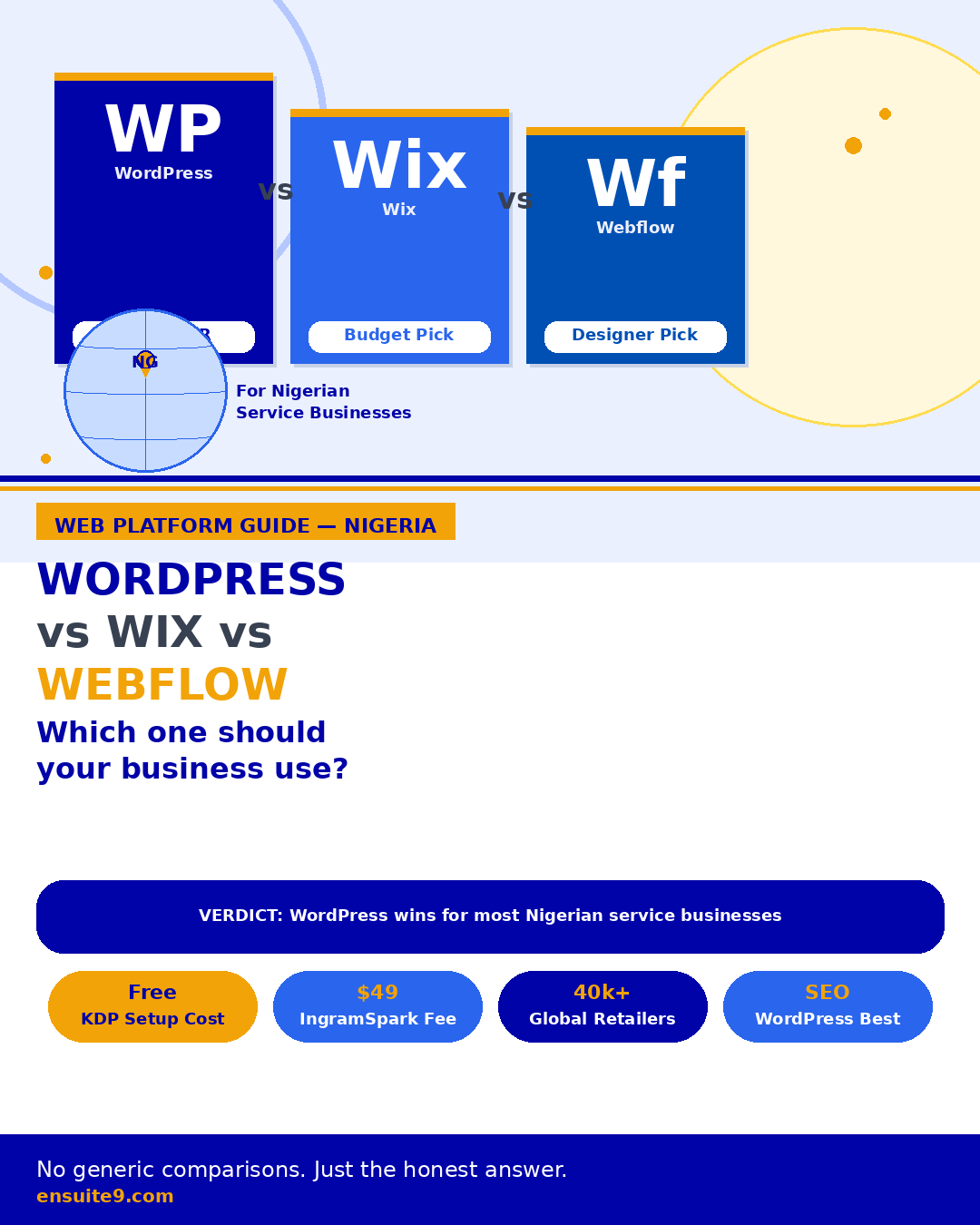
For the vast majority of service business owners in Nigeria, the answer is WordPress.
Now this does not mean it is perfect or that the other options do not work. What is crucial here is what happens after the website is built, when you need to update it, scale it, hand it to a developer, integrate it with local payment tools, or optimise it for search.
WordPress gives you the most control, the most flexibility, and the lowest long-term cost. In a market where most web designers and developers are WordPress-trained, it also gives you the widest access to local support when you need it.
Here is the full breakdown so you can make the decision yourself.
WordPress — Best for most Nigerian service businesses
WordPress powers over 40% of all websites globally and the majority of professionally built service business sites in Nigeria. It is not a hosted website builder; it is a content management system you install on your own hosting, which means you own everything completely.
What makes it the right choice for Nigerian service businesses:
Your website lives on hosting you pay for directly: providers like Namecheap, Bluehost, or local options. No monthly platform fee on top of your hosting. No risk of a platform shutting down your site or changing its pricing model. You own the files, the database, and the domain.
WordPress integrates cleanly with Paystack, Flutterwave, and other Nigerian payment processors. If you are selling a course, a service package, or a product to a Nigerian audience, the payment infrastructure works.
With plugins like Yoast or RankMath, WordPress gives you full SEO control: title tags, meta descriptions, schema markup, and sitemaps. For a service business trying to rank in Google Nigeria, this matters significantly.
Elementor, which is the most popular WordPress page builder in Nigeria, means you can build and edit pages visually without writing code. Most web designers in Nigeria work in Elementor. This makes finding someone to help you far easier and usually more affordable.
Where it gets complicated:
WordPress requires more setup than Wix. You need hosting, a domain, WordPress installation, a theme, and plugins before you have a working site. If you are not technical, you will need a developer or designer to build it for you, which is the right move anyway for a professional service business.
It also requires maintenance: plugin updates, security, backups. A basic maintenance retainer from a WordPress developer in Nigeria typically costs ₦15,000–₦50,000 per month depending on the scope. This is a real cost to budget for.
Wix — Best for getting online quickly with a small budget
Wix is a fully hosted website builder. You pay a monthly or annual fee, log in, drag and drop, and your site is live. No hosting to set up, no plugins to manage, no technical knowledge required.
Where it makes sense:
If you need a professional-looking website in under a week and your primary goal is basic online presence, that is, a place for people to find you, read about your services, and contact you, then Wix works. It is genuinely fast to set up, and the templates have improved significantly.
For a very early-stage business testing a service before committing to a full website investment, Wix is a reasonable starting point.
Where it falls short for Nigerian service businesses:
Wix’s SEO capabilities are weaker than WordPress. The platform has improved, but it still cannot match the depth of control WordPress gives you for on-page SEO. If organic search traffic matters to your business, and it should, because SEO impacts whether or not people find your website online, then this is a real limitation.
Wix pricing is in dollars. At current exchange rates, a business plan costs approximately ₦30,000–₦50,000 per year. That is manageable, but you are paying a recurring platform fee forever on top of any other business costs, and you cannot move your site off Wix to a different platform without rebuilding it from scratch.
Paystack integration on Wix exists but is less straightforward than on WordPress. Nigerian payment tools work better in the WordPress ecosystem.
Webflow — Best for design-led businesses that need a developer
Webflow is a professional no-code development platform that produces clean, fast, custom-designed websites. It is the favourite tool of high-end web designers and design agencies globally.
Where it makes sense:
If your brand demands a visually distinctive, highly customised website and you have the budget to work with a Webflow-specialist designer, typically $1,500–$5,000+ for a professional build, Webflow produces excellent results. The output is fast, SEO-friendly, and professionally built.
Where it falls short for most Nigerian service businesses:
Webflow has a steeper learning curve than both WordPress and Wix. If you need to make simple edits to your site yourself, Webflow requires more technical comfort than most business owners have or want to develop.
The pool of Webflow-trained designers in Nigeria is significantly smaller than WordPress designers. This means higher costs and fewer options when you need support.
Webflow’s hosting is also priced in dollars — typically $23–$39 per month for a business site. At current rates, that is approximately ₦35,000–₦60,000 per month, which is a significant ongoing cost for an early-stage service business.
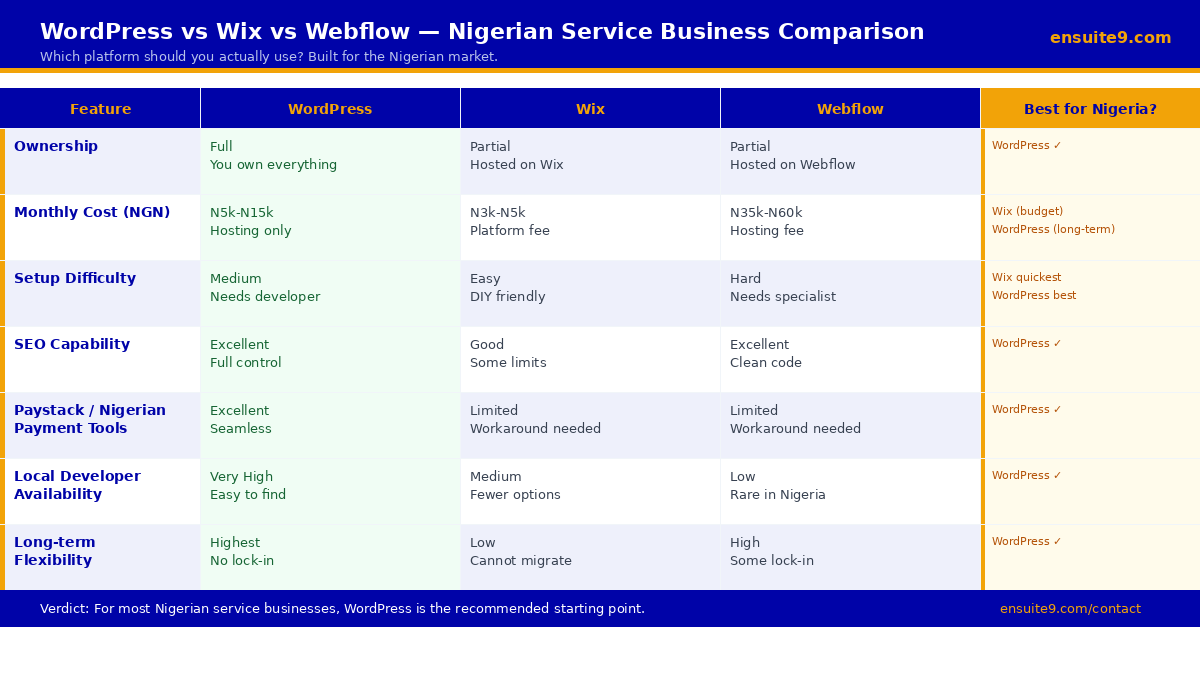
Take a look at this professional comparison
The bottom line for Nigerian service business owners
If you are a coach, consultant, author, or service business owner in Nigeria, build on WordPress. Use Wix only if you need something live immediately on a very tight budget and you understand that you will likely rebuild it later. And consider Webflow only if design is a core part of your brand positioning and you have the budget for a specialist designer and the ongoing hosting cost.
The platform is not what makes your website work. The strategy behind it, the copy on it, and the conversion path through it are what turn visitors into clients. But starting on the right platform means you are not rebuilding from scratch twelve months from now.
Frequently Asked Question on WordPress Vs Wix Vs Webflow in Nigeria
1. Which website platform is best for small businesses in Nigeria?
WordPress is the best platform for most small service businesses in Nigeria because of its flexibility, SEO capabilities, compatibility with Nigerian payment processors like Paystack and Flutterwave, and the wide availability of local WordPress developers.
2. Is Wix good for Nigerian businesses?
Wix works well for businesses that need a simple online presence quickly and on a tight budget. However, its SEO limitations, dollar-denominated pricing, and lack of full ownership make WordPress a better long-term choice for most Nigerian service businesses.
3. How much does it cost to build a WordPress website in Nigeria?
A professionally built WordPress website in Nigeria typically costs between ₦250,000 and ₦500,000 and may go as high as ₦2,000,000, depending on features, complexity, the number of pages, and the designer you work with. Monthly hosting costs range from ₦5,000 to ₦15,000.
4. Can I use Paystack on WordPress?
Yes. Paystack integrates seamlessly with WordPress through its official plugin and through WooCommerce. It is one of the most straightforward payment integrations available on the WordPress platform.
5. Is Webflow worth it for a small Nigerian business?
Webflow is a powerful platform, but the hosting costs in dollars, the smaller pool of local Webflow designers in Nigeria, and the steeper learning curve make it a difficult choice for early-stage small businesses. It is better suited for design-led businesses with larger budgets.
Need help building a WordPress website that actually converts?
At Ensuite 9 we build WordPress websites for coaches, consultants, and service business owners who need more than a digital presence: they need a website that works. Book a free discovery call and we will tell you exactly what your site needs.