You are on LinkedIn. You post occasionally, or perhaps consistently. You have a complete profile: photo, headline, work history, about section. You connect with people in your industry. And almost nothing happens. No discovery call requests, no meaningful DMs from potential clients, no visible return on the time you are spending on the platform.
This is the most common LinkedIn frustration among coaches and consultants in 2026, and the reason it persists is that most guides tell you what to add to your profile without telling you why your current profile is invisible. This one is different. It starts with the specific reasons, rooted in the 2026 algorithm changes, and then gives you the exact fixes for each problem.
The context matters. Following a significant LinkedIn algorithm rewrite in 2026, organic reach for average profiles dropped by approximately 50% according to industry analysis. This means the stakes for having a properly optimised profile are now higher than ever, because the platform is giving less reach by default, and every element that signals a high-quality, relevant, active presence matters more than it did in 2025. A vague headline or an empty featured section that was merely suboptimal last year is now actively costing you visibility.
The good news: all of these problems are fixable. Most can be addressed in under 90 minutes of profile work.
Problem 1: Your Headline Describes You Instead of Serving the Reader
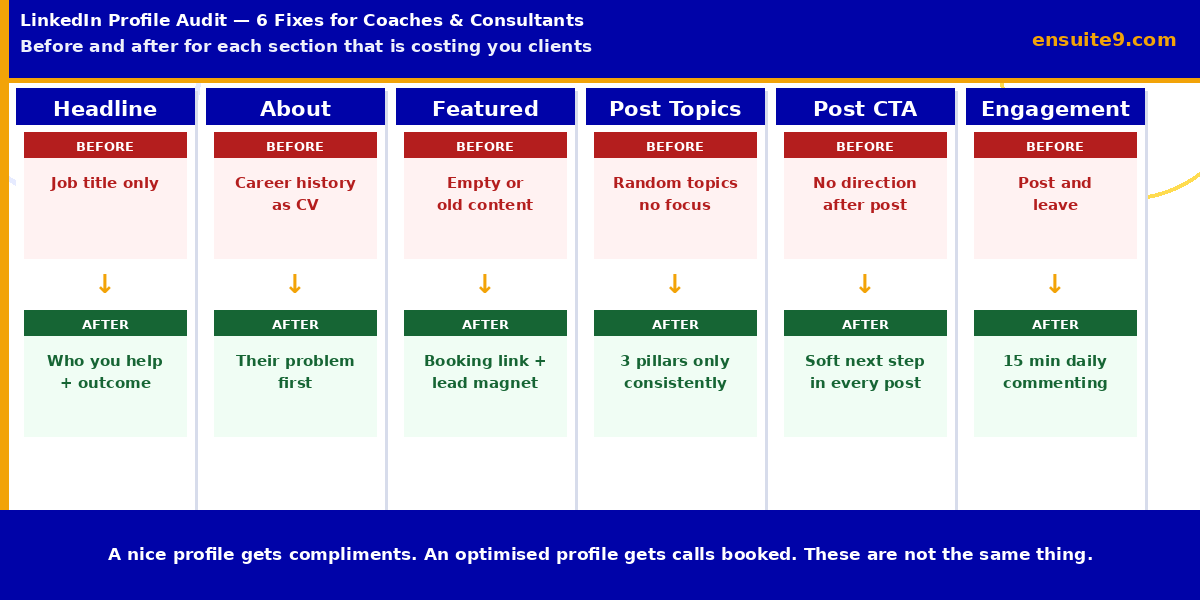
Your LinkedIn headline is the single highest-impact field on your profile. LinkedIn’s algorithm weights the headline more heavily than any other text field for search ranking. It appears under your name in every search result, every comment you leave on a post, every connection request you send, and every notification your network receives. It is the first thing a potential client reads when they see your name anywhere on the platform.
Most coaches and consultants use their headline to list their job title: “Executive Coach | Leadership Consultant | Speaker | Founder.” This tells a potential client what you are. It does not tell them what you do for them, who specifically you help, or what outcome they can expect. It is the professional equivalent of a shop sign that says “shop” rather than naming what is inside.
The 2026 LinkedIn algorithm processes over 60 billion searches annually and ranks profiles based on keyword relevance and semantic inference — meaning it is reading your headline to understand not just what words you use but what professional role and audience those words signal. A headline that lists your job title without context is semantically ambiguous. A headline that clearly articulates who you help and what you do for them is semantically specific — and ranks better for the searches your ideal clients are actually making.
The fix: Rewrite your headline using one of these structures tested against the 2026 algorithm:
Formula 1: “I help [specific audience] achieve [measurable outcome] through [your method]” Example: “I help early-stage founders build their first $500k revenue through repeatable sales systems”
Formula 2: “[Your role] helping [target audience] [specific transformation] | [credibility signal]” Example: “Executive Coach helping first-generation leaders build high-performing teams | Former Head of People, Flutterwave”
Formula 3: “[Outcome] for [audience] | [Specialisation or method]” Example: “Consistent inbound clients for independent consultants | LinkedIn positioning and content strategy”
The specificity of these formulas is not incidental — it is the point. A headline that could describe a thousand different professionals converts nobody. A headline that makes one specific type of person think “that is exactly what I need” converts them.
Problem 2: Your About Section Is a Career Summary Nobody Asked For
The LinkedIn About section is the most consistently wasted real estate on the platform. Most coaches and consultants use it as a career history — a narrative version of their CV starting with where they went to school and ending with what they are doing now. A potential client reading this learns about you. They do not recognise themselves or their problem.
LinkedIn truncates your About section after approximately 300 characters — roughly two to three lines. The reader has to actively click “see more” to read the rest. The first three lines of your About section are the most commercially important writing on your profile. If they do not immediately speak to the reader’s situation, the vast majority of visitors will never click through.
A high-converting About section follows a completely different structure from a career summary. It opens with the reader’s problem, in their language, not yours. It demonstrates that you understand the situation they are in. It introduces your perspective and methodology as the solution. It provides evidence that the solution works. And it ends with a specific, low-friction call to action.
The fix: Rewrite your About section using this structure:
- Lines 1-2 (visible before “see more”): Open with the specific frustration or problem your ideal client is experiencing right now. Write it in their words. “Most consultants spend more time chasing clients than serving them.” “You have 15 years of experience, but your LinkedIn looks the same as someone in their first year.”
- Paragraph 2: Explain why the problem persists and what most people get wrong about solving it
- Paragraph 3: Introduce your specific approach and why it is different
- Paragraph 4: Social proof — a specific result achieved for a client, a credential that is relevant to this specific problem
- Final line: Clear, specific CTA — “If this sounds like your situation, book a free 30-minute call here: [link]”
Write conversationally, in first person, as if you are talking to one specific person across a table. Not formally, not as a press release about yourself. One of the most common mistakes in 2026 is using AI to write or rewrite the About section — the result reads as polished but generic, which is the opposite of what converts.
Problem 3: Your Featured Section Is Empty, Stale, or Irrelevant
The Featured section sits prominently below your About section and is one of the most powerful conversion tools on the profile — when used correctly. It is also one of the most commonly empty, outdated, or misfired sections on coaching and consulting profiles.
According to LinkedIn profile optimisation data from 2026, profiles with active, relevant Featured sections receive significantly more profile-to-action conversions than those without. The Featured section allows you to pin specific content permanently at the top of your profile — content you choose specifically because it serves your conversion goal.
What belongs in your Featured section if your goal is inbound client enquiries?
- First position: Your discovery call booking link. A direct link to your Calendly or booking page with a compelling label — “Book a free 30-minute strategy call” — is the single highest-converting Featured item for coaches and consultants. It removes every barrier between a warm profile visitor and a conversation with you.
- Second position: A lead magnet. A free resource — a framework PDF, a checklist, a short guide — offered in exchange for an email address. This captures visitors who are not yet ready to book a call but want to stay connected. Every email address collected from your LinkedIn profile is a warm prospect who self-selected as interested in your specific approach.
- Third position: Your single best post. The one post that best demonstrates your expertise, generates the most engagement, and best represents what your content is about.
Do not feature old posts that no longer represent your current positioning, generic company pages, or media coverage from years ago that is not directly relevant to what you are currently selling.
Problem 4: Your Posts Cover Too Many Topics With No Clear Direction
Posting consistently is necessary but not sufficient. Posting consistently with no clear positioning is the content equivalent of shouting in a busy market — lots of noise, little signal. If your posts cover ten different topics — some personal updates, some industry news, some motivational observations, some client work, some general business advice — your audience cannot identify what you stand for and cannot tell their network “you should follow this person because she is the one to follow if you want X.”
The 2026 algorithm specifically rewards profiles that generate meaningful comments — defined as 15 or more words that add substantively to the conversation. Generic content that appeals to a broad, undefined audience generates fewer meaningful comments than specific content that speaks directly to a defined audience’s specific situation. The algorithm interprets this as a signal of low relevance and reduces distribution accordingly.
The fix: Define three content pillars and post exclusively within them. For most coaches and consultants, the pillars that perform best are:
- Pillar 1 — Your methodology: How you think about the problem you solve, the framework you use, the counterintuitive insight your clients arrive at when they work with you
- Pillar 2 — Client results and transformation: Before and after, specific outcomes, case studies (anonymised if needed), the moment a client’s perspective shifted
- Pillar 3 — Honest reflection: Your real experience building your practice, the mistakes you made, the things you see your ideal clients consistently getting wrong, your contrarian view on conventional wisdom in your field
Every post should fit within one of these three pillars. Over time, your audience learns what to expect from you. The people who resonate with your pillars follow you. The people who follow you because they resonate with your pillars are the people who become clients.
Problem 5: Your Posts End Without Telling the Reader What to Do Next
Most LinkedIn posts end without a call to action. The post makes its point and then stops. For a potential client who is reading that post at the exact moment they are experiencing the problem you just described, this is a missed conversion opportunity that you cannot recover. The moment of resonance passes. They scroll on. You have created value without creating movement.
Every post that resonates with a potential client is a moment where they are warm — engaged, attentive, thinking about their problem in the context of your perspective. A call to action at that moment does not need to be a sales pitch. It can be as simple as “If this is the situation you are in right now, my DMs are open.” Or “I share a framework for this in a free 10-minute guide — link in my Featured section.” Or “If you are a consultant experiencing this, I would like to hear how you are handling it — leave a comment.”
The key is that every post has some direction for the reader who wants more. Without that direction, the algorithm sees the post as a terminal event — it generated engagement, but no downstream action. With a CTA that drives profile visits, DMs, or link clicks, the algorithm receives signals that your content is generating meaningful interaction beyond the post itself.
Problem 6: You Post and Disappear
The most underrated growth lever on LinkedIn in 2026 is not posting. It is commenting. The algorithm specifically prioritises profiles that generate and participate in meaningful engagement, and commenting substantively on posts from people in your target audience is the fastest way to drive profile visits from exactly the right people.
Profiles that only post and never comment are treated by LinkedIn’s algorithm as broadcast accounts: they send but do not participate. This significantly reduces algorithmic distribution compared to profiles that engage actively with their network’s content.
The specific mechanic: when you leave a substantive comment (15+ words that add something genuine to the conversation) on a post by someone in your target audience, your name and headline appear in that person’s notification. Their followers who see the comment see your headline. If your headline is specific and relevant, some of them will visit your profile. This is how LinkedIn authority compounds — not from your posts alone, but from your visible participation in the conversations your ideal clients are already having.
The fix: Spend 15 minutes every day leaving three to five substantive comments on posts from people in your target audience. Not “great post!”, actual engagement with the content. This costs nothing, takes 15 minutes, and drives profile visits from exactly the right people.
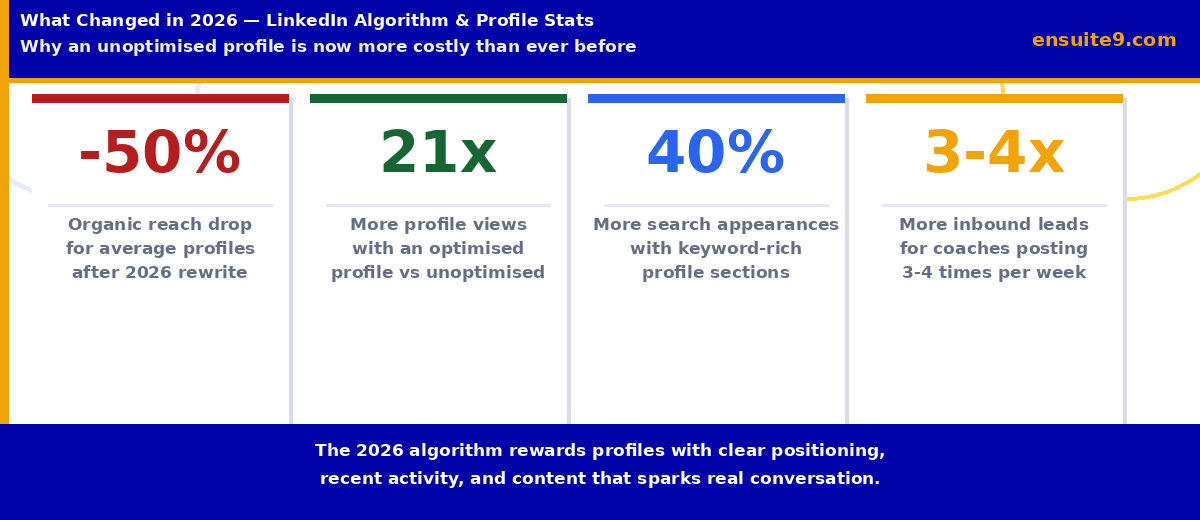
The 2026 Algorithm Context — Why These Problems Are More Costly Now
Each of the problems above has always existed. What changed in 2026 is that they are more costly. Following a significant algorithm rewrite, organic reach for average profiles dropped by approximately 50%. LinkedIn processes over 60 billion searches annually using AI-powered semantic search that ranks profiles by relevance and depth, not just keyword presence. Creator mode changes reward consistent activity, with even one post per week significantly boosting profile visibility compared to inactive profiles.
The platform now has over 1.1 billion members. Average consultants converting under 0.4% of their connections into paid clients is the norm, not the exception. The coaches and consultants generating consistent inbound from LinkedIn in 2026 are the ones who have addressed exactly the problems in this post — and the ones who continue to do so systematically rather than sporadically.
For context on what a consistent LinkedIn content strategy looks like once your profile is optimised, see: LinkedIn Ghostwriting for Coaches and Consultants — How It Works and Whether You Need It. For the broader authority strategy that LinkedIn sits within, see: How to Build Authority Online as a Coach or Consultant Without a Large Following.
The LinkedIn Profile Fix Checklist — What to Do This Week
In order of impact:
- Day 1: Rewrite your headline using one of the three formulas above. Test it on three people who match your ideal client profile — do they immediately understand who you help and what you do for them?
- Day 2: Rewrite your About section. Start with your ideal client’s problem, not your career history. Ensure the first 300 characters are the strongest statement you can make.
- Day 3: Set up your Featured section. Add your booking link in first position, your lead magnet in second position.
- Day 4: Define your three content pillars. Write them out explicitly — one paragraph each. Post your first pillar-aligned post.
- Day 5 onwards: Add 15 minutes of daily commenting to your routine. Three to five substantive comments on posts from people in your target audience, every day.
This sequence addresses the highest-impact elements first. Most clients who implement these changes in this order see measurable increases in profile views within 7 to 14 days as LinkedIn re-indexes the updated profile.
Frequently Asked Questions
How long does it take for LinkedIn profile changes to take effect?
Most clients see increased profile views within 7 to 14 days of updating key sections, particularly the headline and About section. LinkedIn’s algorithm re-indexes updated profiles, and adjusted search ranking typically shows within two weeks. Engagement and inbound enquiry improvements follow from consistent posting and commenting over the subsequent two to three months.
Should I use AI to write or optimise my LinkedIn profile?
No, at least not as the primary writer. The 2026 LinkedIn algorithm detects AI-generated content and deprioritises profiles and posts that use it. More importantly, AI-written profiles read as polished but generic; they sound like a professional LinkedIn profile rather than like you specifically. A profile that converts requires specificity, personal stories, and genuine perspective that only you can provide. AI is a useful tool for structural suggestions and editing. It should not be generating the core content of your profile.
How many connections do I need before LinkedIn starts generating leads?
Connection count matters less than connection quality and profile optimisation. Coaches and consultants with 500 highly relevant connections and a clear, optimised profile regularly generate better inbound results than those with 5,000 broadly connected but unfocused networks. Focus on connecting with people who match your ideal client profile rather than maximising raw connection count.
Is a Premium LinkedIn subscription worth it for coaches and consultants?
Premium provides access to InMail, detailed profile view analytics, and enhanced search filters. For coaches and consultants focused on inbound rather than outbound, the most valuable Premium feature is seeing exactly who has viewed your profile, allowing you to follow up with warm prospects. For passive inbound building, free is adequate. For active client development, Premium typically pays for itself within one to two months if you are using it strategically.
I post consistently but get no engagement. What am I doing wrong?
Consistent posting without engagement usually signals one of three problems: your content is too broad to resonate with anyone specifically, your posts are not ending with a question or CTA that invites response, or you are not commenting on other people’s posts (which is the primary driver of the algorithm showing your posts to new people). Address all three simultaneously, not just the posting frequency.
If you want Ensuite 9 to handle your LinkedIn content strategy and ghostwriting while you focus on client delivery, book a free 30-minute discovery call. We will assess your current profile, identify the highest-impact changes, and walk you through exactly what a LinkedIn ghostwriting retainer looks like for your specific goals.