LinkedIn is the highest-converting platform for coaches and consultants generating inbound client enquiries in 2026. It is also the platform where most coaches and consultants are being failed by low-quality ghostwriting services, specifically by the wave of agencies that have entered the market using AI-generated content with minimal human editing and selling it as professional LinkedIn ghostwriting.
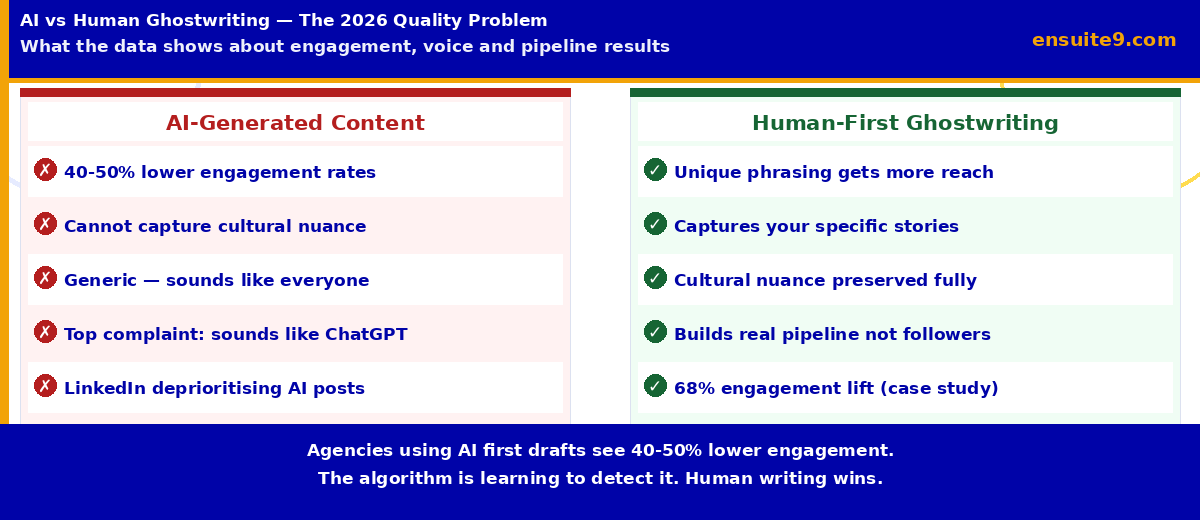
This matters because the data is now clear. According to an analysis of 185+ active LinkedIn ghostwriting clients published in February 2026, agencies using AI for first drafts are seeing engagement rates 40 to 50% lower than agencies using human-first writing processes. LinkedIn’s algorithm appears to be testing content authenticity signals; posts with unique phrasing, specific details, and personal anecdotes consistently get more distribution than posts that read like they were generated by a language model. The most common client complaint across the industry in 2026 is “This sounds like ChatGPT.”
For coaches and consultants who have tried LinkedIn ghostwriting and been disappointed, this context explains why. For those considering it for the first time, it tells you exactly what to ask before you pay.
This guide covers what LinkedIn ghostwriting actually involves, how voice matching works with a human writer, what results are realistic and on what timeline, how to brief your ghostwriter for maximum quality, and specifically what the African coach and consultant context changes about how LinkedIn strategy should be approached.
What LinkedIn Ghostwriting Actually Is
LinkedIn ghostwriting is a professional service in which a writer produces your LinkedIn content: posts, articles, carousels, newsletters, which you then publish under your own name. The ghostwriter writes in your voice, drawing on your ideas, expertise, and professional perspective. The content is entirely yours in terms of substance. The writing is professionally produced.
This is not a new arrangement. Communications directors, speechwriters, and PR professionals have been writing for executives and public figures in their professional voice for decades. LinkedIn ghostwriting is the same practice applied to the most commercially important B2B platform of 2026. As many as 15 to 20% of funded startup founders now use some form of LinkedIn ghostwriting service, according to 2026 industry data. The majority of the LinkedIn profiles you find compelling from coaches, consultants, and executives are ghostwritten or significantly supported by a professional writer.
What changes the dynamic in 2026 is the AI problem. When ghostwriting meant a human writer interviewing you, learning your voice, and producing content that genuinely sounded like you, the arrangement was defensible on every level. When it means an AI tool generating posts from a brief prompt and a light human edit, the result is content that has no relationship to your actual voice, fails to reflect your specific expertise, and now actively underperforms in LinkedIn’s algorithm. Understanding this distinction before engaging a service is the most important due diligence you can do.
For more on identifying the right ghostwriter and avoiding AI-heavy services, see: How to Hire a Ghostwriter — What to Look For, What to Avoid, and What to Ask.
Why LinkedIn Specifically — The 2026 Platform Context
LinkedIn’s algorithm in 2026 rewards three things above all others: consistent posting, meaningful engagement (comments of 15 or more words that add to the conversation), and content authenticity signals including unique phrasing, specific personal details, and original points of view. Personal profiles continue to dramatically outperform company pages across all engagement metrics. For a coach or consultant whose primary business asset is their own expertise and credibility, a personal LinkedIn presence is the most direct path to inbound client enquiries of any platform.
The commercial case for LinkedIn investment is well-documented. Four out of five LinkedIn members drive business decisions. According to one case study involving a B2B consultant who hired a LinkedIn ghostwriter to shift from product promotion to value-based content, the results over one year included a 68% increase in average engagement rate, a 45% increase in demo requests from LinkedIn, an 82% increase in follower count, and a 25% increase in new customer sign-ups traced back to LinkedIn activity.
The ROI calculation for a coach or consultant is straightforward. At a $2,000 per month ghostwriting retainer with an average client value of $5,000, you need one additional client per 2.5 months from LinkedIn to cover the investment. For most coaches and consultants with a correctly positioned LinkedIn presence, that threshold is achievable within the first six months of consistent activity. The agencies reporting the best client results in 2026 are those combining content with systematic engagement — commenting on posts from target audience members, not just producing and posting content and expecting the algorithm to do the rest.
How Voice Matching Actually Works: The Human Process
Voice matching is the core skill of a professional LinkedIn ghostwriter and the element most frequently faked by AI-heavy services. A service that claims to match your voice by asking you to fill out a questionnaire and uploading your existing posts to a language model is not doing voice matching. It is doing voice approximation, and the result reads like it.
Genuine voice matching involves a discovery process that is closer to journalism than to content production. Here is what a professional process looks like:
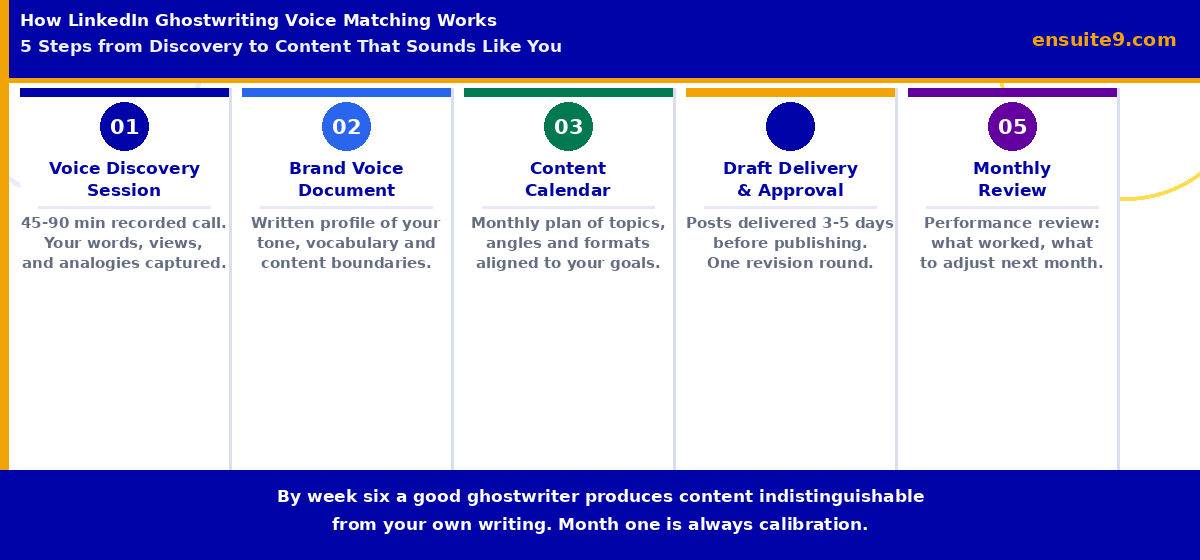
Voice discovery session: A recorded conversation of 45 to 90 minutes in which the ghostwriter asks you questions about your professional background, your beliefs about your industry, your strongest opinions, your client stories, and what you stand for. The questions are designed not to gather topic ideas but to draw out the specific way you communicate, the words you reach for, the analogies you use, the things you get animated about, the positions you hold that contradict conventional wisdom in your field. This conversation is the raw material for everything that follows.
Brand voice document: A written summary of your voice: your tone, your typical sentence structure, your content boundaries, your recurring themes, and your specific perspective on the topics most relevant to your audience. This document is the brief the ghostwriter refers to before writing every piece of content. It should be specific enough that a writer who has never met you could read it and produce content that sounds like you rather than like a generic professional.
Content calendar: A monthly forward plan of the specific posts for the coming month — topic, angle, format (text post, carousel, poll, article), and approximate length. Developed in the monthly briefing session between the ghostwriter and the client, incorporating what happened in your work that month, any specific topics or events worth addressing, and any feedback on what resonated from the previous month.
Draft delivery and approval: Posts delivered three to five days before the planned publication date for your review and approval. You can request edits, adjust tone, add specific details that only you would know, or redirect a post entirely. One revision round is standard. Most well-matched posts require only minor adjustments, or none.
Monthly review: A brief session reviewing which posts performed best, what the data shows about your audience’s engagement patterns, and how to adjust the content strategy for the following month.
The first month of any ghostwriting engagement is always a calibration period. The ghostwriter produces drafts, you give feedback, and the voice becomes progressively more accurate. Most professional ghostwriters reach a point by week six where the content they produce is indistinguishable from content you would have written yourself, because by that point they know how you think, what you care about, and how you express it. An AI tool never reaches this point regardless of how much data you feed it, because AI approximates pattern rather than understanding perspective.

The AI Problem: What to Ask Before You Pay
In 2026, there are estimated to be over 200 LinkedIn ghostwriting agencies globally, up from approximately 50 in 2023. The majority of the growth has come from agencies using AI tools to produce content at scale and selling it as professional ghostwriting. The quality difference between human-first and AI-first ghostwriting is now measurable in engagement data and visible in client churn rates.
Before engaging any LinkedIn ghostwriting service, ask these specific questions:
"Walk me through your voice discovery process in detail." If the answer is "we ask you to fill out a form" or "we analyse your existing posts," the process is AI-driven. A human-first process involves a recorded conversation, a real interview, with a human writer. There is no substitute for this and any service that offers one is selling you something that will not sound like you.
"Do your writers use AI to generate first drafts?" Ask this directly. Some agencies will be honest. Many will give an answer like "we use AI as a tool" without specifying that the tool is writing 80% of your content. Push for specifics: does a human writer produce the first draft, or does AI? The answer tells you everything about what the final product will sound like.
"Can you show me a voice-matched sample in a voice similar to mine?" Ask for an anonymised sample where the writer captured a voice that is similar to yours — in your industry, in your professional context, or with a similar communication style. Read it carefully. Does it sound like a real, specific person? Or does it sound like generic professional content that could describe anyone?
"What are your client retention rates?" High client churn, i.e., clients leaving after two to three months, is the clearest signal that the content is not performing or does not sound right. Agencies with human-first processes retain clients at significantly higher rates than AI-heavy agencies because the content actually sounds like the client and actually generates engagement.
What Results to Expect — And on What Timeline
LinkedIn growth with a human-first ghostwriting strategy follows a predictable pattern that most clients do not understand in advance, which leads to premature cancellations just before results would have appeared.
Month one: Quiet. Impressions are modest. Engagement is limited. The ghostwriter is calibrating your voice and the algorithm is still establishing what your content is about. This is normal. Do not cancel based on month one data.
Month two to three: Gradual increase in post impressions. Occasional posts begin to perform significantly better than others. The ghostwriter and client identify what is working and weight the content calendar toward more of it. Profile visits begin to increase. Some connection requests and DMs from people in your target audience start to appear.
Month four to six: Consistent engagement from your target audience. Profile visits translate into discovery call bookings or DM conversations. Inbound enquiries from LinkedIn become measurable. The algorithm has established your content identity and is consistently distributing your posts to the right audience.
According to data from YellowInk, a specialist LinkedIn ghostwriting agency, most clients notice higher reach, more profile views, and stronger replies within two to four weeks. Real traction in the form of messages, leads, and speaking invitations typically shows within two to three months of consistent posting.
The metrics that matter at each stage: Month one — profile views (are people looking you up after seeing your posts?). Month two to three — comment quality (are the right people engaging?). Month four onwards — DMs and discovery call requests (is the content converting interest into conversations?).
LinkedIn Ghostwriting for African Coaches and Consultants — What Is Different
African coaches and consultants — whether based in Nigeria or in the diaspora in the UK, the US, or Canada — face a specific LinkedIn context that most generic ghostwriting agencies are not equipped to address.
Dual audience positioning. An African professional on LinkedIn in 2026 typically has a potential audience that spans both their country of origin and the international markets where they live, work, or want to attract clients. A Nigerian coach in London needs content that resonates with UK-based professional buyers while maintaining the authenticity of their African professional identity. Content that speaks to only one of these audiences underperforms with the other. A ghostwriter who has only worked with UK or US clients will default to UK or US professional communication norms — which may not serve the full positioning opportunity.
Cultural specificity as a competitive advantage. One of the least exploited positioning opportunities for African professionals on LinkedIn is their specific cultural and professional context — the realities of building a practice or a business from Nigeria or across the diaspora, the specific challenges their clients face, the frameworks they have developed in response to those challenges. Generic professional content flattens this specificity. A ghostwriter who understands it can help you build a positioning that is genuinely distinctive in a crowded professional market.
Building authority across markets simultaneously. The most valuable LinkedIn presence for an African professional in 2026 is one that builds authority with both local and international audiences at the same time. This requires content that is specific enough to resonate deeply with readers who share your context, and positioned broadly enough to be understood and valued by readers who do not. Finding that balance is a content strategy skill that the best human ghostwriters can provide and that AI tools fundamentally cannot.
How to Brief a LinkedIn Ghostwriter for Maximum Quality
The quality of what a ghostwriter produces is directly proportional to the quality of the material you give them to work with. The discovery session is the foundation, but the ongoing monthly briefing determines whether the content improves or plateaus.
The most useful ongoing brief information is not a list of topics. It is a set of specific things that happened in your work that month — a client conversation that revealed something interesting, a problem you solved in an unexpected way, an observation you made that contradicts conventional wisdom in your field, a result a client achieved that you are proud of. These specifics are what separate your content from the generic professional content that populates most LinkedIn feeds — and they are only available from you.
The best clients for LinkedIn ghostwriting are those who come to the monthly briefing session with three to five specific things from the past month that they found interesting, challenging, or instructive. That raw material, in the hands of a skilled ghostwriter, becomes a month's worth of content that sounds exactly like you because it is exactly your thinking.
For a full guide to brand voice and briefing, see: What Is a Brand Voice and Why Every Business Needs One Before They Post Anything.
What a LinkedIn Ghostwriting Retainer at Ensuite 9 Looks Like
Ensuite 9's LinkedIn ghostwriting retainers are human-first. Every engagement begins with a recorded voice discovery session conducted by a human writer — not a questionnaire, not an AI analysis of your existing posts. Your brand voice document is produced from that session and approved by you before a single post is written.
We write for coaches, consultants, authors, founders, and executives across Nigeria, the UK, the US, Canada, and the broader African diaspora. Our ghostwriters are trained to understand the dual-audience positioning challenge that African professionals face — writing content that builds authority with local and international readers simultaneously.
Retainers start at $250 per month for a content-only package and run to $1,200 per month for a full service including strategy, writing, and monthly performance review. Every retainer includes a signed NDA and full IP transfer — everything we write for you belongs to you completely.
For a full guide to ghostwriting costs across all content types, see: How Much Does Ghostwriting Cost in 2026?
Frequently Asked Questions
Is LinkedIn ghostwriting ethical?
Yes. LinkedIn ghostwriting is a professional service that produces content representing your genuine expertise, ideas, and perspective. The ghostwriter expresses your thinking — they do not invent it. The arrangement is standard practice among executives, founders, and professional thought leaders globally. For a full discussion of ghostwriting ethics, see: What Is a Ghostwriter? The Honest Answer.
How long before I see results from LinkedIn ghostwriting?
Most clients see increased profile views and stronger post engagement within two to four weeks. Inbound enquiries and meaningful DMs from target audience members typically begin appearing between months two and four of consistent posting. Do not evaluate results at month one — LinkedIn authority builds slowly and then compounds.
How do I know if a ghostwriting service is using AI?
Ask directly: "Does a human writer produce the first draft of my content, or does AI?" Also ask to see a voice-matched sample produced for a client with a similar professional profile. AI-generated content has a characteristic flatness — smooth but generic, containing no specific details, stories, or opinions that could only belong to the named author.
How many posts per week should I publish on LinkedIn?
Three to four posts per week is the standard recommendation for coaches and consultants in 2026 — enough to maintain consistent presence without posting filler content. Quality and consistency matter more than volume. An active commenting strategy — leaving substantive comments on posts from your target audience — is as important as your own posting frequency for driving profile visits.
Can a ghostwriter also manage my LinkedIn engagement?
Some full-service agencies include engagement management: commenting on target audience posts, responding to comments on your own posts, and sending connection requests, as part of premium retainer packages. At Ensuite 9, our current packages cover writing and strategy. Engagement management is available as an add-on at premium retainer levels.
If you are ready to discuss a LinkedIn ghostwriting retainer with Ensuite 9, book a free 30-minute discovery call. We will walk you through our voice discovery process, show you a relevant sample, and give you transparent pricing for your specific goals.