IngramSpark and Amazon KDP are the two most important self-publishing platforms for African authors targeting a global readership. Most comparisons treat them as alternatives, as if you need to choose one or the other. This is the wrong frame. The right question is not which one to use. It is understanding what each one does, what the other one cannot, and how to use both together to give your book the widest possible reach with the highest possible royalty on each sale.
This guide is updated to reflect the February 2026 IngramSpark pricing changes and the mid-2025 KDP royalty tier update, both of which affect the calculations African authors need to make before choosing their distribution strategy. It is also written specifically for authors publishing from Nigeria and across the African diaspora, addressing the specific considerations — Payoneer payments, bookstore access in Africa and internationally, and library distribution — that generic KDP vs IngramSpark guides typically ignore entirely.
What Amazon KDP Is — And What It Is Not
Amazon KDP (Kindle Direct Publishing) is Amazon’s self-publishing platform for eBooks in Kindle format and print books through print-on-demand. It is the easiest entry point into professional self-publishing, with no upfront fees and a setup process that can be completed in a day once your files are ready.
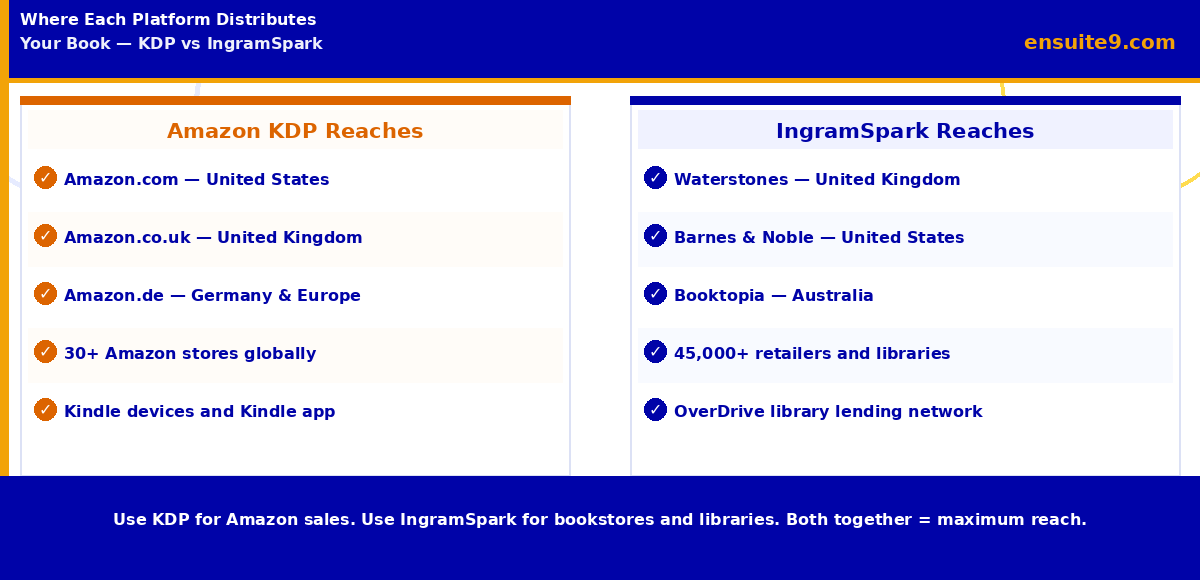
When you publish on KDP, your book is listed for sale on Amazon’s global marketplace — Amazon.com in the US, Amazon.co.uk in the UK, Amazon.de in Germany, and every other regional Amazon storefront simultaneously. For eBooks priced between $2.99 and $9.99, you earn a 70% royalty. For print books, the royalty is calculated as up to 60% of the list price minus the per-copy printing cost, which Amazon deducts before paying you. Following the mid-2025 KDP royalty update, the exact rate depends on your list price and marketplace — always check the KDP pricing calculator when setting up your title as rates can vary.
What KDP is not: it is not a global bookstore distribution system. KDP’s expanded distribution option — which routes your print book to non-Amazon retailers through Ingram — is available only for paperbacks, takes a 20% cut of royalties before passing the remainder to you, and provides significantly less control and visibility than publishing directly on IngramSpark. Most professional self-publishing advisors recommend disabling KDP’s expanded distribution entirely if you are also publishing on IngramSpark, because KDP’s expanded distribution is simply a less efficient version of what IngramSpark does directly.
For a complete guide to setting up KDP from Nigeria — including the W-8BEN tax interview, Payoneer configuration, and metadata optimisation — see: The African Author’s Complete Guide to Amazon KDP in 2026.
What IngramSpark Is — And Why It Matters for African Authors
IngramSpark is the self-publishing division of Ingram Content Group — the world’s largest book distributor. Ingram is the wholesale infrastructure behind the global bookselling industry. When a bookshop in the UK, a library in Canada, or a university bookstore in Australia wants to order a book, they almost certainly order through Ingram’s distribution network. IngramSpark gives independent authors and small publishers direct access to that same network — the same catalogue, the same ordering systems, and the same reach as books from major commercial publishers.
As of 2026, IngramSpark distributes to over 45,000 retailers, libraries, schools, universities, and online stores globally. This includes Waterstones in the UK, Barnes and Noble in the US, Booktopia in Australia, and the OverDrive and Baker and Taylor library lending networks that supply public libraries across the English-speaking world.
For African authors specifically, IngramSpark’s most important function is enabling bookstore and library access in markets where your readers are based. A Nigerian author in the diaspora whose book is on IngramSpark can have it stocked by Waterstones in the UK, available for Nigerian diaspora readers to find on a shelf — not just online. A book published only on KDP is available to order online but will almost never appear on a physical bookshop shelf anywhere in the world.
IngramSpark also offers a feature called Share and Sell, which gives authors a direct link to sell print copies at a higher royalty rate than standard retail distribution. Currently limited to US-based sales, this is worth monitoring as the feature evolves.
For a simple introduction to what IngramSpark is and how it works, see: What Is IngramSpark? A Simple Guide for First-Time Authors.
The 2026 Updates — What Has Changed
Two significant platform changes affect the KDP vs IngramSpark calculation in 2026 and are worth understanding before making distribution decisions.
IngramSpark’s February 2026 pricing update introduced changes to print costs across several formats. For a standard 250-page 6×9 black-and-white paperback, print costs through IngramSpark are now approximately $3.90 to $4.20 per copy — slightly above the equivalent KDP rate. Colour and hardcover formats saw larger cost increases in this update. If you are pricing your book and calculating your royalty, use IngramSpark’s publisher compensation calculator directly, ensuring you select the February 2026 pricing option. Revision fees remain at $25 per file change after the first 60 days — upload only when you are confident your files are final.
KDP’s mid-2025 royalty tier update introduced a tiered royalty structure for print books. The rate is now up to 60% but may be 50% depending on your list price and the specific marketplace where the sale occurs. The exact rate is displayed in the KDP pricing calculator when you set your price during title setup — always check this before publishing rather than assuming the maximum rate applies to all sales.
Royalty Comparison — The Real Numbers
The royalty comparison between KDP and IngramSpark is more nuanced than most guides present. Here are real calculations based on 2026 pricing for a standard non-fiction paperback.
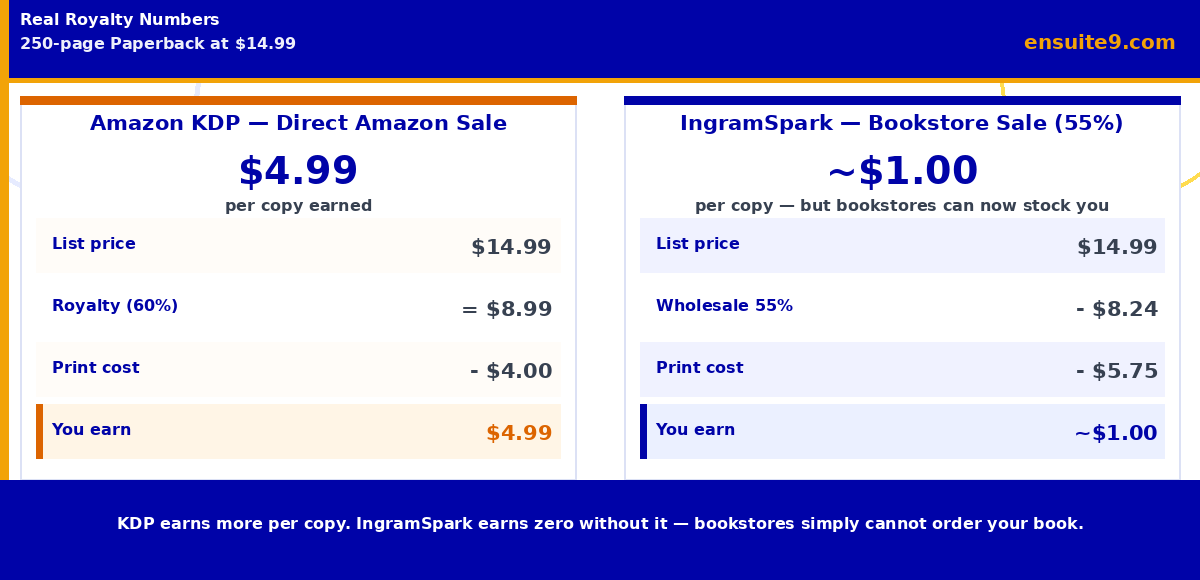
Scenario: 250-page 6×9 black-and-white paperback priced at $14.99
On Amazon KDP (direct Amazon sale):
Print cost: approximately $4.00 (fixed $1.00 + $0.012 per page × 250 pages)
Royalty: 60% × $14.99 = $8.99 minus print cost $4.00 = $4.99 per copy
On IngramSpark (with 55% wholesale discount for bookstore stocking):
Print cost: approximately $5.75 (slightly higher than KDP following the February 2026 update)
Royalty: $14.99 minus $5.75 minus ($14.99 × 40% kept by author) = List price ($14.99) minus print cost ($5.75) minus wholesale amount ($14.99 × 55% = $8.24) = approximately $1.00 per copy to bookstore orders
This comparison reveals the trade-off clearly: KDP generates significantly higher royalties on direct Amazon sales ($4.99 vs approximately $1.00), but IngramSpark provides the distribution network that makes bookstore placement and library stocking possible. The $1.00 royalty from an IngramSpark bookstore sale is not the comparison point — the comparison point is zero, which is what you earn from bookstores if you are only on KDP.
For eBooks: KDP pays 70% on books priced $2.99 to $9.99 — that is $3.49 on a $4.99 eBook. IngramSpark distributes eBooks to non-Amazon retailers but typically at lower royalty rates than KDP’s direct 70%. For eBook distribution beyond Amazon, most authors use an aggregator like Draft2Digital rather than IngramSpark directly, as the royalty rates are more favourable and the platform management is simpler.
The Bookstore Question — Especially Relevant for African Authors
For African authors in the diaspora, bookstore access in the UK, the US, or Australia carries a specific significance beyond sales volume. Being stocked in Waterstones or a major US independent bookshop positions your book differently than an Amazon-only listing — it signals mainstream publishing credibility, makes the book available to buyers who browse physical shops, and creates the kind of serendipitous discovery that online-only distribution cannot replicate.
Getting your book stocked by physical bookshops through IngramSpark requires two things: a wholesale discount deep enough for the bookshop to make a viable margin (typically 55%), and a returns policy that allows the bookshop to return unsold copies without financial risk. Without the returns policy enabled, most bookshops will not order speculatively. With it enabled, you carry the financial risk of returns — but significantly increase the probability of proactive stocking.
The practical consideration: if a bookshop orders 20 copies of your book and returns 15, you absorb the cost of those 15 returned copies. For authors with modest marketing budgets and no established bookshop relationships, the risk is real. For authors who are actively marketing their book to specific communities, speaking at events, or targeting specific institutional buyers, the returns risk is manageable and the stocking benefit is significant.
Library Distribution — An Underused Opportunity for African Authors
Library distribution through IngramSpark is one of the most underused revenue and visibility opportunities available to African authors, and it deserves specific attention.
When your book is distributed through IngramSpark, it becomes available to the OverDrive and Baker and Taylor networks — the primary acquisition systems used by public libraries across the UK, the US, Canada, and Australia. A library that adds your book to its catalogue exposes it to every borrower in that system. A popular library book generates repeated impressions among exactly the professional, book-reading audience that coaching and consulting authors want to reach.
For African authors specifically, library placement in communities with large Nigerian or broader African diaspora populations — areas of London, cities like Houston, Atlanta, and Washington DC in the US, Toronto in Canada — creates discoverability among an audience that is both interested in African professional voices and financially able to purchase follow-on products and services.
Library distribution requires the same IngramSpark setup as bookstore distribution. There is no separate process — once your book is correctly configured on IngramSpark with appropriate metadata, it is available for library acquisition through the standard Ingram catalogue.

The Recommended Strategy — Using Both Together
The professional standard for self-published authors in 2026 who want maximum distribution is to use both platforms simultaneously for different purposes. Here is the exact setup:
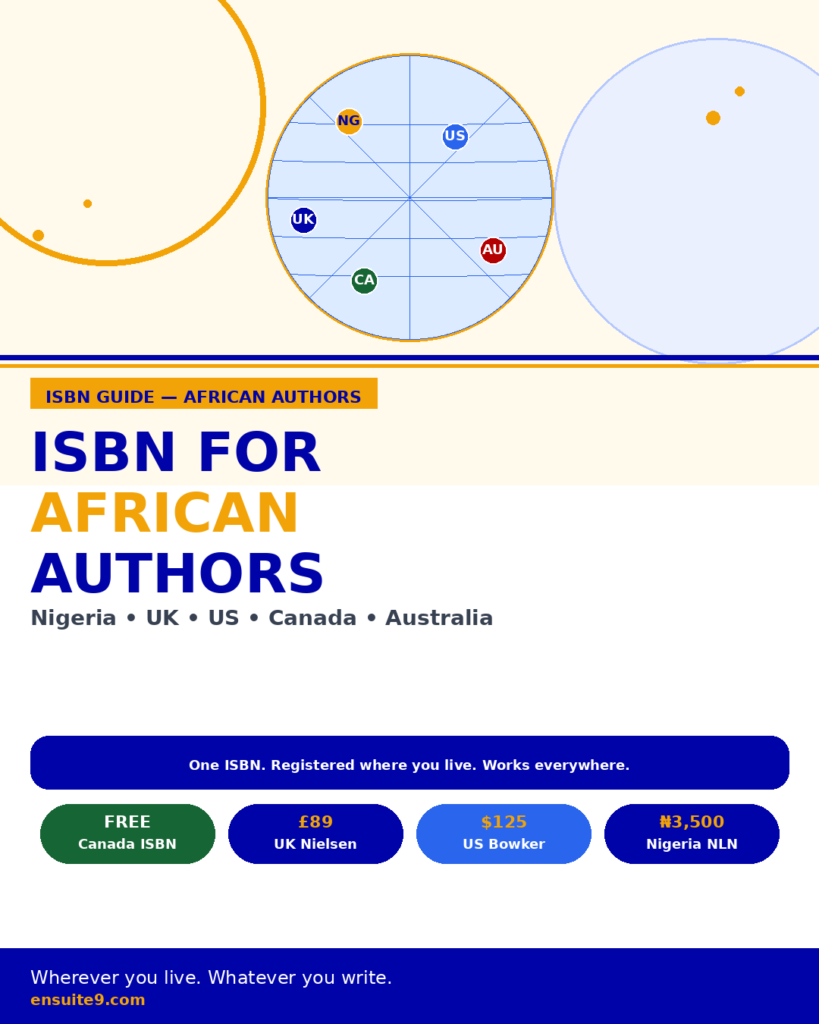
Step 1: Own your ISBN. You must own your own ISBN to use the same book on both platforms legally without creating ISBN conflicts. Do not use KDP’s free ISBN or IngramSpark’s free ISBN, register your own through the National Library of Nigeria (for Nigeria-based authors), Nielsen (UK), Bowker (US), or the appropriate agency for your country of residence. For a complete guide, see: ISBN Registration in Nigeria — Step by Step Guide or ISBN for African Authors — Nigeria, UK, US, Canada and Australia.
Step 2: Prepare separate files for each platform. KDP and IngramSpark use different file specifications. Your print interior PDF and cover file need to be built to each platform’s specific template. A file that works on KDP will typically need adjustment before it meets IngramSpark’s specifications. Prepare both before uploading to either platform.
Step 3: Set up KDP first. Upload your eBook and print book to Amazon KDP. During print setup, do NOT enable expanded distribution — leave that box unchecked. IngramSpark will handle non-Amazon distribution far more effectively and at better royalty rates than KDP’s expanded distribution.
Step 4: Set up IngramSpark with the same ISBN. Upload to IngramSpark using the same ISBN you used on KDP. In your IngramSpark distribution settings, disable distribution to Amazon — you are already selling through Amazon directly via KDP, and routing Amazon sales through IngramSpark reduces your royalty unnecessarily. Enable distribution to all other retailers and libraries.
Step 5: Set your wholesale discount and returns policy. For maximum bookstore and library access, set your wholesale discount to 55% and enable returns. If you are not actively targeting physical bookstores, a 40% discount with no returns is a lower-risk setup that still makes your book orderable through Ingram’s catalogue.
Step 6: Order proof copies from both platforms. Before going live, order a physical proof from both KDP and IngramSpark and compare the print quality. Both are generally good, with IngramSpark using slightly heavier 70lb paper compared to KDP’s 60lb. Adjust if needed before committing to the final published versions.
eBook Distribution — The Third Element
For eBooks, the distribution strategy has a third component beyond KDP and IngramSpark. Wide eBook distribution — making your eBook available on Apple Books, Kobo, Google Play Books, Barnes and Noble, OverDrive, and Scribd simultaneously — is best handled through an aggregator like Draft2Digital rather than through IngramSpark directly.
Draft2Digital is free to use, takes a percentage of each sale rather than charging upfront fees, and provides a single dashboard for managing your eBook across all major non-Amazon platforms. For Amazon Kindle sales, continue publishing directly on KDP for the full 70% royalty rate — routing Amazon eBook sales through Draft2Digital costs you an additional 10% commission. For a full guide to book distribution options, see: What Is Book Distribution and How Does It Work for Self-Published Authors?
Direct Sales — The Fourth Channel African Authors Should Not Ignore
Both KDP and IngramSpark are third-party platforms that take a percentage of your sales and put the customer relationship in the hands of the retailer. A direct sales channel — selling through your own website, through Selar, or through Bambooks for the Nigerian market — gives you 90 to 95% of the sale price and keeps the customer relationship yours.
For African authors with an active Nigerian audience, direct sales through Paystack-enabled platforms are often more valuable than Amazon sales on a per-copy basis. Nigerian readers are more likely to discover your book through your own social channels and community than through Amazon search, and a direct sale at 90% royalty is significantly more profitable than an Amazon sale at 60% royalty minus print costs. For a full guide, see: How African Authors Can Sell Books Directly Without Relying on Amazon.
Frequently Asked Questions
Can I publish on both KDP and IngramSpark at the same time?
Yes — and for most African authors seeking maximum distribution, you should. Publish your print book on KDP for Amazon sales and on IngramSpark for bookstore and library distribution. Disable KDP’s expanded distribution. Disable IngramSpark’s Amazon distribution. Use your own ISBN on both. This is the standard professional setup.
How much does IngramSpark cost to set up?
IngramSpark charges approximately $49 per title for setup — payable directly to IngramSpark and separate from any publishing service fees. There is no monthly fee. File revisions after the first 60 days cost $25 per file change. Upload only when your files are final.
Does IngramSpark work for Nigerian authors?
Yes. IngramSpark is accessible to authors worldwide and does not restrict access by country. Nigerian authors can set up and manage IngramSpark accounts and receive payment through international transfer. The ISBN must be registered through the National Library of Nigeria or your country of residence. For ISBN guidance, see: ISBN Registration in Nigeria.
Is IngramSpark better than KDP for African authors?
Neither is better — they serve different purposes. KDP is better for Amazon sales royalties. IngramSpark is better for global bookstore and library reach. Using both together gives African authors the best of each platform’s strengths without the limitations of either alone.
What wholesale discount should I set on IngramSpark?
55% is the standard recommended discount for authors who want their books proactively stocked by bookshops. This gives the retailer enough margin to make the book viable on their shelves. If you are not targeting physical bookstore stocking, 40% is a lower-risk option that still makes your book orderable through Ingram’s system.
Ensuite 9 handles both KDP and IngramSpark setup as part of all print publishing packages — including separate file preparation for each platform, metadata optimisation, discount and returns policy configuration, and proof coordination. To discuss your book’s distribution strategy, book a free 30-minute discovery call.