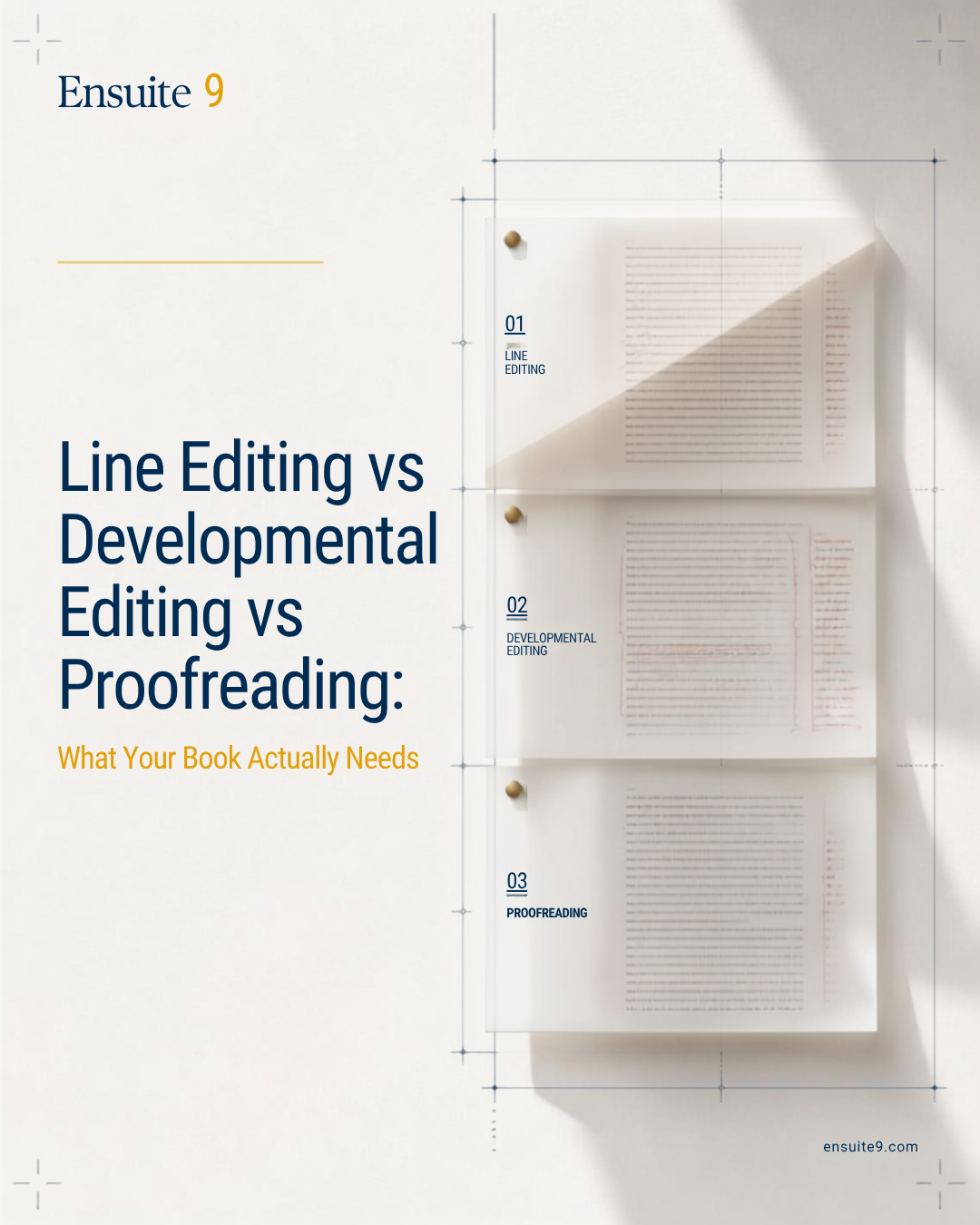
Almost every dispute between an author and an editor comes down to one thing: the author expected a different kind of editing than what they paid for. An author who commissions proofreading expects their plot holes fixed. An author who commissions line editing expects their sentence structure to change completely. An author who commissions developmental editing is surprised when the editor rewrites entire chapters, because they thought editing meant fixing typos.
None of these expectations are unreasonable on their own. They are simply describing four different services that professional publishing treats as four distinct stages, each with a different scope, a different price, and a different moment in the production process where it belongs. Confusing them is one of the most expensive and most common mistakes a self-published or first-time author makes, and it is entirely avoidable once you understand what each stage actually does.
This guide breaks down developmental editing, line editing, copy editing, and proofreading in plain language, explains the order they happen in and why that order matters, tells you honestly which one your manuscript probably needs, and gives you real Nigerian pricing so you can budget correctly before you commission anything.
The Four Stages, In the Order They Actually Happen
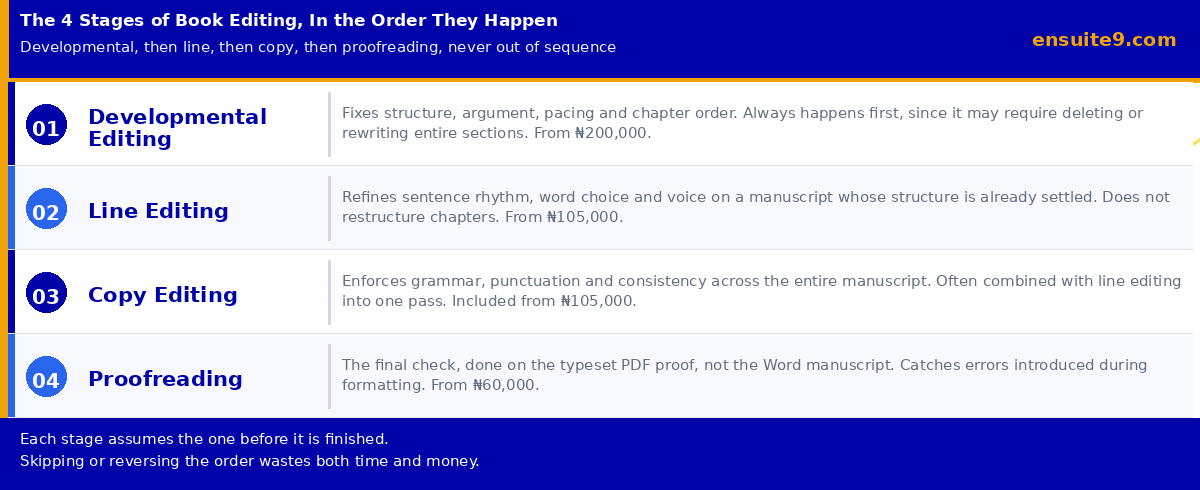
Professional publishing recognises four levels of editing, and the Chicago Manual of Style, the standard reference for English-language publishing, names them in a fixed sequence: developmental editing, line editing, copy editing, and proofreading. Each stage assumes the previous one is already finished. A proofreader is not looking for plot holes. A developmental editor is not fixing comma placement. Each editor is doing a specific job on a specific version of the manuscript, and the four jobs happen in a specific order because doing them out of sequence wastes both the author’s money and the editor’s time.
Developmental editing always comes first, because it can require significant restructuring or even a full rewrite of certain sections. There is no value in polishing the prose of a chapter that a developmental edit later determines should be deleted or moved elsewhere in the book. Line editing comes second, refining the sentence-level style and voice once the structure is settled. Copy editing comes third, enforcing grammatical correctness, consistency, and factual accuracy on a manuscript whose structure and style are already finalised. Proofreading comes last, and it happens on a completely different kind of document, the typeset, formatted proof rather than the Word manuscript, catching errors that were introduced during layout or that survived every earlier stage.
Developmental Editing: Fixing the Big Picture
Developmental editing addresses the structure, argument, and overall coherence of a manuscript. For fiction, this means plot, character development, pacing, and whether scenes are in the right order to create the intended effect on the reader. For non-fiction and memoir, this means whether the argument builds logically, whether chapters are sequenced to build understanding rather than confusion, and whether the central thesis of the book is clear and consistently supported throughout.
A developmental editor typically delivers an editorial letter, a detailed critique identifying structural problems and suggesting specific changes, though many also mark up sections directly with comments. This is the most involved and most expensive stage of editing, and it is also the stage most likely to require real back-and-forth between author and editor, sometimes multiple rounds, since structural problems rarely have a single obvious fix.
You need developmental editing if: you have just finished a first draft and have not had objective feedback on whether the structure works. You are unsure whether your chapters are in the right order. Early readers have told you the middle “drags” or the argument “loses focus” without being able to say exactly why. You are working from a rough outline rather than a fully realised manuscript.
Line Editing: Shaping the Prose
Line editing works at the sentence and paragraph level, on a manuscript whose structure is already settled. A line editor is reading for how the writing sounds, not what it says. This means sentence rhythm, word choice, clarity, flow between paragraphs, and whether your voice comes through consistently across the manuscript. Line editing can involve substantial rewriting of individual sentences and paragraphs, but it does not restructure chapters, move scenes, or challenge the underlying argument of the book.
This is the stage most frequently confused with developmental editing, because both involve close reading and both can result in significant changes to the text. The distinction that matters: developmental editing asks whether the right things are happening in the right order. Line editing asks whether the sentences describing those things are doing their job well. A line editor working on a manuscript with a structural problem will make the prose in a weak chapter read beautifully without ever addressing the fact that the chapter should not exist in its current form.
You need line editing if: you are confident in your structure and argument, but you know your sentence-level writing needs professional polish. You have already had developmental feedback, or you are confident your book does not need it. Your manuscript reads clearly to you but you suspect it does not yet carry your intended voice consistently.
An important note that causes real friction between authors and editors: a line edit is performed on the manuscript as submitted. If an author independently rewrites large portions of a manuscript after a line edit has been delivered and approved, that is not a revision of the line edit, it is a new manuscript requiring a fresh editorial pass. Revisions are changes made to the edited version based on author feedback on that specific edit. A substantially reworked manuscript is a different document, and treating it as a minor addition to the previous edit is a common and costly misunderstanding.
Copy Editing: Enforcing Correctness
Copy editing is mechanical rather than stylistic. A copy editor checks grammar, punctuation, spelling, capitalisation, and consistency, ensuring that a character’s name, a place, a date, or a term is spelt and used the same way every time it appears across the entire manuscript. Copy editing also enforces a consistent style guide, deciding, for example, whether numbers under ten are spelt out or written as numerals, and applying that decision uniformly throughout the book.
Many editors, including at Ensuite 9, combine line editing and copy editing into a single service for manuscripts that do not require developmental work, since the two stages overlap significantly and can reasonably be performed together by an experienced editor working through the manuscript once. This is standard practice and not a shortcut, provided the editor is genuinely checking both style and mechanical correctness during that pass.
Proofreading: The Final Check
Proofreading is the final stage, and it happens on a fundamentally different document than every stage before it. Developmental editing, line editing, and copy editing all happen on the manuscript, typically a Word document. Proofreading happens on the proof, the typeset, laid-out PDF that shows exactly how the book will look on a printed page or an eBook screen.
This distinction matters because typesetting introduces its own category of errors that did not exist in the Word manuscript: hyphenation breaking awkwardly across a page turn, widows and orphans (a single word or short line stranded alone at the top or bottom of a page), inconsistent running headers, incorrect chapter numbering after a late reorganisation, and caption or page reference mismatches. A proofreader is reading the book exactly as a reader will encounter it, not as it existed in an editor’s tracked-changes document. This is also precisely why proofreading cannot happen before formatting. There is no typeset proof to check for these errors until the interior layout is complete.
A common and expensive mistake: hiring “a proofreader” when the manuscript actually needs a developmental or copy edit. Proofreading polishes a manuscript that has already been properly edited and formatted. It cannot fix a structural problem, cannot meaningfully improve weak prose, and is not designed to catch the volume of grammatical inconsistency a genuinely unedited manuscript will contain. Asking a proofreader to do a copy editor’s job, or asking a copy editor to catch typesetting errors that do not yet exist because the book has not been laid out, produces a frustrating result for everyone involved.
Why the Order Cannot Be Skipped or Reversed
The sequence exists because each stage builds on a stable version of the manuscript produced by the stage before it. If a copy editor perfects the grammar and consistency of a chapter, and a developmental pass afterward decides that chapter should be cut or substantially restructured, all of the copy editing work on that chapter is wasted. If proofreading happens before formatting, the proofreader is checking a document that does not yet reflect the actual typeset errors the reader will encounter, meaning the process has to be repeated once formatting is complete anyway.
This is also why, once a manuscript has been through editing and moved into formatting, the production process does not run in reverse. A publisher does not format a manuscript and then return to edit the text underneath the finished layout. Editing happens first, on the manuscript. Formatting happens second, converting the edited manuscript into a laid-out interior. Once a manuscript is formatted into a print-ready PDF, it is treated as locked. Any further textual change at that point requires reformatting from scratch, not a simple edit, which is precisely why getting your final review done before formatting begins, rather than after, saves significant time and cost.
Which One Does Your Book Actually Need?
Use this as a simple diagnostic before you commission any editing service.
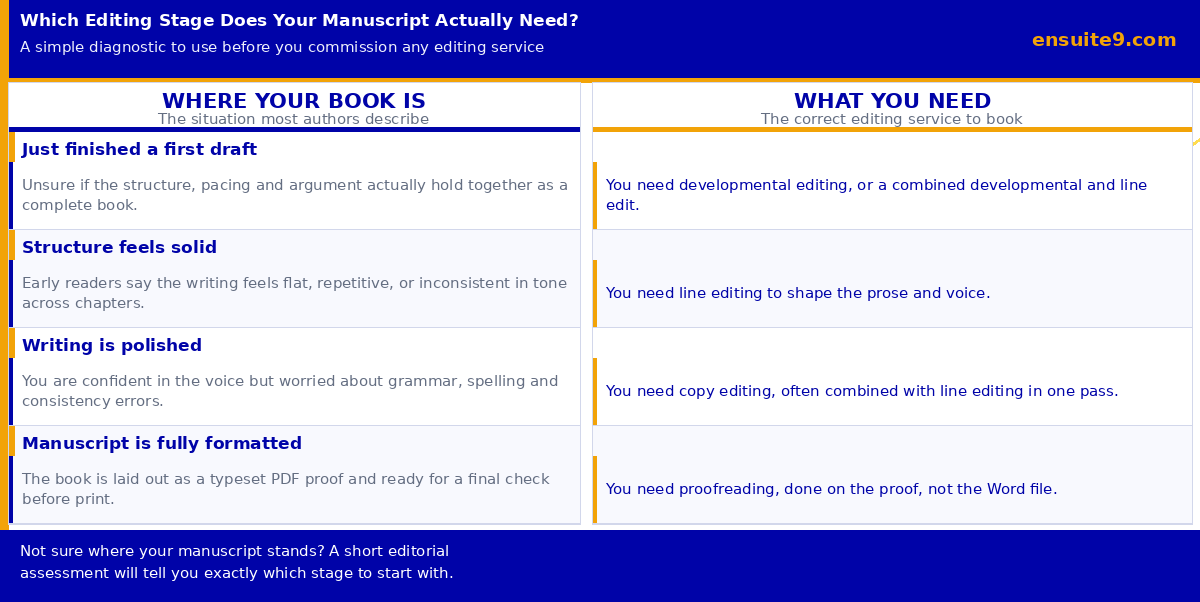
- Just finished a first draft, unsure if the structure and argument hold together: you need developmental editing, or a combined developmental and line edit.
- Structure and argument feel solid, but the prose feels flat, repetitive, or inconsistent in voice: you need line editing.
- Writing is polished and you’re confident in the voice, but you’re worried about grammar, consistency, and factual accuracy: you need copy editing.
- The manuscript is fully edited and formatted into a typeset proof, ready for a final check before print: you need proofreading.
- Genuinely not sure which stage you’re at: request a short editorial assessment before committing to a full service. A professional read of a sample chapter or two will tell you exactly where your manuscript stands.
Most first-time authors, particularly those who have not worked with a professional editor before, benefit from a combined line and copy edit rather than developmental editing, provided they are genuinely confident in their book’s structure and have already had honest feedback from readers on the overall shape of the story or argument. If you have not had that feedback yet, be honest with yourself and your editor about that before committing to a service that assumes structure is already settled.
What Editing Costs in Nigeria in 2026
Real, current pricing for a standard-length manuscript, based on Ensuite 9’s active rates:
- Proofreading: from ₦60,000 for a typical manuscript, scaling with length
- Line editing / copy editing (combined): from ₦105,000 to ₦180,000 depending on manuscript length and complexity
- Developmental editing: from ₦200,000 as a project fee, since scope varies significantly by manuscript
Internationally, the Editorial Freelancers Association’s 2026 rate chart puts fiction developmental editing at roughly 3.0 to 3.5 cents per word, which works out to $2,400 to $2,800 for an 80,000-word manuscript, giving useful context for how Nigerian rates compare to the international benchmark for the same scope of work.
For a full breakdown of every publishing cost, not just editing, see: Cost to Publish a Book in Nigeria 2026, or use our free publishing budget calculator to get an instant estimate based on your specific manuscript.
How to Avoid the Most Common Editing Dispute
The most frequent source of conflict between authors and editors is not quality, it is scope. An author who told their editor they were confident in their manuscript’s structure and did not need developmental editing, and who therefore commissioned and paid for line editing, cannot reasonably expect the delivered edit to have restructured their argument or rewritten large sections, because that was never the service agreed upon. Equally, an editor who delivers a proper line edit within the agreed scope has fulfilled their obligation even if the author, upon reflection, decides they actually wanted something more substantial.
The practical safeguard, on both sides, is clarity before work begins. Be honest with your editor about your manuscript’s actual state, not the state you hope it is in. If you are not sure, ask for an assessment first. Confirm in writing exactly which stage of editing is being commissioned and what it does and does not include. And understand that once an edit is delivered and approved, any subsequent large-scale rewriting by the author constitutes a new manuscript requiring a fresh editorial pass, not a free revision of the original.
Frequently Asked Questions
Can I skip line editing and go straight from developmental editing to copy editing? It is not recommended. Line editing addresses sentence-level style and voice, which copy editing does not cover. Skipping it typically means the prose reads grammatically correct but stylistically flat or inconsistent, which a copy edit alone will not fix.
Do I need developmental editing if beta readers already gave me feedback? Beta reader feedback is valuable but not a substitute for a professional developmental edit. Beta readers can tell you something feels off. A developmental editor can diagnose exactly what is wrong and how to fix it, with the structural expertise to solve problems rather than just identify them.
Why can’t proofreading happen before the book is formatted? Proofreading specifically catches errors introduced during typesetting, such as awkward page breaks, widows and orphans, and inconsistent headers. These errors do not exist until the manuscript has been laid out into its final print or eBook format, so there is nothing for a proofreader to check before that stage.
What happens if I want to make major changes after my manuscript has been edited? Minor revisions based on the delivered edit are normal and expected. However, if you substantially rewrite large portions of the manuscript independently after editing is complete, this constitutes a new manuscript and will require a fresh editorial pass, typically at an additional cost, since it is a different document from the one originally edited.
Can line editing and copy editing be combined into one service? Yes, and this is standard practice for manuscripts that do not require developmental work. Many professional editors, including Ensuite 9, combine the two into a single pass for manuscripts with a settled structure, since the two stages overlap considerably.
How do I know which stage my manuscript is at? If you are unsure, request a short editorial assessment before committing to a full service. A professional read of a sample chapter will identify whether your manuscript’s core issue is structural, stylistic, or mechanical, and recommend the right starting point.
Not sure which level of editing your manuscript needs? Book a free discovery call with Ensuite 9 and we will assess your manuscript honestly before recommending a service, rather than defaulting to the most expensive option.