Most advice about selling books as an independent author assumes Amazon is the centre of your publishing business. For African authors, and specifically for authors based in Nigeria or selling to Nigerian and diaspora readers, this assumption creates a set of problems that most generic publishing guides never address. Amazon pays royalties in US dollars, with a minimum threshold of $100, through a payment processor that requires additional setup for Nigerian bank accounts. Amazon owns the customer relationship entirely, meaning you never see a buyer’s email address and cannot communicate with your readers after a sale. And Amazon’s royalty structure, while competitive by Western standards, loses a significant portion of its value in naira terms through the currency conversion process.
Direct book sales, selling your book through platforms and channels you control, remove most of these frictions simultaneously. You set the price in naira, receive payment within 24 to 48 hours directly to your Nigerian bank account, and own the customer relationship completely. The trade-off is that you are responsible for driving traffic to your sales page rather than benefiting from Amazon’s organic search and recommendation engine. This guide covers how to build a direct sales infrastructure that makes that trade-off work in your favour and why using both Amazon and direct sales simultaneously is the right strategy for most African authors in 2026.
Why Direct Sales Matter More for African Authors Than for Western Ones
For an author based in the US or UK, selling on Amazon is largely frictionless. Royalties arrive in dollars into a dollar bank account. The payment threshold is easily cleared within a month or two of a moderately successful launch. Customer acquisition through Amazon’s organic search is genuinely powerful, since the platform serves hundreds of millions of readers who are already looking for books. The calculation for a US or UK author is legitimately different from the calculation for a Nigerian one.
For a Nigerian author, every step in the Amazon process introduces a layer of friction or cost that does not exist for their Western counterparts. The Payoneer account required to receive USD payments carries its own fees and conversion rates. The minimum $100 threshold means a new author may wait months before seeing their first payout. The naira equivalent of a $6.99 royalty shifts constantly with the exchange rate, making revenue unpredictable in the currency you actually spend. And at no point in any of this do you ever know who your readers are.
Direct sales through platforms built for the African market remove most of these layers at once. Selar, the most widely used digital product selling platform for African creators, was built specifically with the reality of Nigerian buyers and sellers in mind. It accepts naira payments, supports bank transfers (which matter enormously in a market where card infrastructure can be inconsistent), and pays out to a Nigerian bank account within 24 to 48 hours of each sale. When your customer is in Lagos or Accra or Nairobi and they land on a product page that accepts their local payment method, the conversion rate improves relative to sending them to a dollar-denominated checkout.
The 6 Direct Sales Channels African Authors Are Using in 2026
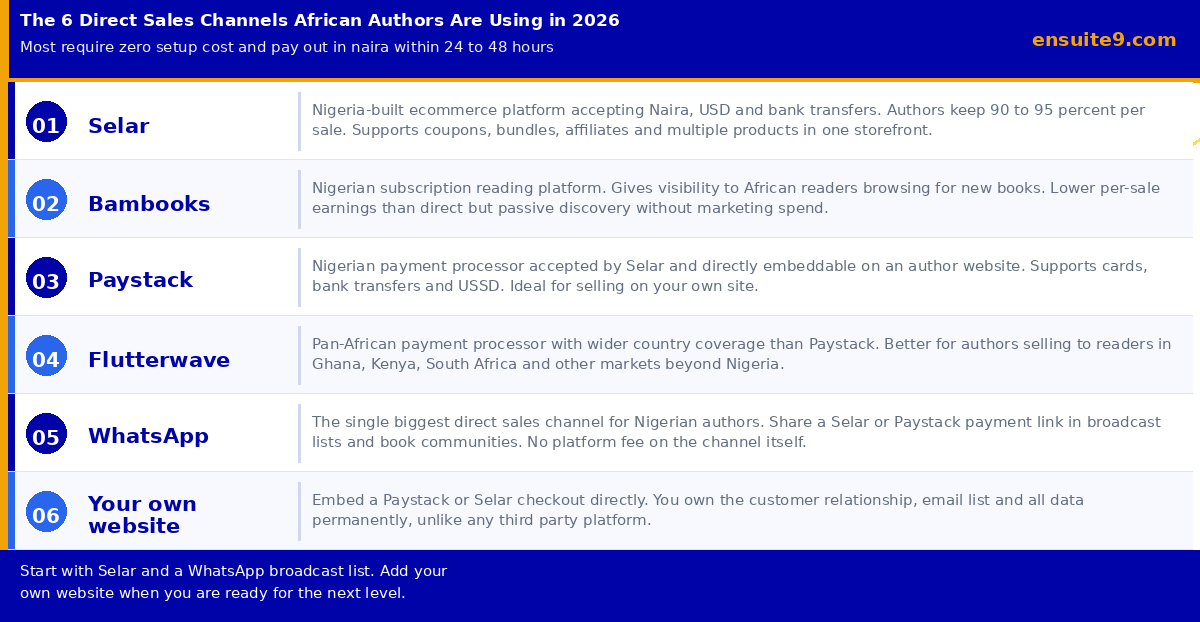
Selar is the starting point for most Nigerian authors moving into direct sales. It is an ecommerce platform for digital products, including eBooks, courses, and bundles, that accepts payment in naira, USD, and other currencies, with support for bank transfers, card payments, and Paystack as the underlying payment processor. Authors keep 90 to 95 percent of each sale depending on their plan, a significantly higher margin than any retail platform offers. Selar also supports coupon codes, product bundles, affiliate programmes, and upsells, giving authors the tools to build a genuine sales funnel rather than just a single product listing. Setting up a Selar storefront takes under an hour for a first-time user and requires no technical knowledge.
Bambooks operates on a Netflix-style subscription model, where readers pay a monthly fee to access a library of books from African authors. For authors, this means your book appears in a catalogue that readers are already browsing, which provides passive discoverability without requiring you to drive every individual reader to a specific product page. The trade-off is that per-read earnings through a subscription model are lower than per-copy earnings through direct sale. Bambooks works best as a visibility layer, putting your book in front of Nigerian readers who may not have found you otherwise, rather than as a primary revenue driver. It is free to list on Bambooks as an author.
Paystack is the payment processor that powers much of Nigeria’s digital commerce, and it can be embedded directly into an author website as a checkout mechanism. If you have a WordPress site, you can install a Paystack plugin, upload your eBook as a downloadable file, and sell directly from your own domain without any intermediary platform taking a percentage of each sale. Paystack charges a transaction fee of 1.5 percent plus 100 naira per transaction, capped at 2,000 naira for Nigerian transactions. This is significantly cheaper than any third party platform’s percentage cut, making it the highest margin direct sales option available for authors with an existing website audience.
Flutterwave serves a similar function to Paystack but with broader coverage across African markets, supporting payments in more than 30 African currencies, including Ghanaian cedis, Kenyan shillings, and South African rand. For Nigerian authors whose audience extends across the continent rather than being primarily Nigeria-focused, Flutterwave’s wider geographic reach makes it the better payment infrastructure choice. Flutterwave also integrates with Selar, giving authors the option of receiving both naira and non-naira payments through a single storefront.
WhatsApp is the channel that surprises most authors when they first encounter the scale of direct sales happening through it. More Nigerian books are sold through WhatsApp broadcast lists and communities than most Western publishing guides would ever mention, precisely because WhatsApp is not a channel that Western publishing data captures. For a Nigerian author with an existing following or community, sharing a Selar payment link through a WhatsApp broadcast list to 1,000 contacts who already know and trust you converts at a meaningfully higher rate than sending traffic to an Amazon listing where you are competing with thousands of other titles. There is no platform fee on WhatsApp itself, and the Selar link handles the payment and file delivery automatically.
Your own website is the most resilient direct sales channel because it is the only one you own outright. Selar can change its terms, Paystack can go down, WhatsApp can change its broadcasting policy, and Amazon can change its royalty structure, none of which affects your own domain. An author website with a Paystack or Selar checkout embedded directly, combined with a blog that generates organic search traffic, is a sales infrastructure that compounds in value over time without depending on any third party platform’s continued goodwill. For more on what a conversion-focused website looks like in practice, see: How to Build a Website That Converts.
Amazon KDP vs Direct Sales: The Real Numbers
The comparison between Amazon KDP and direct sales is not straightforward in either direction. Amazon offers volume and discoverability that no direct sales channel can replicate at launch. Direct sales offer margin, customer ownership, and naira-denominated revenue that Amazon cannot offer Nigerian authors. The right answer for most African authors is not to choose one or the other but to understand what each channel does better and configure your strategy accordingly.
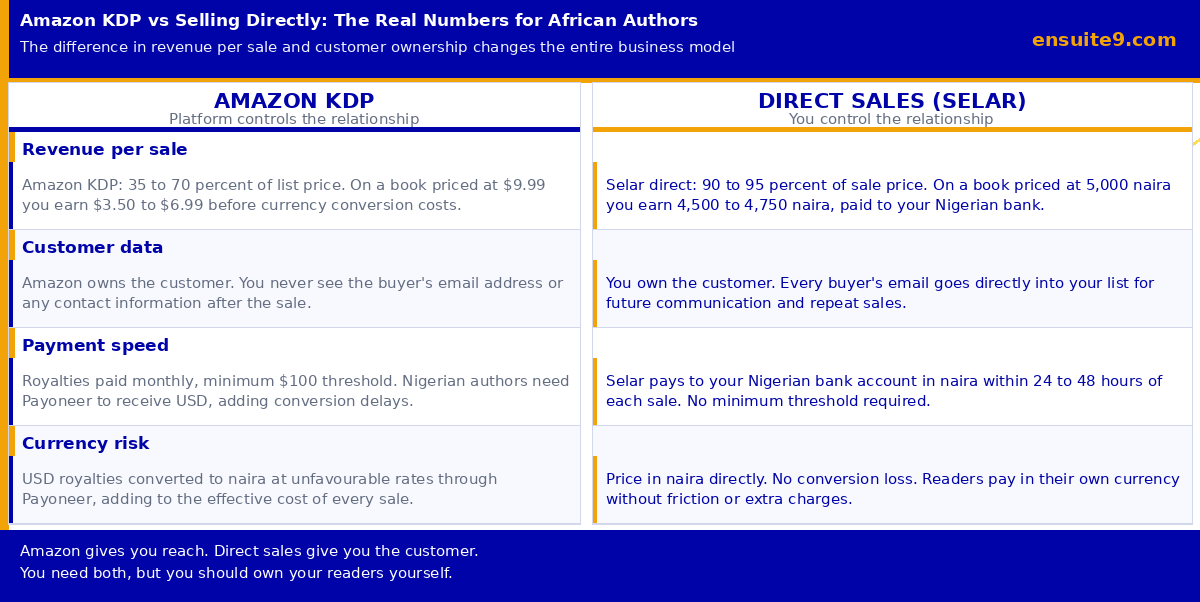
On revenue per sale, Amazon KDP offers a 70 percent royalty on eBooks priced between $2.99 and $9.99 in the US market, falling to 35 percent outside that range. On a book priced at $9.99, you earn approximately $6.99 per sale before Payoneer conversion fees reduce the effective naira value further. On Selar, keeping 95 percent of a book priced at 5,000 naira, you earn 4,750 naira per sale, deposited to your Nigerian bank account within 48 hours. The naira value of the Selar sale is more predictable than the dollar value of the Amazon sale converted at a variable exchange rate.
On customer data, Amazon owns the customer completely. You are never given the buyer’s email address, name, or any contact information after a sale. If you want to communicate with readers who bought your book on Amazon, build your email list, or sell them a future book directly, you have no way to reach them. On Selar, every buyer’s email address goes directly into your account, and you can export that list at any time and import it into MailerLite, which means every direct sale compounds into a future marketing asset as well.
On payment speed, Amazon pays monthly with a minimum $100 threshold and a 60-day payment delay, meaning a sale made today is not paid until approximately two months from now. Selar pays within 24 to 48 hours of each sale, with no minimum threshold, directly to your Nigerian bank account in naira. For an author managing cash flow in a high-inflation environment, the difference between waiting two months for a dollar payment and receiving naira within 48 hours is commercially significant.
How to Set Up Your Direct Sales Infrastructure
Building a direct sales infrastructure does not require technical knowledge or significant upfront cost. Here is the sequence that works for most African authors starting from zero.
Step 1: Set up a Selar account. Go to selar.co and create a free account using your email address. Complete your profile, including your display name and payout bank details. Selar requires a Nigerian bank account for naira payouts. The account setup takes under 30 minutes and you can be live with a product the same day.
Step 2: Upload your eBook. In your Selar dashboard, click Create Product and choose Digital Download. Upload your EPUB or PDF file, set the price in naira or USD, write a compelling product description, and upload your book cover image. The product page Selar generates is clean, mobile-friendly, and designed to convert. You do not need a separate website to start selling.
Step 3: Get your product link. Selar generates a unique URL for your product page. This is the link you share everywhere, in your WhatsApp broadcast list, in your Instagram bio, in your email signature, in your blog posts, and in your LinkedIn profile. Every time someone clicks it and completes a purchase, the file is delivered to them automatically and the payment hits your account within 48 hours.
Step 4: Build your WhatsApp broadcast list. If you do not already have one, start a WhatsApp broadcast list with everyone in your contacts who fits your ideal reader profile. A broadcast list sends a message to multiple contacts privately rather than in a group, meaning each person receives it as a direct message from you. When your book is ready, share the Selar link with a brief personal message explaining what the book covers and who it is for. This single step, done to a warm list of people who already know you, typically generates the first sales of any new release before any other marketing channel does.
Step 5: Add your Selar link to every platform you are on. Instagram bio, Twitter bio, LinkedIn featured section, email signature, and the end of every blog post you publish. Treat the Selar link the way you would treat a contact page link, it should be findable from every online presence you have without a reader needing to search for it.
Selling to Diaspora Readers
African authors selling to diaspora readers in the UK, US, Canada, and Australia face a slightly different set of considerations than those selling primarily to readers in Nigeria. Diaspora readers are more likely to have dollar-denominated payment methods and to be comfortable purchasing through Amazon or Apple Books as they would for any other book. They are also more likely to be reached through LinkedIn, Twitter, and podcast appearances than through WhatsApp broadcast lists or Nigerian book communities.
Selar supports USD pricing and accepts international card payments, which means your Selar storefront can serve both Nigerian readers paying in naira and diaspora readers paying in dollars from the same product page. You do not need a separate storefront for each audience. Set your price in naira, and Selar handles the currency conversion for international buyers automatically.
For diaspora readers who specifically prefer purchasing through Amazon, keeping your book live on KDP as well as Selar means you are not excluding any segment of your potential readership. Amazon remains the most trusted retail channel for readers who are accustomed to buying books there, and there is no reason to remove it from your distribution simply because you have added a direct sales channel. The two are complementary, not competing. For a full guide to Amazon KDP setup for African authors, see: The African Author’s Complete Guide to Amazon KDP in 2026.
The Role of Email in Direct Sales
The most important thing that direct sales give you, more important even than the higher margin per sale, is the email address of every person who buys your book. That email address is the beginning of a reader relationship that compounds over time in a way that a one-time Amazon transaction never can.
When you have a reader’s email address, you can tell them when your next book is coming out. You can invite them to a virtual launch event. You can share a free excerpt. You can offer them a discount on a related title. You can ask them for a review. None of these conversations are available to you through Amazon, because Amazon never gives you access to the people who bought your book. Through direct sales, every buyer becomes a potential long-term reader relationship rather than a one-time anonymous transaction.
Export your Selar buyer list into MailerLite regularly, at minimum monthly, and treat it as your most valuable publishing asset. An email list of 500 people who have already bought one of your books is worth considerably more to your publishing business than 5,000 social media followers who have never purchased anything.
Pricing Your Book for the Nigerian Market
Pricing a book for the Nigerian market requires a different calculation from pricing for international retail. The naira price needs to be accessible enough that your target reader does not hesitate at checkout, while still reflecting the value of the work and covering your production costs with a meaningful margin remaining.
For most non-fiction e-books targeted at Nigerian professionals, coaches, and business owners, a price range of 3,000 to 8,000 naira sits in the sweet spot between accessible and credible. Below 2,000 naira, a professional non-fiction book risks being perceived as low quality regardless of its actual content. Above 10,000 naira, the purchase requires active justification from the buyer, which increases cart abandonment for impulse-driven purchases.
Fiction pricing tends to run lower than non-fiction in the Nigerian market, typically 1,500 to 4,000 naira for an eBook, reflecting the reading habits and purchasing patterns of Nigerian fiction readers who are accustomed to the pricing structures of platforms like Bambooks and OkadaBooks.
Test your pricing. Selar allows you to change your price at any time, and the platform supports coupon codes for promotional pricing without permanently reducing your list price. Start at the price that feels right for your audience, run a launch promotion at a reduced rate for the first two weeks, and then return to your standard price. The launch discount creates urgency without permanently devaluing the book.
Frequently Asked Questions
Can I sell on Selar and Amazon at the same time? Yes, and for most African authors this is the recommended approach. Amazon handles the global retail audience who prefer buying through Amazon. Selar handles Nigerian readers and anyone else who finds you through your own marketing channels. The two platforms do not conflict with each other unless your book is enrolled in KDP Select, which requires Amazon exclusivity for the eBook edition. If you are in KDP Select, you cannot also sell the eBook on Selar. If you are on KDP without Select, wide distribution is available and you can sell on both simultaneously.
How does Selar deliver the eBook to the buyer? Automatically. When a buyer completes their purchase on your Selar product page, Selar sends them an email with a download link for your file. You do not need to manually send anything to anyone. The delivery happens immediately after payment confirmation regardless of the time of day.
What file format should I upload to Selar? EPUB is the recommended format for eBooks since it works on all devices and reading apps. PDF is also widely accepted and some authors upload both formats and let the buyer choose. For a full explanation of the difference between EPUB and PDF for eBook distribution, see: What Is an EPUB File? Everything Authors Need to Know.
Do I need an ISBN to sell on Selar? No. Selar does not require an ISBN to list a digital product. However, if you want your eBook to also be distributed through retail platforms like Amazon KDP, Apple Books, and IngramSpark, a registered ISBN is important for those channels. For a full guide to ISBN registration in Nigeria, see: ISBN Registration in Nigeria.
How do I drive traffic to my Selar page? Your existing audience is the starting point, WhatsApp broadcast list, Instagram bio link, LinkedIn featured section, and email signature. Beyond that, the most sustainable traffic source is organic search from your blog or website, since a blog post that ranks for a relevant search term continues sending readers to your Selar page indefinitely after it is published.
Is Bambooks worth using for a first-time author? Yes, as a visibility tool rather than a primary revenue channel. Listing your book on Bambooks costs nothing and puts it in front of Nigerian readers who are already paying for access to African literature. The per-read earnings are lower than direct sales, but the discoverability is passive, meaning readers find you without you having to actively market to them on the platform.
Ensuite 9 helps African authors build complete publishing and distribution strategies, from manuscript to live book across Amazon KDP, IngramSpark, Selar, and your own website. Book a free discovery call to discuss your book’s distribution plan.