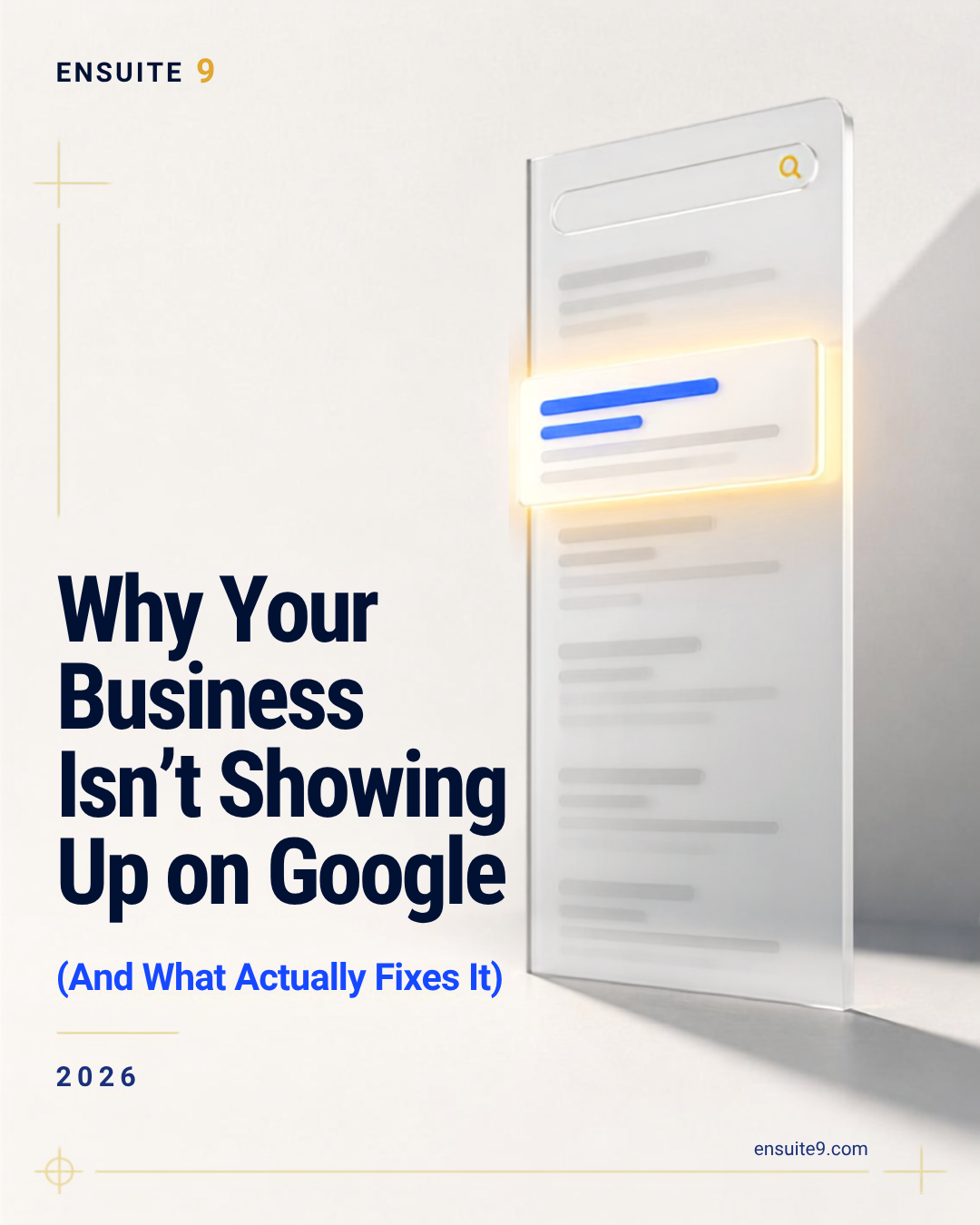
You typed your own business name into Google. Nothing came up. Or you searched the service you offer plus your city, and watched three competitors take the map results while you were nowhere on the first page, or missing entirely.
This is one of the most common frustrations for Nigerian business owners, and it usually has nothing to do with the quality of your product or service. It has to do with a handful of specific, fixable gaps between what your business is actually doing and what Google needs to see in order to trust and show you. This guide walks through exactly why this happens, and what genuinely fixes it, not vague advice about “doing more SEO,” but the specific, sequenced actions that actually move the needle.
The First Question: Do You Even Have a Google Business Profile?
Before anything else, check whether your business has a Google Business Profile at all. Search your business name plus your city. If no information panel appears on the right side of the results, your profile likely does not exist yet, or was never claimed. Studies suggest a majority of small and medium businesses have not properly claimed their Google Business Profile, which means most businesses are starting from behind without realising it.
Sometimes a panel does load, but the listing looks abandoned, no photos, incorrect hours, a greyed out “claim this business” link. This means the listing exists in Google’s system, generated automatically from public data, but nobody from the business has claimed and taken ownership of it. This is a five-minute fix with meaningful consequences: an unclaimed or unverified profile sends a weak trust signal to Google’s local ranking systems, and Google does not show what it does not trust.
“I’m on Instagram” Is Not the Same as Being on Google
This is the single most common misunderstanding among Nigerian business owners, and it deserves to be addressed directly. Many business owners reasonably assume that being active on Instagram, with a WhatsApp Business account for orders, is sufficient online presence. For day to day sales to an existing audience, it can work reasonably well. But it does not solve the discoverability problem, because Instagram and Google are fundamentally different systems answering different questions.
Instagram shows your content to people who already follow you, or to people the algorithm guesses might be interested based on behaviour. Google shows your business to people who are actively typing a specific need into a search bar, a much higher intent moment. Roughly 85 percent of Nigerians searching online are doing so from their phones, and the overwhelming majority of that active searching happens on Google, not inside Instagram. When someone needs a specific service urgently, a notary, a tailor, a clinic that does not require a three week wait, they Google it. If your business only exists on Instagram, you are invisible in exactly the moment someone is ready to buy.
A WhatsApp link compounds this problem rather than solving it. A WhatsApp link has genuine value as a contact mechanism once someone has found you, but it has zero SEO value. It is not indexed by Google, it does not accumulate content over time, and it cannot rank for any search term, no matter how many people click it. “Order via DM” or “message us on WhatsApp” as your only call to action means Google has nothing to actually index, crawl, or rank. You are relying entirely on people already knowing you exist.
The Three Things Google Is Actually Evaluating
Google’s local ranking system in 2026 is built around three core factors, and understanding them changes how you think about every fix that follows.
Relevance is whether your business genuinely matches what someone is searching for. This depends on your category selection, the words used on your website and profile, and whether your content actually describes what you do in the language customers search with, not necessarily the language you’d use internally.
Proximity is how close your business is to the person searching. This one is largely outside your control, Google knows where the searcher is and where your listed address is, and there is no trick to override physical distance for local searches.
Prominence is your overall authority: your reviews, your content, your online reputation, and how consistently your business information appears across the web. This is the factor most within your control, and the one most businesses neglect entirely.
Relevance and prominence are yours to build. Proximity is not. This means the fixes that matter are the ones that improve how clearly Google understands what you do, and how much trust and authority your business has accumulated online.
The Five Specific Reasons Businesses Stay Invisible
1. An unverified or incomplete Google Business Profile
Beyond simply claiming it, a genuinely optimised profile has an accurate primary category, complete service listings, correct and updated hours, and photos. Missing even one of these weakens the whole listing.
2. Inconsistent business information across the web
This is referred to as NAP consistency, Name, Address, Phone number. If your business name, address, or phone number differs even slightly between your website, your Google Business Profile, your Instagram bio, and any directory listing, Google’s systems read this as a trust signal problem rather than a typo. Audit every platform your business appears on and make every instance identical.
3. No website, or a website Google cannot properly read
A website becomes necessary once you want to rank for anything beyond the most basic local search, once you want to publish content that builds long term authority, or once your services genuinely need explanation before a customer is ready to contact you. Instagram-only and WhatsApp-only businesses hit this ceiling quickly, particularly if they serve customers across multiple cities or sell products that benefit from being searchable individually.
4. Weak or absent prominence signals
Recent reviews matter more than total review count. A business with 10 reviews from the past month signals more current activity to Google than a business with 200 reviews from three years ago and silence since. Local directory listings (Nigerian directories like VConnect, business list sites, and category-specific marketplaces) also contribute meaningfully to this signal and take under an hour each to set up.
5. A poor mobile experience
Since the overwhelming majority of Nigerian searches happen on mobile devices, a website that loads slowly or requires pinching and zooming to read is actively working against you. Google factors mobile usability directly into ranking, and visitors abandon slow or clunky mobile pages before they even read your first sentence.
What Actually Fixes This, In Order
Work through these in sequence rather than attempting all of them simultaneously.
- Claim and fully complete your Google Business Profile: correct category, complete service list, current hours, real photos.
- Audit your business name, address, and phone number across every platform you appear on, and make them identical everywhere.
- Build a proper website with clear service pages, if you do not already have one, since this is the foundation everything else depends on.
- List your business on relevant Nigerian directories, an hour of setup work with a real ongoing visibility return.
- Ask satisfied customers for reviews consistently, not as a one-time push, since recency matters as much as volume.
- Ensure your website works properly and loads quickly on a phone, since this is where the vast majority of your visitors will actually experience it.
What Not to Do
Do not assume paying for Google Ads solves an underlying visibility problem. Ads can put you in front of people temporarily, but they do not fix why your organic listing is weak, and the moment the ad budget stops, the underlying invisibility returns exactly as it was. Do not stuff keywords into your business name on your Google profile either, this is against Google’s guidelines and risks suspension of your listing entirely. And do not treat this as a one-time task. Google rewards businesses that show ongoing activity, fresh reviews, updated information, active content, not businesses that set everything up once and go quiet.
How Long Before You See Results
Local SEO is a genuinely fast-moving category compared to broader national search rankings. Nigerian businesses that properly complete a Google Business Profile optimisation and clean up their citation consistency often see meaningful map pack visibility within 30 to 60 days, particularly in categories where competitors have been neglecting their own profiles, which is common. Broader website ranking for competitive search terms takes longer, typically 3 to 6 months of consistent content and authority building, but the local, high-intent searches that actually bring in customers ready to buy can move considerably faster than that.
Frequently Asked Questions
Can I rank on Google without a website at all?
To a limited extent, yes, through a fully optimised Google Business Profile and directory listings. But you will hit a ceiling quickly if you want to rank for anything beyond the most basic local search, or if you need to explain your services in depth before a customer contacts you.
Does having a WhatsApp Business account help my Google ranking?
It helps as a contact mechanism once someone has already found you, but it has no SEO value on its own. A WhatsApp link is not indexed or ranked by Google in any way.
Does a .com.ng domain rank better than a .com domain for Nigerian searches?
A local domain extension can provide a modest local trust signal, but it is a minor factor compared to a complete Google Business Profile, consistent NAP information, and genuine content relevance.
How many reviews do I actually need?
There is no fixed number. Recency of reviews matters more than total count, so a steady, ongoing flow of new reviews is more valuable than a large historical total with no recent activity.
Will running Google Ads fix my visibility problem?
Ads can generate temporary visibility, but they do not address the underlying reasons your organic listing is weak. Once ad spend stops, the invisibility problem returns exactly as it was before.
My business serves customers in multiple Nigerian cities. Does that change anything?
Yes. Multi-city service businesses hit the limits of profile-only and social-only visibility much faster, since Google Business Profiles are inherently tied to a single physical location. A website with dedicated content for each service area becomes necessary sooner in this case.
Ensuite 9 builds websites and Google visibility foundations for businesses that are ready to move beyond Instagram and WhatsApp as their only presence online. Book a free discovery call to talk through what your specific business needs.