Most authors sign their first publishing contract without fully understanding what they are agreeing to, not because they are careless, but because nobody explains the difference between what a publishing contract traditionally means and what it actually means when you self-publish with a production partner in Nigeria today. These are two genuinely different documents, and confusing them is where most misunderstandings between authors and their publishing partners begin.
This guide explains exactly what to expect from a publishing contract in Nigeria, the difference between the two types of contracts you might encounter, the specific clauses that protect you, and what a fair, professional agreement actually looks like from start to finish.
The Confusion That Most First-Time Authors Battle
When most people hear “publishing contract,” they picture a traditional publishing deal, the kind where a publisher acquires the rights to your book, pays you an advance, and takes a share of every sale going forward. A traditional publishing agreement is built around four core provisions: the rights grant, the advance, the royalty structure, and the publication obligations. The rights grant is the engine of the whole document, and in most standard traditional agreements, it is sweeping. Publishers typically seek exclusive rights to publish, sell, distribute and license the work across all formats, languages and territories, often for the full duration of copyright, which is the life of the author plus 70 years. That is not a typo. Unless the contract contains a genuine reversion clause, the publisher can control your book for longer than you will be alive.
This is not what most African authors self-publishing today are actually signing, and it is important to be clear about that upfront. When you work with a self-publishing production partner like Ensuite 9, you are not transferring your rights. You are purchasing a service. The contract you sign is a production and services agreement, not a rights-acquisition agreement. You remain the publisher of record. You own the ISBN, the manuscript, and every final file produced. There is no royalty split with your production partner because you are not licensing anything to them, you are paying them to produce your book.
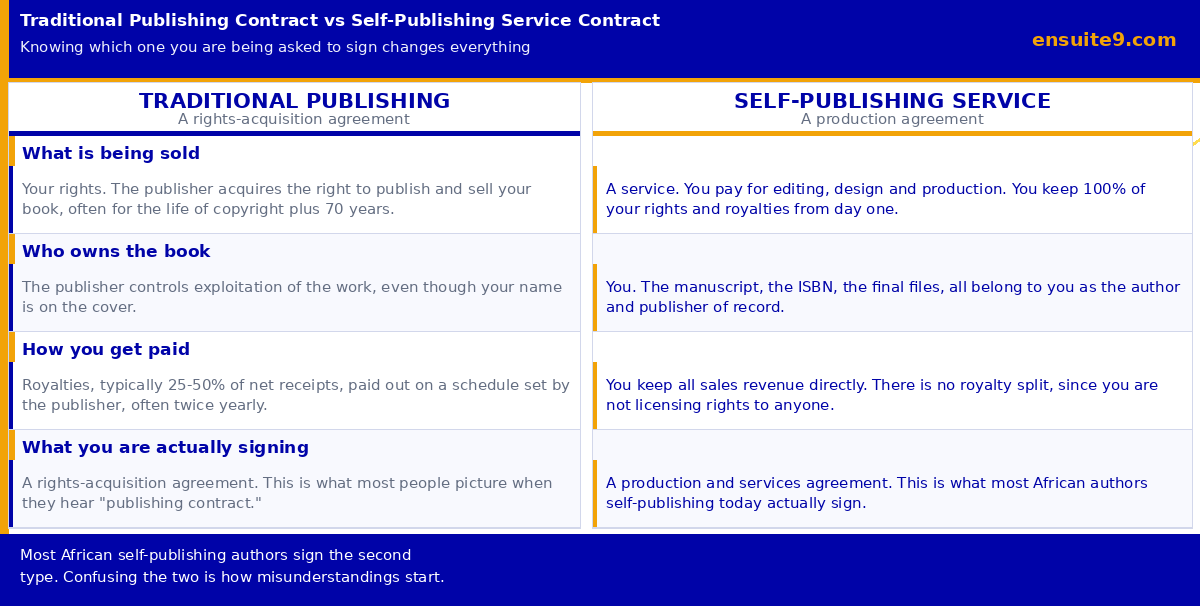
Understanding which type of agreement you are being asked to sign changes everything about how you should read it. If a Nigerian publisher or production company presents you with a contract that talks about acquiring rights, royalty percentages on your own sales, or long exclusivity terms, ask direct questions before signing, since this signals a fundamentally different arrangement than a standard self-publishing service agreement.
The Six Clauses Every Publishing Service Contract Should Include
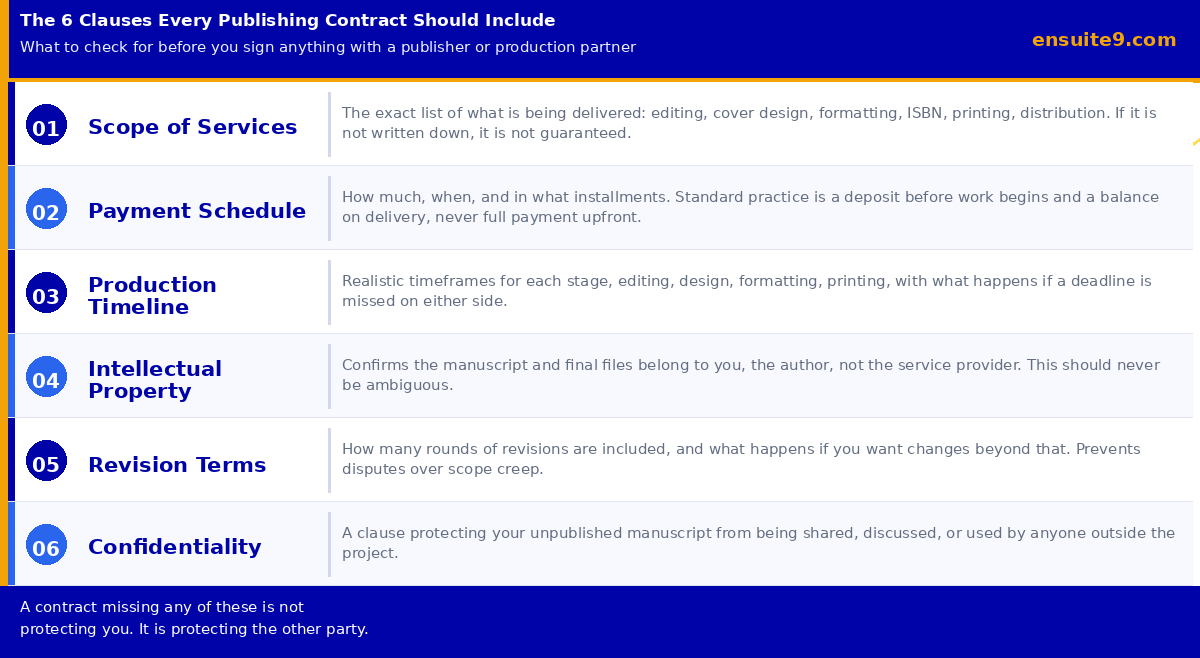
1. Scope of services. The contract should list, in specific detail, exactly what is being delivered, editing, cover design, interior formatting, ISBN registration, print production, eBook distribution, and any other service included. Vague language like “full publishing support” is not a scope of work. If it is not written down as a specific, itemised list, it is not something you can hold your production partner to.
2. Payment schedule. A professional contract sets out exactly how much is due, when, and in what installments. The standard and safest structure for both parties is a deposit paid before work begins, typically 50 to 80 percent, with the balance due on delivery of final files. Be cautious of any arrangement asking for 100 percent payment upfront with no milestones, since this removes your leverage entirely if something goes wrong partway through the project.
3. Production timeline. Realistic timeframes should be attached to each stage of the process, editing, design, formatting, and printing, along with what happens if a deadline is missed on either side. A contract with no timeline at all gives you nothing to hold anyone accountable to, and a contract with an unrealistically fast timeline is often a warning sign of corners being cut.
4. Intellectual property. This clause should state plainly and without ambiguity that the manuscript, and all final production files, belong to you as the author. In a proper self-publishing service agreement, your production partner acquires no rights of any kind in your work simply by producing it. If a contract is unclear on this point, or implies any transfer of rights to the service provider, that is a serious red flag worth questioning directly before signing anything.
5. Revision terms. The contract should specify how many rounds of revisions are included at each stage, cover design, editing, formatting, and what the cost is for revisions beyond that. This single clause prevents the most common source of disputes between authors and production partners, since without it, “how many changes are reasonable” becomes a matter of opinion rather than a written agreement.
6. Confidentiality. A confidentiality clause protects your unpublished manuscript from being shared, discussed, or used by anyone outside the direct scope of the project. This matters more than many first-time authors realise, particularly for memoirs, sensitive non-fiction, or manuscripts touching on personal, legal, or professional matters that have not yet been made public.
What a Realistic Payment Structure Looks Like
The most common and reasonable payment structures for a self-publishing service agreement fall into two patterns. The first, and most standard, is 50 percent on signing and commencement of work, with 50 percent due on satisfactory completion and delivery of final files. The second, more common for larger or more involved projects, is 80 percent upfront to cover the significant upfront cost of print production, cover design, and editorial work, with 20 percent due on final delivery.
Neither structure is inherently more correct than the other, the right split depends on the size of the project and how much of the cost is front-loaded into materials and print production versus spread across the timeline. What matters is that the split is clearly written, tied to specific milestones rather than vague dates, and that no reputable production partner asks for full payment with no protection for you if work is not delivered as agreed.
What Happens When the Manuscript Changes Significantly After Signing
One area worth addressing directly, since it is a genuinely common source of friction, is what happens when an author substantially revises their manuscript after editing or formatting has already begun. A good contract distinguishes clearly between two different things: revisions, which are changes made to an already-edited manuscript based on the author’s feedback on that specific edit, and a substantial rewrite, which is effectively a new manuscript requiring a fresh editorial and formatting pass.
If your manuscript changes significantly, new chapters, a different structural approach, extensive rewriting, after an editor has already worked on it, this is reasonably treated as new work requiring additional scope and, in most cases, additional cost. A well-written contract states this plainly upfront, which protects both you and your production partner from a disagreement about what should reasonably be included in the original scope of work.
Author Warranties: What You Are Confirming When You Sign
Most publishing contracts, including self-publishing service agreements, include a warranties clause requiring the author to confirm that they own the rights to the manuscript and that the work does not infringe on any third party’s rights or contain defamatory or libelous content. This exists to protect both parties, it is standard practice, not a sign of distrust, and any author should expect to see and agree to a clause like this in any publishing agreement they sign, regardless of who they are working with.
Reversion and Termination: What Happens If Things Do Not Work Out
Even in a straightforward production services agreement, it is worth having clarity on what happens if either party needs to end the arrangement partway through. A fair contract sets out the conditions under which the author can terminate the agreement, typically stating whether any deposit already paid is refundable, and under what conditions the production partner may pause or end the arrangement, such as non-payment or a serious breach of the agreed terms. Since this is a services contract and not a rights-acquisition deal, there is no “out of print” reversion clause to worry about the way there would be in a traditional publishing agreement, your rights were never transferred in the first place.
Red Flags to Watch For
A handful of warning signs are worth knowing before you sign anything. Vague promises without teeth, phrases like “author approval” of cover design or “consultation” on major decisions can sound reassuring while the fine print quietly gives the publisher full discretion to override your input anyway. Watch for this specific pattern: a right that sounds meaningful on the surface but has an escape hatch buried elsewhere in the document.
Also be cautious of any self-publishing arrangement that asks you to assign copyright to the company producing your book. While not all publishing contracts demand this, some smaller or less transparent operators do, and it means you would no longer legally own your own work. This is particularly important for authors self-publishing in Nigeria, since the entire appeal of self-publishing is retaining full ownership and control, a request for copyright assignment defeats the purpose of self-publishing altogether and should be treated as a serious red flag.
What This Looks Like in Practice
A properly structured self-publishing contract in Nigeria typically opens with the identities of both parties and the project details, the book title, format, specifications, and total agreed value. It then sets out the scope of services section by section, pre-press work such as editing and cover design, print production, and any digital distribution included. A payment schedule follows, tied to specific milestones rather than calendar dates alone. A production timeline sets realistic expectations for each stage. Clauses covering client obligations, intellectual property, revisions, confidentiality, and general terms round out the agreement, and the document closes with a signature block for both parties.
None of this needs to feel intimidating. A good contract is not designed to trap you, it is designed to make sure both sides know exactly what was agreed, so that if a question or disagreement comes up later, there is a written answer rather than a memory of a conversation.
Frequently Asked Questions
Do I lose my rights when I sign a self-publishing service contract? No. A self-publishing service agreement is fundamentally different from a traditional publishing deal. You remain the author and publisher of record, and you retain full ownership of your manuscript, your ISBN, and all final production files.
What is a reasonable deposit to pay before work begins? Most self-publishing service agreements in Nigeria require between 50 and 80 percent upfront, with the balance due on delivery of final files. Full payment upfront with no protection is not standard practice and is worth questioning.
What happens if I want to significantly change my manuscript after editing has started? Minor revisions based on feedback on the delivered edit are normal and typically included. However, a substantial rewrite after editing is complete is treated as new work requiring a fresh editorial pass, usually at additional cost, since it is effectively a different manuscript.
Should I be worried if a contract asks me to assign copyright? Yes, this is a significant red flag for a self-publishing arrangement. The entire benefit of self-publishing is retaining full ownership of your work. A legitimate self-publishing service provider has no reason to ask for copyright assignment, since they are being paid for a service, not acquiring rights.
Is a publishing contract negotiable? Yes. Any professional contract should be open to reasonable discussion before signing, particularly around timelines, payment structure, and revision terms. A production partner unwilling to discuss or clarify any part of their standard agreement is worth being cautious of.
Do I need a lawyer to review my publishing contract? For a standard self-publishing production agreement with a transparent, reputable partner, it is not strictly necessary, but it is always a reasonable and welcomed step, particularly for larger projects. Any legitimate production partner should have no objection to you taking time to review the contract carefully before signing.
Want a template to reference before you sign your own publishing agreement? Download our free sample publishing contract template, showing exactly how a fair, transparent self-publishing service agreement is structured, or book a free discovery call to discuss your project.