Book distribution is the system that gets your finished book from your computer into the hands of an actual reader. It sounds simple until you realise that bookstores almost never buy directly from individual authors, libraries do not accept submissions the way a publisher would expect, and Amazon, despite being the largest bookseller in the world, is only one piece of a much larger supply chain that most self-published authors never fully understand.
This guide explains what book distribution actually is, who the players are, how print and eBook distribution differ, what changed in the wholesale industry in 2025 that every author needs to know, and how African authors specifically should think about building a distribution strategy that does not depend entirely on one platform.
What Book Distribution Actually Means
Book distribution is the process of making your book available for purchase, formatted correctly, listed with accurate metadata, priced appropriately, and connected to every retailer, library, and platform where a reader might look for it. It is the supply system that connects your finished book to retailers, libraries, subscription services, and readers across formats, territories, and platforms.
For independent authors, distribution has never been more accessible than it is right now. It is possible to distribute eBooks, print books, and audiobooks globally without holding inventory or negotiating individual retailer deals, something that simply was not true twenty years ago, when getting a book into a physical bookstore required a traditional publishing deal and a sales team. At the same time, the sheer number of distribution options can feel overwhelming at first, and the system has a genuine learning curve. Every author finds the setup unfamiliar the first time through it.
The Four Roles in the Book Supply Chain
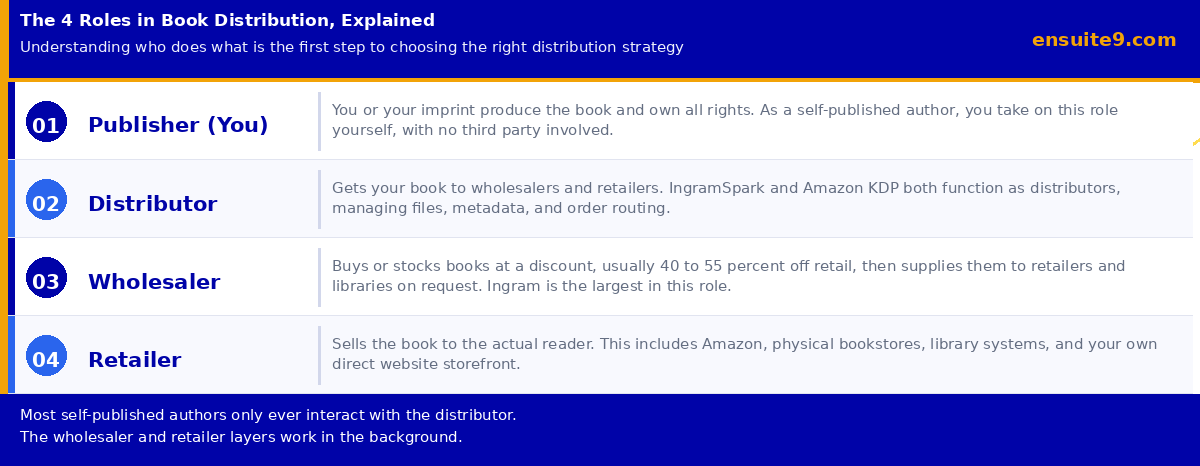
Understanding distribution starts with understanding four distinct roles, each of which can overlap with the others depending on the platform involved.
The publisher produces the book and owns the rights. As a self-published author, this role is you. You are not waiting for someone else to take this position, you occupy it from day one.
The distributor acts as the logistical link between the publisher and the marketplace. Distributors manage warehousing for print, order fulfilment, and relationships with wholesalers, bookstores, and online retailers. IngramSpark and Amazon KDP both function as distributors for self-published authors, though they operate quite differently from each other, which is covered in more detail below.
The wholesaler purchases or stocks books at a discount, typically 40 to 55 percent off the retail price, and supplies them to retailers and libraries on request. Wholesalers maintain large inventories specifically so that a bookstore can order five copies of your book without needing to contact you directly. Ingram Content Group is the largest wholesaler in this space, servicing more than 39,000 retail and library partners. Baker and Taylor has historically served a similar function, particularly for library distribution, though its role shifted significantly in 2025, which is covered in the section below on what changed last year.
The retailer sells the book to the actual reader. This includes Amazon, physical bookstores, library systems, and increasingly, an author’s own direct sales storefront. It is worth noting that Amazon plays more than one role simultaneously, it considers itself a retailer and a wholesaler at once, which is part of why KDP behaves differently from a traditional wholesale relationship.
Wholesalers, Distributors, and Aggregators: The Distinction That Confuses Most Authors
Three terms get used almost interchangeably in self-publishing advice, and untangling them clarifies a lot of confusion. Wholesalers purchase large quantities of books from publishers or distributors and resell them to retailers, libraries, and educational institutions at a markup, maintaining large warehouses that serve as inventory hubs. Distributors serve as the logistical link, managing warehousing, order fulfilment, and relationships across the chain, with some specialising in particular genres or formats. Aggregators are a separate category entirely, digital service providers that consolidate an author’s files and metadata and distribute them to a variety of online platforms, typically focused specifically on eBooks and audiobooks rather than physical inventory.
Draft2Digital is the clearest example of an aggregator, taking a single eBook file and pushing it out to Apple Books, Kobo, Barnes and Noble, and other platforms simultaneously. IngramSpark, by contrast, functions as both a distributor and, through its connection to Ingram Content Group, a wholesaler, which is exactly why it carries weight with bookstores and libraries that Amazon’s expanded distribution simply does not.
How the Process Actually Works, Step by Step
When you set up your title on a distribution platform like IngramSpark, the practical sequence looks like this. You upload your book file, a print-ready PDF or a properly formatted EPUB, along with the metadata that tells the system and everyone downstream what your book actually is. Metadata includes the title, subtitle, author name, ISBN, genre, keywords, BISAC subject codes, page count, trim size, publication date, and description.
You then set your retail price and choose a wholesale discount, usually somewhere between 40 and 55 percent. This discount is how a retailer makes a profit when reselling your book, and it is non-negotiable in the sense that a discount too low will cause most retailers to simply decline to stock the title at all. You also decide whether your book will be returnable, meaning a bookstore can send back unsold copies for a refund. Most chain bookstores, including Barnes and Noble, will not consider stocking an unreturned title, since the returns policy is what shifts the financial risk of an unsold copy away from the retailer.
Once your metadata, pricing, and discount terms are set, your title appears in the relevant wholesale catalogue, where retailers and libraries can search for it and place orders exactly as they would for a book from any major publisher. When a customer places an order, whether print or digital, the distributor or wholesaler fulfils it, the retailer takes its share, the distributor or platform takes its share, and the remainder, your royalty, is paid to you, usually monthly or quarterly depending on the platform.
Print Distribution vs eBook Distribution
Print and digital distribution operate through genuinely different mechanics, and conflating the two is a common source of confusion for first-time authors.
Print distribution used to be the hardest part of self-publishing. Print on demand changed that completely, allowing books to be manufactured only when an order is actually placed, which removes the financial risk of printing a large run and hoping it sells. With no inventory on hand, books are manufactured as retailers place orders, and you are paid for the sale minus the cost of printing, with no upfront inventory cost beyond a nominal title setup fee. The trade off is that print on demand reduces your per copy margin compared to a traditional bulk print run, since the unit cost of printing one copy at a time is higher than printing a thousand copies at once.
Not all print distribution is equal, though. Bookstores and libraries rely on wholesale supply chains and expect standard trade discounts and a returns policy, terms that KDP’s print on demand does not fully satisfy. This is precisely why many authors use more than one print on demand service depending on where the book is actually being sold, rather than treating uploading to a single platform as duplication for its own sake. Different services serve different parts of the supply chain, and using more than one improves availability across the market rather than wasting effort.
eBook distribution works through a more straightforward set of relationships. Most authors use a combination of direct retailers and aggregators. Working directly with a retailer like Amazon KDP usually means better profits and more control, but it requires managing that relationship individually. Working through an aggregator like Draft2Digital means giving up a percentage of profit in exchange for centralised management across multiple stores at once, plus access to outlets an individual author cannot reach alone, such as the library eBook market through OverDrive. Most authors do not need to choose exclusively between the two approaches, since it is rare for any aggregator to demand exclusivity, meaning you can sell directly through KDP for Amazon while using an aggregator for everything else.
Getting Into Physical Bookstores: What Actually Happens
Getting a self-published book onto a bookstore shelf is genuinely possible, but it is slower and more competitive than most first-time authors expect, and the mechanics are worth understanding clearly before you set expectations.
Bookstores rarely order titles directly from authors. They rely on wholesale catalogues available through platforms like Ingram, because no bookstore can manage individual ordering relationships with the millions of authors publishing books each year. A bookstore typically becomes aware of a new release through a publisher representative sharing it ahead of time, a mechanism self-published authors do not automatically have access to, which means you generally have to become your own sales representative.
To get a bookstore’s attention, upload your book to IngramSpark so the store can purchase it wholesale through Ingram, then approach the buyer or decision maker at the store directly, asking whether they would consider stocking it. Anything that bolsters their confidence that the book will actually sell, press coverage, awards, an existing local following, makes a meaningful difference, since stores are managing risk on every title they agree to carry. Your local and regional independent bookstores are a far more realistic starting point than national chains, particularly if your book or your audience has a genuine connection to that community.
If a store agrees to stock your book, the standard arrangement involves a 40 to 55 percent wholesale discount and a returns policy, meaning unsold copies can be sent back. Once on the shelf, a new release typically has around 89 days to sell before the store can return what has not moved, after which the title is sent back to the distributor or, in some cases, destroyed rather than reshipped. Many independent stores also offer consignment arrangements for first time authors, which can be a more accessible entry point than a full wholesale order, though consignment requires you to supply books upfront at your own cost.
What Changed in the Wholesale Industry in 2025, and Why It Matters
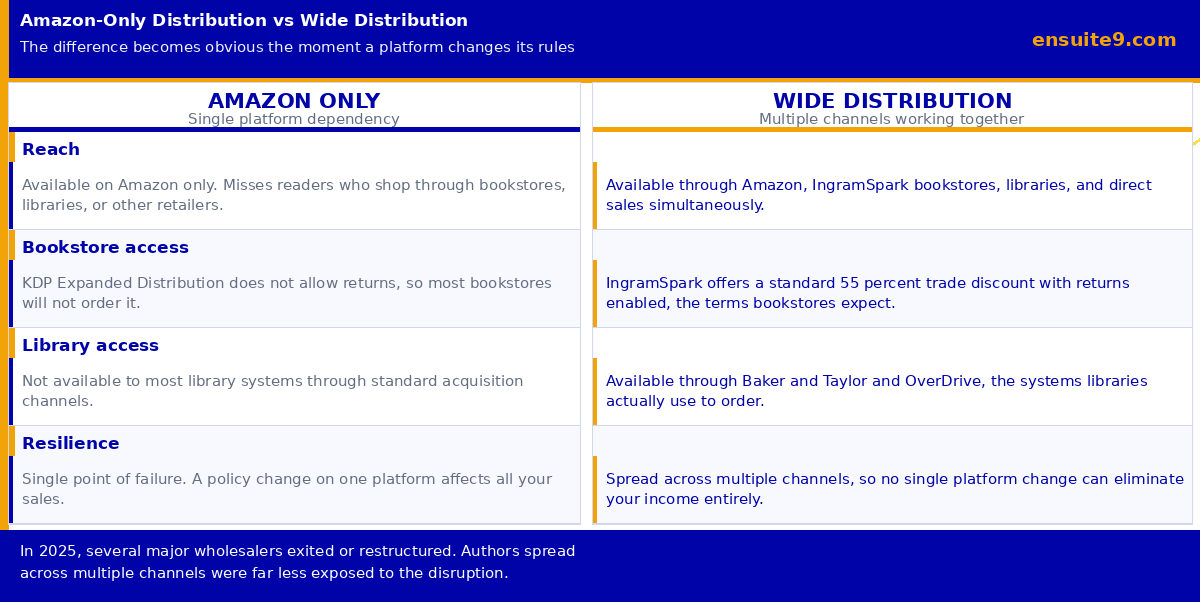
One of the most significant developments in self-publishing happened quietly in the background of the industry during 2025, and every author building a distribution strategy in 2026 needs to know about it. A number of long standing wholesale and distribution players, including Small Press United, Baker and Taylor, Reader Link, Lectorum Publications, and Diamond Comics, all exited the market or dramatically changed their operations within the same year.
The practical effect has been the rise of what the industry now calls the low velocity seller problem. Books that do not sell fast and in large quantities are increasingly being shut out of traditional wholesale and retail channels, which disproportionately affects independent authors, niche titles, and new releases that do not immediately sell in volume from launch. This is a genuine structural shift, not a temporary disruption, and it changes the calculation for where an author’s distribution effort is best spent.
The encouraging part of this shift is that print demand itself has not declined. Readers have not stopped buying physical books. What has changed is where those sales are actually happening. The data from major self-publishing service providers increasingly shows that the bulk of indie author print sales now occur through two channels specifically, Amazon and an author’s own direct sales storefront, with other retail and wholesale channels generating comparatively negligible revenue for most independent authors and creating unpredictable delays and returns risk along the way.
This does not mean bookstore and library distribution through IngramSpark is no longer worth pursuing. It remains genuinely valuable for credibility, for specific local or community based sales, and for the rare title that does build momentum. What it does mean is that an author’s distribution strategy in 2026 should not assume that wide wholesale listing alone will generate meaningful sales volume. The realistic, evidence based approach is to treat Amazon as the volume channel, a direct sales storefront as the profit channel, and wholesale or bookstore distribution as a credibility and opportunistic channel rather than a primary revenue source.
Why Wide Distribution Still Matters Despite the Shift
Even with the wholesale contraction described above, distributing across multiple channels rather than relying on a single platform remains the more resilient strategy, for reasons that go beyond raw sales volume. A platform that changes its royalty structure, its terms of service, or its policies overnight can materially affect an author’s income if that platform is the only channel in use. An author distributed across Amazon, a direct storefront, and at minimum a presence in the Ingram catalogue is far less exposed to any single point of failure.
The guiding principle from the Alliance of Independent Authors remains sound advice even after the 2025 wholesale changes, publish in as many formats as you reasonably can, and make your book available in as many appropriate stores as possible, while keeping your own website at the centre of your publishing business. The centre of your business being your own website and direct sales channel, not a third party retailer, is the part of this advice that has become more, not less, important given the events of the past year.
Book Distribution for African Authors
For African authors specifically, the global wholesale contraction described above changes the calculation in a way that is arguably more favourable than it sounds at first. African authors have historically faced a steeper climb into the traditional wholesale and bookstore system regardless of the 2025 disruption, since most physical bookstore distribution networks are built around UK and US retail relationships that are harder to access from Lagos, Nairobi, or Accra in the first place.
This means African authors are, in a sense, already structurally positioned for the strategy that the rest of the industry is now being pushed toward, building a direct relationship with readers rather than depending on wholesale gatekeepers. Platforms like Selar and Bambooks, built specifically for the African market with Paystack and Flutterwave integration, already function as exactly the kind of direct sales storefront that BookBaby and similar Western platforms are now promoting as the more profitable, more resilient channel. African authors selling directly to a Nigerian or diaspora audience are not behind the global shift, they were arguably ahead of it.
The practical recommendation for African authors building a distribution strategy in 2026 is therefore threefold. Use Amazon KDP for global reach and discoverability, since it remains the largest single retail channel in the world. Use IngramSpark for the credibility and occasional bookstore or library placement it provides, understanding that it is unlikely to be a major revenue driver on its own. And build a direct sales channel through a platform like Selar, treating your own website and audience as the centre of your publishing business rather than a secondary afterthought. For a full breakdown of how to set this up, see: How African Authors Can Sell Books Directly Without Relying on Amazon.
For the technical comparison between KDP and IngramSpark specifically, see: IngramSpark vs Amazon KDP for African Authors. For the ISBN registration that underpins distribution on any platform, see: ISBN Registration in Nigeria.
Metadata: The Unglamorous Detail That Determines Whether You Get Found
Good metadata does not just help readers find your book, it helps retailers and wholesalers know where to place it within their own systems. Keywords and BISAC subject codes are what allow your book to surface correctly in retailer searches and what allow a wholesaler’s catalogue to categorise it accurately enough for a bookstore buyer to discover it among the millions of other titles competing for the same shelf space. Authors who treat metadata as an afterthought, filling in the minimum required fields without genuine thought, are quietly limiting their own discoverability regardless of how good the book itself is.
Pricing is also part of distribution, not simply a marketing decision made separately. The goal is sustainable pricing that supports a fair royalty after wholesale discounts and printing costs are deducted, not constant discounting in pursuit of short term sales spikes that erode the perceived value of the book over time.
Frequently Asked Questions
Do I need to use a distributor if I am only selling on Amazon?
Amazon KDP itself functions as your distributor for Amazon sales specifically, so no separate distributor is required if Amazon is genuinely your only channel. However, relying on a single platform leaves you fully exposed to any policy or royalty change that platform makes, which is the core reason most authors eventually add at least one additional channel.
What is the difference between a distributor and a wholesaler?
A distributor manages the logistics connecting your book to the wider market, including file management, metadata, and order routing. A wholesaler purchases or stocks your book at a discount and supplies it onward to retailers and libraries. IngramSpark functions as both simultaneously, which is part of why it carries the weight it does with bookstores.
How much should I expect to pay in wholesale discounts?
Standard trade discount is 40 to 55 percent of the list price, depending on the platform and the territory. Lower discounts can limit which retailers are willing to stock your title, since most expect the standard range to make the arrangement worthwhile for them.
Is it still worth pursuing bookstore distribution after the 2025 wholesale changes?
Yes, but with realistic expectations. Bookstore and library distribution through IngramSpark remains valuable for credibility and for specific local or community sales, but it should not be treated as your primary revenue channel. Amazon and a direct sales storefront are where most indie authors now generate the bulk of their actual income.
Can I use more than one distributor for the same book?
Yes, and for most serious authors this is the recommended approach. Using KDP for Amazon and IngramSpark for wider trade distribution, with your own ISBN used consistently across both, gives you the broadest realistic reach without duplicating effort.
What is returnability and why do bookstores insist on it?
Returnability means a bookstore can send back unsold copies for a refund rather than absorbing the cost of stock that does not sell. Most chain bookstores will not consider stocking a non-returnable title, since the policy is what shifts financial risk away from the retailer and onto the distributor or wholesaler.
Ensuite 9 helps African authors build a complete distribution strategy across Amazon KDP, IngramSpark, and direct sales platforms, with the metadata and pricing decisions handled correctly from the start. Book a free discovery call to discuss your book’s distribution plan.