IngramSpark is a self-publishing and print-on-demand platform owned by Ingram Content Group, the world’s largest book distributor. It gives independent authors access to the same wholesale distribution network that supplies most of the world’s bookstores and libraries, including Waterstones in the UK, Barnes and Noble in the US, Booktopia in Australia, and thousands of independent retailers in every major English-speaking market.
The key distinction that makes IngramSpark important: when you publish through IngramSpark, your book enters the same database as frontlist titles from major publishers. Retailers and libraries can search for it, order it, and stock it just like any other traditionally published title. Amazon KDP, by comparison, is a retailer. It sells your book on Amazon and, through its limited expanded distribution option, makes it theoretically available to some other retailers. But most independent bookshops do not order through KDP’s expanded distribution because it does not offer the trade discount and returns policy that bookshops require to stock titles speculatively.
If you want your book to be genuinely available in bookstores and libraries beyond Amazon, IngramSpark is how you make that happen. This guide explains what IngramSpark is, how it works, what it costs in 2026 including the February 2026 pricing update, and how to use it correctly alongside Amazon KDP to give your book the widest possible reach.
Who Owns IngramSpark and Why That Matters
IngramSpark is operated by Ingram Content Group, a company founded in 1970 that has grown into the infrastructure backbone of the global publishing industry. Ingram Content Group serves 39,000 or more book retailers worldwide, both brick-and-mortar and online. Traditional publishers use Ingram’s network to get their books into stores.
IngramSpark is Ingram’s platform specifically built for independent authors. It is distinct from Ingram’s other operations: Ingram Content Group handles wholesale distribution for commercial publishers, and Lightning Source (also owned by Ingram) serves publishers needing higher-volume print runs. IngramSpark sits between these as the entry point for self-published authors who want access to the same global infrastructure without the volume requirements of a traditional publisher.
This ownership structure is the core reason IngramSpark matters. It is not a startup building a distribution network from scratch. It is a self-publishing interface layered on top of a distribution infrastructure that already supplies most of the world’s bookshops. When a buyer for an independent bookshop in London, a library in Toronto, or a university bookstore in Sydney wants to order books, they access the Ingram catalogue. A book published through IngramSpark is in that catalogue alongside titles from Penguin Random House and HarperCollins.
What IngramSpark Actually Does: The Five Core Functions
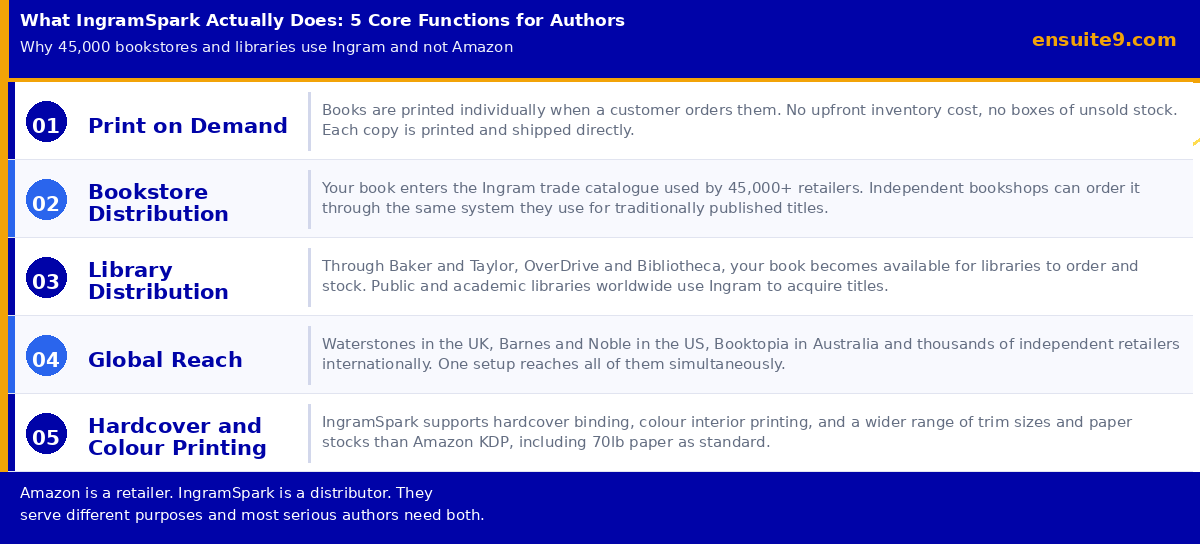
Print on demand. IngramSpark uses a print-on-demand model, which means your book is printed individually each time a customer or retailer orders a copy. There is no minimum print run and no upfront inventory cost. When a reader orders your book through Barnes and Noble or a library requests a copy through Baker and Taylor, IngramSpark prints and ships that specific copy. IngramSpark is one of the most reliable POD services when it comes to the actual product. The quality is professional grade, provided your formatting and cover design have been executed correctly.
Bookstore distribution. IngramSpark distributes through Ingram’s full trade network, meaning independent bookstores can order your book wholesale through the same system they use for traditionally published titles. For a bookshop to stock your book speculatively, you need to offer a trade discount of 55% and enable returns. Without these, your book is orderable but unlikely to be proactively stocked. With them, a bookshop can order your book, stock it on their shelves, and return unsold copies just as they would with a commercially published title.
Library distribution. Public and academic libraries order through Ingram. An IngramSpark title with proper metadata, including subject categories, BISAC codes, and library discounts, can be ordered by libraries through Baker and Taylor and Bibliotheca alongside traditionally published titles. Library distribution is one of the most underused opportunities for self-published authors. A book stocked in a public library system with 50 branches generates 50 individual borrowing opportunities with every acquisition. For African authors in the diaspora targeting readers in the UK, Canada, and the US, library placement in areas with large African diaspora communities is a commercially meaningful reach that retail sales alone cannot replicate.
Global reach. IngramSpark’s distribution covers over 45,000 retailers, libraries, schools and online stores globally. For African authors, this is particularly significant because it includes markets where Amazon has a weaker presence than in the US and UK, specifically independent bookshops across Europe, library systems in Canada and Australia, and the UK market where Waterstones, Blackwell’s and Gardners are the primary supply channels rather than Amazon.
Hardcover and colour printing. IngramSpark supports hardcover binding, colour interior printing, and a wider range of trim sizes and paper stocks than Amazon KDP, including 70lb paper as standard. KDP’s standard print paper is 60lb, which is lighter and slightly thinner. For authors publishing non-fiction, illustrated books, cookbooks, or any title where presentation quality matters for professional credibility, IngramSpark’s print options are superior to KDP’s.
What IngramSpark Costs in 2026
IngramSpark made significant changes to its pricing in February 2026. The current fee structure as of June 2026 is as follows, though fees do change periodically, and you should verify current rates at ingramspark.com before publishing.
Title setup fee: $49 per title. This covers both print and eBook formats for a single title. You pay this once per title when you first set up the book. There is no ongoing monthly or annual platform fee.
File revision fee: $25 per file change after the first 60 days. If you upload your interior PDF and then need to correct an error after 60 days, each revision costs $25. This makes it important to upload only when your files are final. The first 60 days allow free revisions, which is your window to catch and correct any issues before the fee kicks in.
Print costs are deducted from your compensation before you receive payment. For a standard 250-page 6×9 black and white paperback, print costs through IngramSpark are approximately $3.90 to $4.20 per copy following the February 2026 update. Colour printing and hardcover formats are significantly more expensive. Always use IngramSpark’s publisher compensation calculator to work out your earnings at a given price before setting your list price.
Promotional codes that waive the setup fee are available through writing associations, including the Alliance of Independent Authors (ALLi) and the Independent Book Publishers Association (IBPA). If you are a member of either organisation, check for a current promo code before paying the setup fee. Draft2Digital partnership also occasionally provides fee waivers.
IngramSpark vs Amazon KDP: The Key Differences
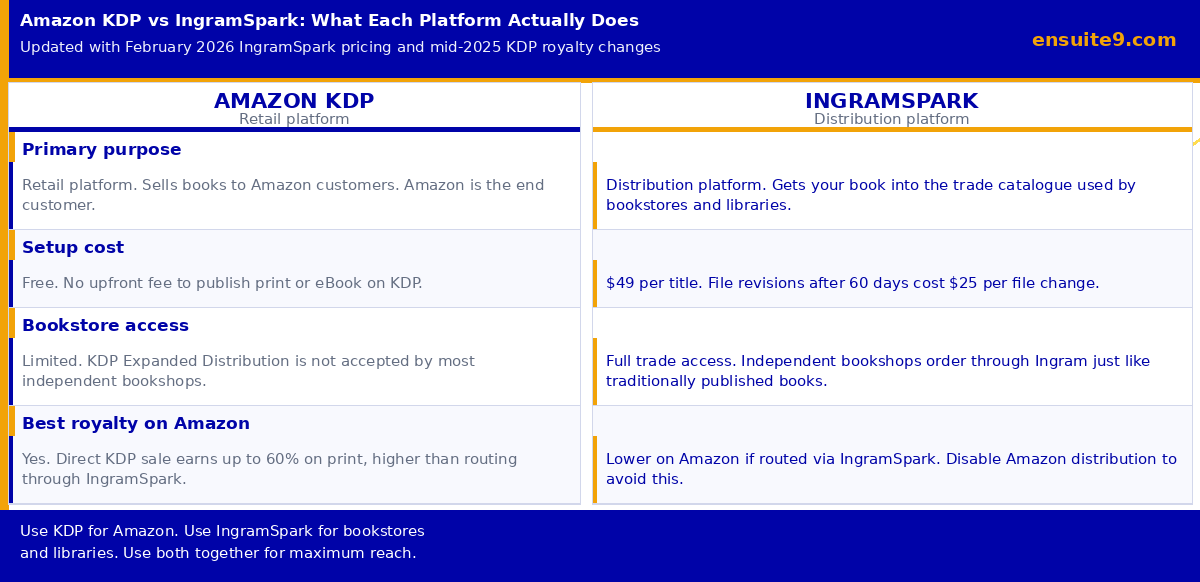
The most important thing to understand about KDP and IngramSpark is that they serve different purposes. Understanding this eliminates the confusion about which one to use because the answer for most authors is both, configured correctly.
Amazon KDP is a retailer. It sells your book to Amazon customers. It is free to set up, pays the highest available royalty on Amazon sales (up to 60% on print, 70% on eBooks priced between $2.99 and $9.99), and is the fastest path to your book being available on the world’s largest online bookshop. KDP’s expanded distribution option routes your print book to some non-Amazon retailers through Ingram’s network, but at a lower royalty rate and without the trade discount and returns policy that independent bookshops require.
IngramSpark is a distributor. It does not sell your book directly to readers. It makes your book available to the 45,000 retailers, libraries and schools that order through Ingram’s wholesale catalogue. When a bookshop orders your book through IngramSpark, they are placing a trade order through the same system they use to order titles from major publishers. This is genuine trade distribution, not a retail listing.
The recommended setup for most authors is to use both: KDP for Amazon sales and IngramSpark for everything else. Critically, you should disable KDP’s expanded distribution when using IngramSpark, and disable IngramSpark’s Amazon distribution channel when using KDP. Routing Amazon sales through IngramSpark reduces your royalty on those sales. Routing bookstore and library sales through KDP’s expanded distribution produces a worse result than IngramSpark. Each platform should handle only the distribution it does best. For a full step-by-step guide to configuring both platforms together, see: IngramSpark vs Amazon KDP for African Authors.
The ISBN Question: Own Your ISBN Before Using IngramSpark
IngramSpark offers a free ISBN for US-based publishers. For authors publishing from Nigeria or from the diaspora, this free ISBN is not available, and even for those who qualify, using a free IngramSpark ISBN creates a platform dependency that limits your flexibility.
If you use a free Ingram ISBN, you are locked into their ecosystem. This is why purchasing your own ISBNs is recommended, as it makes your brand platform agnostic. A book published with an IngramSpark-issued ISBN cannot be transferred to a different platform without being treated as a new title with a new ISBN.
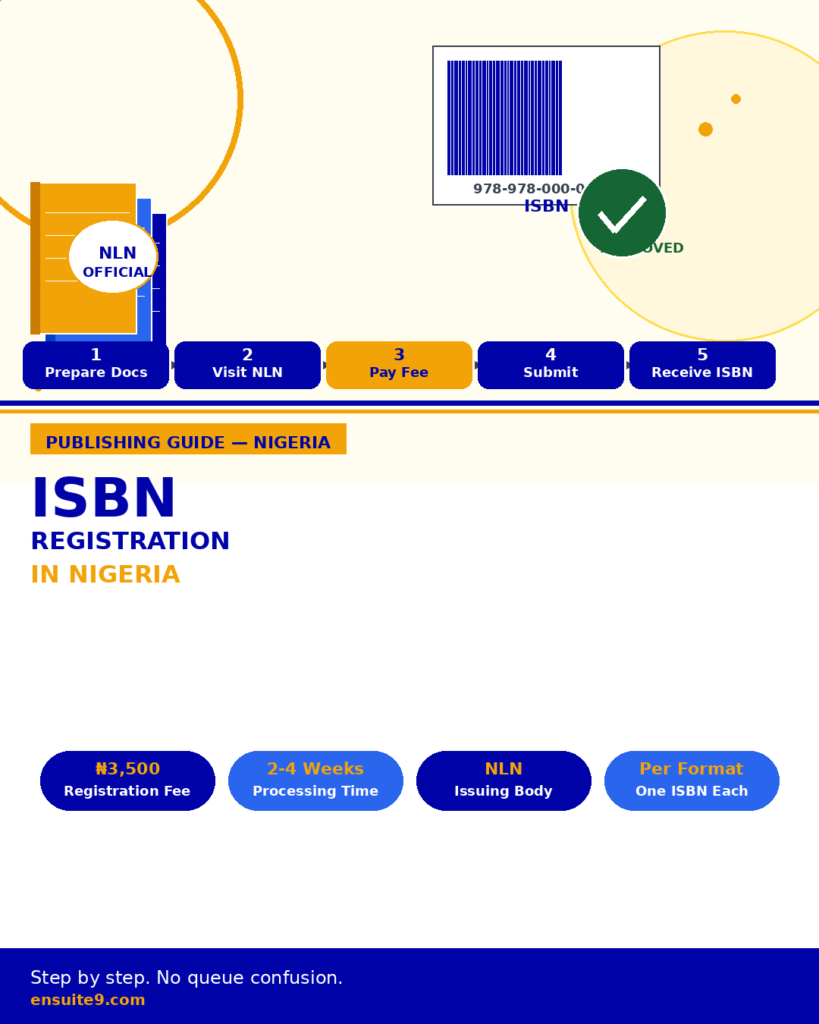
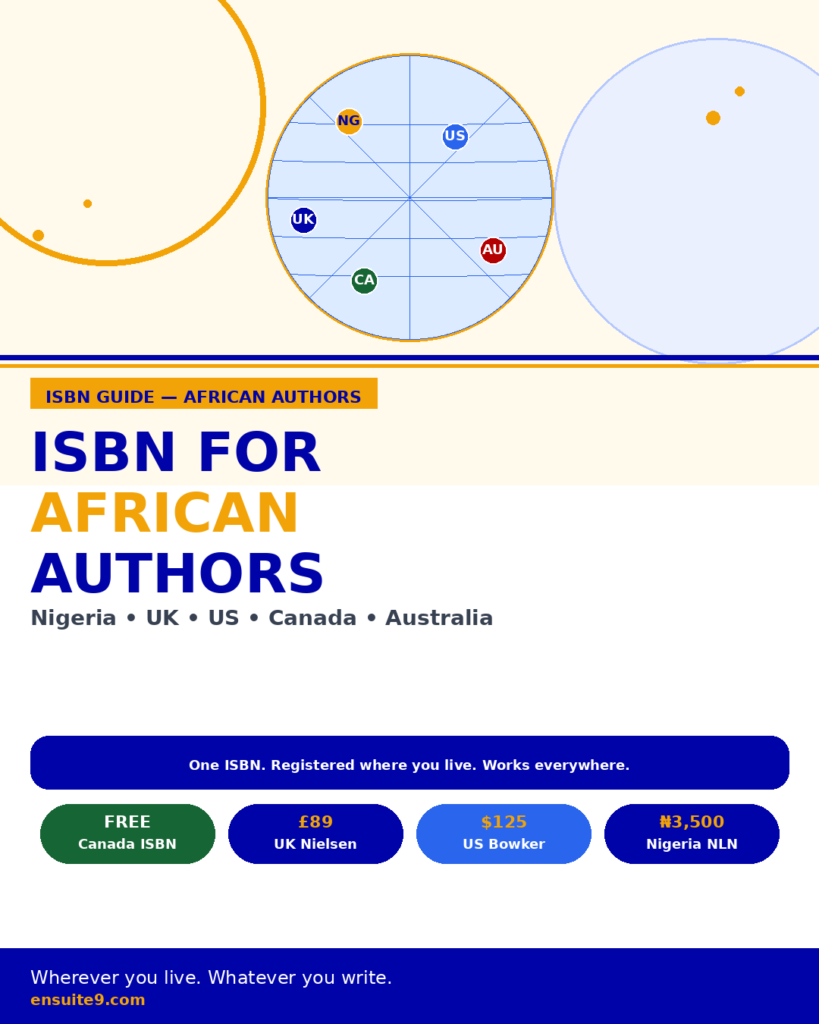
For Nigerian authors, ISBNs are issued by the National Library of Nigeria. For diaspora authors in the UK, ISBNs are issued by Nielsen. For those in the US, they are issued by Bowker. Owning your own ISBN means the same number can be used on IngramSpark, Amazon KDP, Draft2Digital, and any other platform simultaneously, with no platform dependency. For a full guide to ISBN registration by location, see: ISBN Registration in Nigeria or ISBN for African Authors in the Diaspora.
Setting Your Wholesale Discount and Returns Policy
When you set up your title on IngramSpark, you choose a wholesale discount percentage and a returns policy. These two settings determine whether bookshops are likely to stock your book speculatively or only order it when a specific customer requests it.
IngramSpark lets you set a discount between 40% and 55% per territory. If you are marketing heavily to bookstores, set 55% and allow returns, as this gives booksellers their expected trade discount and makes them more likely to stock your book. If you are focused on online sales, set the minimum 40% and do not allow returns. Online retailers will still list your book regardless, and readers can still place special orders through their local bookshop. You can also set different discounts and returns policies for each market.
The practical consideration for most self-published authors: the majority of books sold in physical bookshops are special orders placed by customers who already know the book exists, not speculative shelf purchases. Unless you are actively marketing to specific bookshops and have reason to believe they will stock your title, a 40% discount with no returns is a reasonable starting configuration that still makes your book orderable through Ingram’s catalogue. You can always increase the discount and enable returns later if your marketing strategy shifts toward active bookshop placement.
IngramSpark for African Authors: The Specific Opportunity
For African authors, IngramSpark’s most commercially significant function is reaching the markets where your diaspora readers are concentrated but Amazon is not the dominant book-buying channel.
In the UK, the majority of bookshop purchases happen through independent bookshops, Waterstones branches, and library borrowing rather than Amazon. A Nigerian author whose book is on IngramSpark is available to every one of those channels. A Nigerian author whose book is only on KDP is effectively invisible to those buyers unless they specifically search on Amazon.
In Canada and Australia, library borrowing is a significant part of how books reach readers, particularly in communities where purchasing in local currency at international prices is a barrier. IngramSpark’s library distribution through OverDrive and Baker and Taylor makes your book available for Canadian and Australian library acquisition at no additional cost beyond the initial IngramSpark setup.
For the growing African professional book market, specifically the business books, coaching books, and professional development titles that coaches and consultants are increasingly publishing, IngramSpark distribution is the infrastructure that makes a book credible in international professional contexts. A book that appears in the Ingram catalogue is treated as a legitimate trade title. A book that is Amazon-only is perceived, rightly or wrongly, as a self-published title that has not cleared the credibility bar of trade distribution.
For a full comparison of costs and royalties across both platforms, see: IngramSpark vs Amazon KDP for African Authors. For a guide to the publishing process that leads up to IngramSpark setup, see: How to Write and Publish a Book as a Coach or Consultant in 2026.
Frequently Asked Questions
Is IngramSpark free to use?
No. IngramSpark charges $49 per title for setup. File revisions after the first 60 days cost $25 per file change. There are no ongoing monthly or annual fees. Promotional codes from writing associations can waive the setup fee, so check for a current code before paying.
Can I use IngramSpark and Amazon KDP for the same book?
Yes, and for most authors this is the recommended approach. Publish on KDP for Amazon sales and on IngramSpark for bookstore and library distribution. Use your own ISBN on both platforms. Disable KDP expanded distribution and disable IngramSpark’s Amazon channel to avoid routing the same sales through both platforms at lower royalty rates. For step-by-step instructions, see: IngramSpark vs Amazon KDP for African Authors.
How long does IngramSpark take to distribute my book?
Once your title is approved and live on IngramSpark, it appears in the Ingram wholesale catalogue within 2 to 4 weeks. Individual retailers may take additional time to list or stock the title. Amazon typically lists IngramSpark titles within 2 to 6 weeks, though it is faster to list directly on KDP for Amazon specifically.
Do I need a Nigerian ISBN to use IngramSpark?
You need an ISBN but it does not have to be a Nigerian ISBN. Any valid ISBN from any national agency, including the National Library of Nigeria, Nielsen in the UK, or Bowker in the US, works on IngramSpark. Owning your own ISBN rather than using IngramSpark’s free option gives you platform flexibility. For ISBN registration guidance, see: ISBN Registration in Nigeria.
Is IngramSpark difficult to use?
IngramSpark’s interface is somewhat less intuitive than those of KDP. While their platform will flag major issues when you are uploading your book file, it does not hold your hand through the formatting process or make suggestions for improvement. The platform is manageable once you understand its requirements, but it has a steeper learning curve than KDP. Having your files professionally formatted to IngramSpark’s specifications before uploading is the single most effective way to avoid upload errors and revision fees.
Ensuite 9 handles IngramSpark setup as part of all complete publishing packages, including file preparation to IngramSpark’s specifications, title setup, metadata optimisation, discount and returns configuration, and proof coordination. To discuss getting your book distributed through IngramSpark, book a free 30-minute discovery call.